Gujarat | Spot leopard, read pattern
Leopards seen ambling in Ahmedabad's newer fringe put focus on the real apex predator: booming human cities
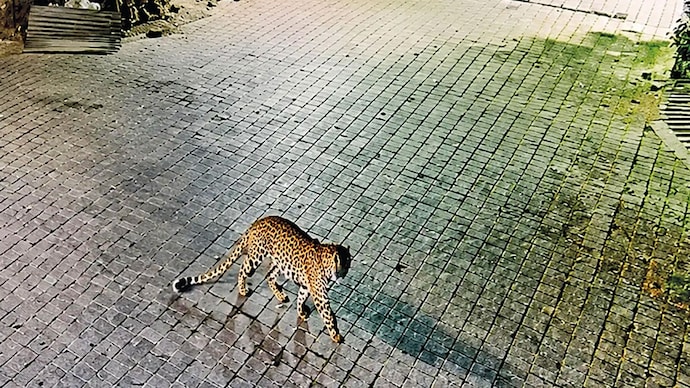
A CCTV at a residential society suddenly catches sight of a leopard: it’s coolly climbing into Serendeep Mansions, a gated community on VIP Road in Ghuma. Days later, a cafe owner claims a sighting in Zundal. Then another, in Chandkheda, 25 kilometres away. Forest teams go on the hunt with thermal cameras and drones, unsure if they are tracking one animal or several. Ahmedabad’s residents, who may have happily spent money for a leopard sighting in a sanctuary, find it hard to quell the tremors at the thought of an unwelcome bounty in the neighbourhood. After one spotted autumn in the city, urban planners fret over the map.
A CCTV at a residential society suddenly catches sight of a leopard: it’s coolly climbing into Serendeep Mansions, a gated community on VIP Road in Ghuma. Days later, a cafe owner claims a sighting in Zundal. Then another, in Chandkheda, 25 kilometres away. Forest teams go on the hunt with thermal cameras and drones, unsure if they are tracking one animal or several. Ahmedabad’s residents, who may have happily spent money for a leopard sighting in a sanctuary, find it hard to quell the tremors at the thought of an unwelcome bounty in the neighbourhood. After one spotted autumn in the city, urban planners fret over the map.
A CCTV at a residential society suddenly catches sight of a leopard: it’s coolly climbing into Serendeep Mansions, a gated community on VIP Road in Ghuma. Days later, a cafe owner claims a sighting in Zundal. Then another, in Chandkheda, 25 kilometres away. Forest teams go on the hunt with thermal cameras and drones, unsure if they are tracking one animal or several. Ahmedabad’s residents, who may have happily spent money for a leopard sighting in a sanctuary, find it hard to quell the tremors at the thought of an unwelcome bounty in the neighbourhood. After one spotted autumn in the city, urban planners fret over the map.
Why are leopards moving to the city? For the same reason as people: food. Stray dogs are relatively easy prey, and the scrub and farmland on the city offer plenty residential options. That’s logical, but invert it and it’s still logical. It’s the city that has come to the leopard, predating upon its space. Those scrub forests were their natural habitat not too long ago, part of Gujarat’s wildlife corridor continuum. Now, a range of posh bungalows have invaded those zones, followed by noisy shopping centres, wide roads and restaurants.
DEVOURING COUNTRY
Every city expands. The issue is, 90 per cent of this is unplanned, haphazard. Which means no thought given to integrating within it spatial reservoirs for the natural lifeworlds it is eating up. Result: a cancerous growth of ‘contiguous built-up area’. Landsat imagery shows Ahmedabad’s has more than doubled in three decades. It was 132 sq. km in 1990, it touched 305 sq. km by 2019; researchers project another quarter by 2030. That’s 18-20 sq. km of leopard country devoured each year. Delhi expands 50 sq. km every year, adding one central Paris every two years. In area, and not aesthetic terms.
As all energies get diverted to an unthought-through and ecologically disastrous colonisation of biodiversity zones, the old city receives no attention in terms of redevelopment strategies. “Except Mumbai, no city in India has succeeded in redeveloping effectively,” says Prof. Saswat Bandopadhyay, chair, Infrastructure Planning, CEPT University. “This is largely due to archaic planning regulations that artificially clamp down on Floor Space Index—in Ahmedabad, the FSI for the central business district is 1.8, very low compared to the global average of 3-4. Redevelopment isn’t lucrative.”
To be fair to authorities, they do draw planning boundaries. Trouble is, as soon as those boundaries are laid down, prices in those areas shoot north and developers start looking for cheaper alternatives outside. “This is where the political economy kicks in,” Bandopadhyay says, reiterating this is a nationwide phenomenon. A high-level committee of the Union ministry of housing and urban affairs (MoHUA) documented water bodies gradually vanishing in government planning.
For instance, a lake in Vastrapur still marked on state documents now hosts a government-built handicraft market. By the time Vastrapur got an actual plan, the region had had a residential population for over a decade—but the lake had disappeared without a trace. The debilitating water-logging in the city is a natural outcome of this. The Bopal-Ghuma-Shela belt is among the worst-affected on this front. In July, the same time when the area was blessed with the leopard sighting, it was also nearly fully under stagnant water.
The pressure is only set to intensify with the 2030 Commonwealth Games and bidding on for the 2036 Olympics. Those ambitions have triggered an urgent, state-backed building drive across the entire Ahmedabad-Gandhinagar region. This is planned development, of course, but even so, it is steering growth straight into wildlife corridors.
The sprawl is spreading fastest in the southwest—the same Sanand-Shela-Ghuma belt. This corridor is being remade for global-standard sporting facilities. A 500- to 1,000-acre sports city and an Olympic Village are coming up across Manipur and Godhavi villages, to be served by a new metro line. On the Sanand-Ghuma road, the Sanskardham Sports Academy already trains athletes across a dozen disciplines.
A DIFFERENT CENSUS
As stress on land deepens, leopard numbers keep rising, celebrated as a conservation success—familiarising with urban zones, they are losing their wariness of people. Gujarat’s 2023 census counted 2,274 leopards, up 63 per cent from 2016. It also recorded the species in Ahmedabad district for the first time. The Asiatic Lion population grew 29 per cent over 2020-2025. In 2022, a lion was spotted on the Ahmedabad-Bhavnagar highway, about 140 km from the city. A dispersing individual, not a pride, but a lion nonetheless.
The solution, says Bandopadhyay, is to create guidelines—and ‘local improvement districts’—that can ensure more holistic development outside defined planned areas. Put simply, “Indian cities need a district planning framework. That’s imperative now.”

