Luxury, chaos and the $400 pocket watch | Audemars Piguet x Swatch
Serpentine queues, days-long vigils and chaotic crowds fuelled some of the frenzy that drove the Audemars Piguet-Swatch collaboration. Marketing ploy or industry disruptor, the jury is still out on that one.
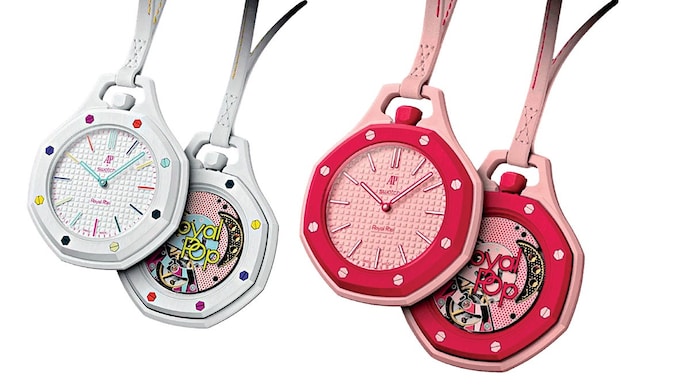
Tobody queues for a watch anymore. They queue for the gap between retail and resale. That’s what last Saturday became—in Mumbai, Delhi, Milan, London, Chicago, and a dozen other cities that briefly lost their minds over a pocket watch on a lanyard.
Tobody queues for a watch anymore. They queue for the gap between retail and resale. That’s what last Saturday became—in Mumbai, Delhi, Milan, London, Chicago, and a dozen other cities that briefly lost their minds over a pocket watch on a lanyard.
The object in question is the Royal Pop. Eight colourways, bioceramic case, hand-wound movement, forty thousand rupees in India. Clip it to a bag, wear it like a pendant, put it on a stand on your desk. It is charming, bizarre, and completely unlike anything you’d expect from a brand whose cheapest wrist watch starts somewhere north of `20 lakh. That brand is Audemars Piguet, and they either know exactly what they’re doing or they’re quietly panicking. Possibly both. Some watch forums will tell you there is a trademark battle over the Royal Oak’s octagonal shape quietly sitting behind all of this, though nobody has confirmed that and AP certainly is not talking.
At Palladium Mall in Mumbai, people had been waiting since before dawn. DLF Avenue in Delhi looked the same. So did Westfield London, SoHo New York, King of Prussia in Pennsylvania, and a Swatch store in Milan where the disagreements reportedly turned physical. When the stores did not open— most did not, because the scenes outside had stopped looking like queues and started looking like liabilities—someone at Palladium Mumbai had to stand in front of a packed crowd and scream, just to be heard, that the store would not be opening that day. That clip went viral. It deserved to.
The resale math was simple and seductive. Buy at 40,000, and flip it for two lakhs before dinner. That is not watch collecting. That is arbitrage with a lanyard. The irony, of course, is that the Royal Pop is not even a limited drop. The initial allocations were simply scarce enough to create the illusion of one.
The watch community, predictably, went to war with itself. On the one side: collectors who spent years cultivating relationships with authorised dealers, who feel that the Royal Oak’s power was always inseparable from its impossibility, and who watched something quietly deflate when that same silhouette showed up at a mall stampede. On the other: people who argue that the MoonSwatch (OMEGA x Swatch) made a new generation want real Speedmasters; that aspiration flows upward precisely because it first flows down, that luxury brands do not survive on purity alone. Both sides are making the same argument from opposite ends. Both are right.
What neither side is saying plainly enough is this: the chaos itself became the product. Swatch has run this playbook before, and they do it brilliantly. The cancelled launches, the overwhelmed cities, the footage ricocheting across every platform—this is not merely a logistics failure. It is the campaign.
The real question is what survives the spectacle. Luxury has always been a confidence trick that works only as long as everyone agrees to believe in the distance between those who have it and those who do not. Shrink that distance too recklessly and you do not democratise luxury. You simply remind everyone it was always theatre.
AP is betting that decades of carefully built mystique can survive one chaotic day. Maybe it can. But most of the people in that queue were not dreaming about a Royal Oak. They were dreaming about the resale price. And that gap—between what AP intended and what actually showed up— is the most interesting thing about this whole story.
Availability Select Swatch stores in Delhi, Mumbai and Bengaluru

