The ghost of flavours past | Column by chef Suvir Saran
Have celebrity-status, awards and Michelin stars shifted the focus of modern dining toward visual performance, prioritising the spectacle of the plate over the intimacy of the palate?
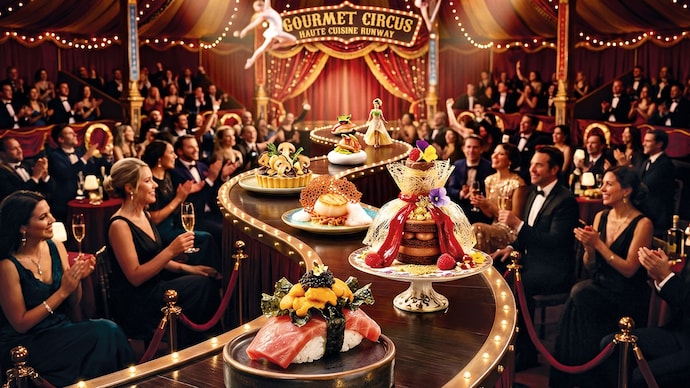
The anxiety that flavour is taking a back seat isn’t entirely misplaced—but it’s also not the whole story. What we’re witnessing is a shift in how food is consumed, not just how it is cooked. Dining today is no longer a private act between plate and palate; it is a public performance. The first bite is often taken by the camera. And so, the plate has been asked to do something new: to arrest attention before it earns affection.
The anxiety that flavour is taking a back seat isn’t entirely misplaced—but it’s also not the whole story. What we’re witnessing is a shift in how food is consumed, not just how it is cooked. Dining today is no longer a private act between plate and palate; it is a public performance. The first bite is often taken by the camera. And so, the plate has been asked to do something new: to arrest attention before it earns affection.
In that context, visual drama, conceptual storytelling, and what people dismiss as “gimmickry” have become a language. But languages evolve because something deeper is changing. We are living in a moment where memory is externalised—documented, shared, validated. A dish is no longer just nourishment or even pleasure; it is content, identity, currency.
And yet, this isn’t unprecedented. Every era of cooking has flirted with excess. Classical French cuisine elevated precision to the point of intimidation. The era of molecular gastronomy gave us foams, spheres, and a radical rethinking of technique. It was thrilling, transformative—and ultimately unsustainable in its purest form.
The legendary American critic Gail Greene once cut through that moment with brutal clarity, calling this strain of cooking “brain effing with no orgasm.” It was said half in jest, but with full intent. Because what she was pointing to was not technique, but absence—the loss of pleasure, of satisfaction, of that deeply human response to food that cannot be intellectualised or staged.
And that absence is something diners are quietly beginning to feel. Across India and globally, people are spending thousands on meals that are hyper-tweaked, hyper-tweezered, hyper-styled to reflect locality, seasonality, philosophy, narrative—everything except, sometimes, memory. They admire, they photograph, they discuss. But the next day, many cannot recall what they actually ate. The meal lingers as an idea, not as a craving.
And so, almost instinctively, they return home and order what they remember with their bodies: butter chicken, dal makhani, a simple khichdi, a familiar bowl of something that does not need explanation. This is not regression—it is a correction. Because while the mind may be seduced by performance, the body continues to seek satiety, comfort, and pleasure.
When that balance is lost, it does a quiet disservice—not just to Indian cuisine, but to food everywhere. Because the consequence is not that people become more adventurous; it is that they oscillate. They experience the high-concept meal, and then they retreat to the most accessible version of satisfaction—sometimes even to the lowest common denominator. It is why, after nights of elaborate tasting menus, people still find themselves in the familiarity of something as blunt as McDonald’s—not out of preference, but out of a need their previous meal did not fulfil.
We saw similar arcs elsewhere. Noma, under Ren Redzepi, redefined global fine dining with foraging and hyper-locality. It influenced a generation. And yet even Noma has had to confront the question of sustainability—not just ecological, but human, economic, and creative. When a restaurant becomes an idea larger than its own daily practice, it begins to strain under its own mythology.
More recently, restaurants like Ultraviolet in Shanghai or Alchemist in Copenhagen have pushed dining into immersive theatre—multi-sensory, narrative-driven, intellectually ambitious. They are extraordinary experiences. But they also raise a question: how long can experience outrun appetite? At what point does the diner begin to crave not astonishment, but comfort?
Because here is the quiet truth: novelty has a short shelf life. What dazzles today can feel dated tomorrow. Entire categories of restaurants have risen meteorically—built on virality, on a signature plating style, on a singular “moment”—only to fade just as quickly when the next aesthetic arrives. We have all seen dining rooms that were impossible to book one year and eerily available the next.
Even some of the most talked-about spaces today—those built on spectacle, maximalism, or hyper-curated narratives—run the risk of becoming self-referential. The plating becomes predictable in its unpredictability. The experience becomes rehearsed. The very thing that once felt revolutionary begins to feel like repetition. And when that happens, the diner doesn’t just lose interest—they lose trust.
This is where the conversation about flavour becomes essential. Because flavour is not a trend; it is memory. It is cultural inheritance. It is the only dimension of food that deepens over time rather than dating itself. A perfectly made dal, a deeply reduced stock, a patiently fermented batter—these do not go out of style because they are rooted in something older than fashion: they are rooted in human satisfaction.
To dismiss plating, storytelling, or sustainability outright would be reductive. Thoughtful presentation is an extension of respect—for the ingredient, for the craft, for the diner. Sustainability is no longer a virtue; it is a necessity. But when these elements begin to substitute for flavour rather than support it, we enter dangerous territory. When the narrative becomes more important than the nourishment, the plate becomes an object rather than an offering.
Why are we here? Because the role of the chef has changed. Today’s chef is expected to be a creator, an entrepreneur, a public figure, a digital presence. Visibility drives value. A dish that photographs well travels further than one that simply tastes extraordinary. Investors understand this. Media amplifies it. Diners participate in it. The ecosystem rewards immediacy. But, ecosystems also correct themselves.
We are already beginning to see signs of fatigue. Diners are more travelled, more curious, more informed than ever before. They are asking better questions. They are seeking not just novelty, but nourishment—emotional as much as physical. There is a return, quietly but steadily, to places that feel grounded. Restaurants where the food is not trying to prove a point, but simply to please.
And those are the places that endure.
Because sustainability, in the truest sense, is not about sourcing alone—it is about repeat desire. Can a diner return to your table not once, but again and again, and still find joy? Can your food comfort as much as it impresses? Can it live beyond the moment of its unveiling?
The future, I believe, does not belong to those who reject modernity, nor to those who chase it blindly. It belongs to those who integrate it with restraint. Who understand that innovation must be anchored in flavour, not the other way around. Who recognize that deliciousness is not a baseline—it is the point.
Food cannot become garnish to its own presentation. It cannot be reduced to an idea on paper while failing on the palate. Because at the end of it all—after the lights dim, after the photograph is taken, after the narrative is consumed—the only thing that remains is the taste in your mouth.
And that is either enough, or it isn’t.

