Architect of the Month | Vineeta Singhania: 'I eat, drink, sleep and breathe architecture'
She leads a 250-person architecture firm, works on some of India's biggest real estate projects, and can still spend an afternoon worrying about a marble floor joint. For, architecture isn't a profession. It's a way of seeing the world
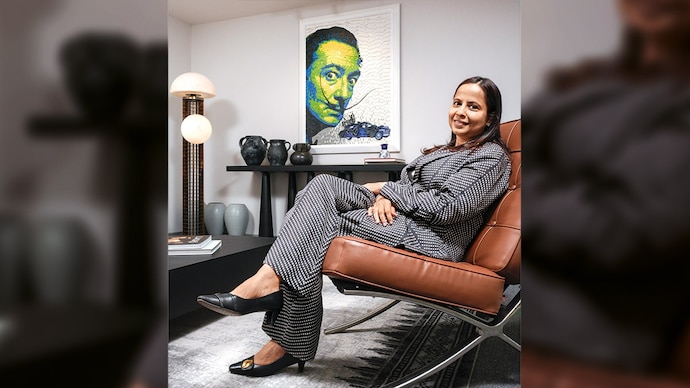
Walk into Vineeta Singhania’s studio office in Delhi and something strikes you that doesn’t always happen in beautifully designed interiors. The space feels calm and you relax, settling into your chair without even realising it. There’s warmth that no mood board can produce; sunlight filters softly through rooms, greens feel genuinely alive, and nothing shouts for attention. Everything seems in place, quietly.
Walk into Vineeta Singhania’s studio office in Delhi and something strikes you that doesn’t always happen in beautifully designed interiors. The space feels calm and you relax, settling into your chair without even realising it. There’s warmth that no mood board can produce; sunlight filters softly through rooms, greens feel genuinely alive, and nothing shouts for attention. Everything seems in place, quietly.
It’s only after you’ve been sitting for an hour or two that you realise the space has been influencing your mood all along. “That’s my personality in design,” says Singhania with a smile. “That’s who I am.” For Singhania, founder partner and principal architect, Confluence, an architecture and interiors practice she set up in 1999 with a few friends, there is no separation between the person and the work. Nearly three decades after founding Confluence, she still speaks about design with the enthusiasm of someone discovering it for the first time.
A 250-person architecture firm now, Confluence is behind some of the country’s most ambitious, talked-about large-scale projects including the ultra-luxurious high rise Adani Veris tower in Gurgaon for the Adani Group and Trump Towers in Noida, the twin towers rising 195 metres above the skyline.
WHERE IT ALL BEGAN
Luxury towers and corporate campuses that now form much of her portfolio were never the ambition in itself. As a curious child growing up in Ranchi, Singhania was the kid who loved maths, physics and the newly arrived computer lab in equal measure. In Class 9, she wrote a programme imagining how technology could centralise agricultural supply chains for water-scarce regions in Rajasthan complete with a hand-drawn illustration of a camel cart and a woman in traditional dress. She still has that notebook. “I wanted something creative,” she recalls. “But I also loved maths, science and problem-solving. Architecture brought all of that together.”
LITTLE THINGS MATTER
Whether she’s describing a 5-million-sq-ft mixed-use development or a single bedroom, she uses exactly the same language. The day before our conversation, she had been walking through one of her largest projects, but what stayed on her mind wasn’t the scale of the project. It was whether the door closer in a corridor worked smoothly. Whether the joint between two marble slabs aligned perfectly. Whether an air-conditioning grille disappeared neatly into the ceiling instead of drawing attention to itself.
It sounds obsessive, but perhaps, that’s what explains the consistency of her work. Whether it’s a home, an office, a tower or an experience centre, she approaches every project with the same attention to detail. The consistency of that micro-to-macro thinking is what holds the design vision together across dozens of consultants, two or more architects per project, lighting designers, landscape specialists, vertical transport engineers and more.
BRINGING NATURE BACK
If there is one thread that runs most visibly through Singhania’s portfolio, it is biophilic design—the deliberate and deeply considered return of nature into built spaces, particularly vertical ones. “When we go vertical and into high-rise, how you get disconnected with the greens,” she says. “Bringing back the greens in the high-rise is something that really resonates with me.”
One of her current projects, the iconic Adani Veris tower, pushes that idea to an ambitious scale. With apartments spanning 6,500 sq ft across every floor, the residents will find living planters on their terraces managed not by themselves but by a centralised BMU system (a specialised building maintenance system), where operatives descend the tower in gondolas to tend the greenery.
It’s regenerative architecture, as she calls it, the kind where a butterfly might land on your balcony railing on the 30th floor and that, to her, is the whole point. The result, she hopes, is that nature becomes part of everyday life again. The goal isn’t merely aesthetics, but about well-being. “Your mental wellness, your connection to the sky and nature, all of that matters,” she says.
THE ROAD AHEAD
Ask Singhania where she sees herself and the practice in next five years and her answer surprises you. She doesn’t mention bigger projects or more awards. What she wants is to run her firm the way a top law firm or consulting practice runs with the same rigour, structure, and global credibility. She already has a business consultant and an organisational design specialist incoming. “I don’t see ourselves different from a large law firm or a large CA consulting firm,” she says.
After nearly three decades of building things her own way, quietly and precisely, that ambition feels completely at home, just like the room itself.

