Eco-friendly architecture | Made to breathe
We take you inside two forward-thinking breathable homes that have rewritten the rules of sustainable luxury and turned traditional climate wisdom into striking modern, eco-friendly architecture
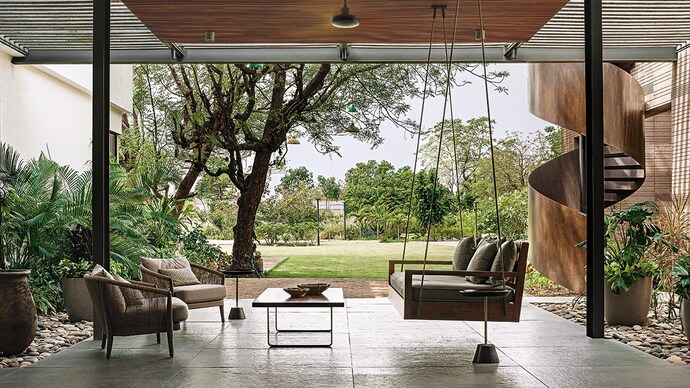
True sustainability isn’t just a checklist of green features; it is an active dialogue between architecture and the ecosystem, as brilliantly demonstrated by two shortlisted residential projects. Instead of relying on energy-heavy mechanical systems, Khosla Associates’ project in Ahmedabad and Taliesyn’s design in Bangalore show that eco-friendly luxury comes from zero-resource passive planning. What makes these homes particularly interesting is how they harness regional geography as a design tool, whether it is Khosla Associates utilising an eastern pool and existing neem trees to naturally condition incoming air, or Taliesyn splitting building volumes to manipulate air pressure and force the structure to breathe. By grounding their designs in hyper-local, low-carbon materials like regional clay, Mangalore tiles and native stone, both projects prove that high-end modern architecture can significantly shrink its environmental footprint simply by honouring the microclimate it sits in.
True sustainability isn’t just a checklist of green features; it is an active dialogue between architecture and the ecosystem, as brilliantly demonstrated by two shortlisted residential projects. Instead of relying on energy-heavy mechanical systems, Khosla Associates’ project in Ahmedabad and Taliesyn’s design in Bangalore show that eco-friendly luxury comes from zero-resource passive planning. What makes these homes particularly interesting is how they harness regional geography as a design tool, whether it is Khosla Associates utilising an eastern pool and existing neem trees to naturally condition incoming air, or Taliesyn splitting building volumes to manipulate air pressure and force the structure to breathe. By grounding their designs in hyper-local, low-carbon materials like regional clay, Mangalore tiles and native stone, both projects prove that high-end modern architecture can significantly shrink its environmental footprint simply by honouring the microclimate it sits in.
SCULPTING THE SHADOWS
In Ahmedabad’s blistering 42-degree summers, architecture must act as an active shield. For Abhikram, an eco-conscious residence, Khosla Associates turned climate response into the primary driver of form. The structure negotiates with the fierce sun through deep verandahs, horizontal pergolas and vertical louvers that filter harsh light while promoting cross-ventilation.
The double-height living space features permeable east and west verandahs to capture breezes. The western porch integrates two existing neem trees for natural shade, while its north wall features grooved pink sandstone. To prevent heat absorption, 80 per cent of the roofs are clad in clay tiles, glass expanses are minimised, and southern bedrooms utilise double walls to block thermal transfer.
Sustainability is anchored by natural, locally sourced materials including regional clay bricks, cast-in-situ beige terrazzo, Kota stone and reclaimed timber. Doors and windows utilise sustainable plantation Accoya wood. This layout allows summer breezes to pass over the eastern pool, cooling the living zones naturally. Furthermore, abundant filtered daylight eliminates the need for light bulbs during the day.
Experientially, a sculptural Corten steel staircase leads to a 30 ft bridge spanning the living volume. Overhead, three trapezoidal roofs admit soft northern light. Their warm wood veneer contrasts with the cool terrazzo floors below, proving that deep environmental responsibility can inhabit a striking, luxurious footprint.
THE VOLUMETRIC VENT
Built amidst a serene landscape in rural Bangalore, House by the Grove by Taliesyn champions passive design and green architecture. Rather than relying on energy-heavy mechanical systems, the home intuitively responds to its environment through intelligent spatial planning and a climate-conscious material palette. The structure is thoughtfully divided into two blocks at varying heights, a technique that creates a gradual transition of volumes to prevent heat build-up while actively encouraging continuous air movement. Columned living spaces form porous edges that invite cross-ventilation and diffuse natural light. At the entrance, a strategically placed water body provides natural evaporative cooling, working in tandem with multiple openings to ensure a constant breeze throughout the home.
The material choices deeply reinforce this sustainable ethos while adding a rich, tactile character to the interiors. A high-pitched Mangalore-tiled roof plays a critical role in thermal regulation. Underfoot, thermally stable materials like Kota stone, Sira stone and clay-tiled flooring leverage their natural thermal mass to maintain cooler indoor conditions. This is complemented by hand-finished cement walls that further minimise heat absorption while giving the home an earthy, breathable quality. By seamlessly weaving together porous planning, native materials and the microclimate of the surrounding pre-existing grove, this home remains naturally cool and comfortable.

