The cockroach phenomenon | Cockroach Janta Party
The cockroach becomes a viral emblem for India's youth as a parody 'party' breaks the internet—amassing millions of followers. What it says about Gen Z's pent-up frustration
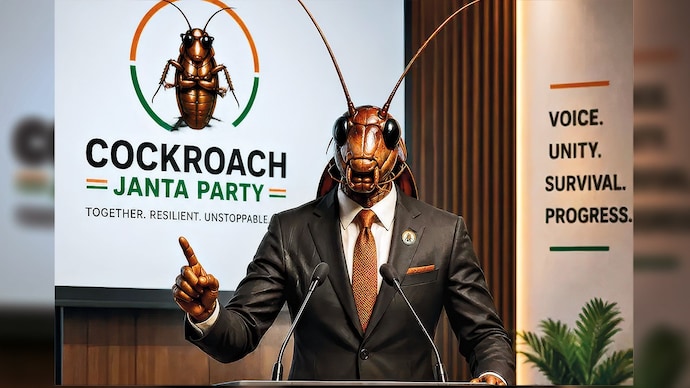
A spectre is haunting India. The spectre of...er, revolution? No, just a revolting insect. Not even the real thing. The figurative version, etched in countless online posts, arriving at the gates of the republic in an insurrection of laughter. Irreverent, satirical, youthful laughter. What is it exactly? Well, it has a parodic name: the Cockroach Janta Party, which brought on the quasi-formal short form, CJP. A political party, then? No, not in the formal sense. Going by the latest updates, it remains more a party of the other sort, where you rave and rant. A chamber version could have been called an online laughter club. But this one metastasised dangerously, going so viral as to deliver a full-fledged pandemic of mirth before you could blink it.
A spectre is haunting India. The spectre of...er, revolution? No, just a revolting insect. Not even the real thing. The figurative version, etched in countless online posts, arriving at the gates of the republic in an insurrection of laughter. Irreverent, satirical, youthful laughter. What is it exactly? Well, it has a parodic name: the Cockroach Janta Party, which brought on the quasi-formal short form, CJP. A political party, then? No, not in the formal sense. Going by the latest updates, it remains more a party of the other sort, where you rave and rant. A chamber version could have been called an online laughter club. But this one metastasised dangerously, going so viral as to deliver a full-fledged pandemic of mirth before you could blink it.
Something of volcanic proportions had clearly been building up among India’s youth, and circumstances had uncorked it. Just as well that the lava was made up of levity, nothing more serious. Or is it? Depends on whether you see it as a harmless test of India’s funny bone, or read it within the tangled web of politics, society and law where it was born. This is what happened. A lawyer, miffed at not getting Senior Advocate status in the Delhi High Court, questioned the process before the Supreme Court. It wasn’t the first time he was litigating his personal gripe, and the judges—to cut them some slack—had reason to be annoyed. Dismissing it as a frivolous case, a waste of time, the bench gave full vent to its petulance. “The entire world should become a Senior (Advocate) but not you. If the high court grants you a senior designation, we will set it aside,” thundered Chief Justice Surya Kant. “You have no other litigation to pursue?” asked Justice Joymalya Bagchi.
Then, the obiter dicta got a bit free-flowing. “There are already parasites of society who attack the system and you want to join hands with them?” asked the CJI. “There are youngsters like cockroaches, they don’t get any employment, they don’t have any place in profession. Some of them become media, some become social media, some become RTI activists, some become other activists, and they start attacking everyone” In digital parlance, that blew up. The text, headlined all across, became a founding manifesto for what was to follow. The youth weren’t alone in feeling it was the system that was parasitic on India’s hapless, dreamless young—for whom the future seems less neon-lit and star-spangled than in official brochures. But instead of indignation, they accepted the slur and wore it as an emblem. The CJI, pained, penitent, said his words were misconstrued: he only meant those with fake degrees. By then, Abhijeet Dipke, a young, bearded, Boston-based PR pro who had once been a digital war room infantryman for the Aam Aadmi Party (AAP), had made his move.
“Launching a new platform for all the ‘cockroaches’ out there,” Dipke wrote on X. “If you wish to join, hit the link below,” directing users to a Google registration form. It had the name ‘Cockroach Janta Party’, and said anyone “unemployed, lazy, chronically online, and possessing the ability to rant professionally” was eligible to join. That gained the sort of traction political parties would pay billions for. On Instagram, the CJP exploded. In four days, it had 11 million followers with just 56 posts, surpassing the handle of the Bharatiya Janata Party (BJP), which sat at 8.7 mn with 18.4K posts logged after years of diligent activity. Then it overtook the Congress’s 13 mn. One week: 22 mn. A creative commons bloomed alongside, a tsunami of cheers, jeers, parodic memes and anti-establishment reels. The #MainBhiCockroach hashtag spread like a superbug. Election-style posters appeared, as did a five-point manifesto that called for banning defecting politicians for 20 years, preventing retired chief justices from accepting Rajya Sabha seats, investigating the bank accounts of “Godi media” anchors, and 50 per cent reservation for women in Parliament.
They came from everywhere. “After I learnt what the CJI had said, I followed the CJP,” says Sayan Sen, a 37-year-old tech worker in Kolkata. “All their issues resonate with the youth of India. I feel the crisis is real,” says Rajan Joshi, a naturalist in Amreli, Gujarat, who, at 29, is a veteran exam-taker. “The youth don’t get to participate in political discourse anywhere. Creating accountability is our birthright,” says Ahmedabad-based content creator Biswarup Goswami, 25. This was not samizdat. It was all out there, on public platforms, a disembodied body of anger, sublimated as humour, articulating what India’s youth wished to say. Even the world media took notice: Reuters, BBC, Al Jazeera, NBC, Deutsche Welle, all ran reports. Was India’s youth cohort, the world’s largest at 371 million, not so quiescent after all? Youth rebellions had rumbled across the subcontinent, toppling regimes in Sri Lanka, Bangladesh, Nepal. Despite oblique exhortations, young India had seemed dutifully docile, prompting a wit to quip: “Other countries have Gen Z. India has Gen Zzzzz.” Turns out India’s youth are wide awake, perhaps even a little woke. “A youth upsurge may take place if this situation continues,” says Tukaram Natkar, another competitive exam aspirant and farmer, in Selu, Maharashtra. Till now, though, the weapons have been memes, not Molotovs.
A BLEAK WORLD
Caught in a cesspool of diminishing dividends, India’s famed demographic dividend had reason to meme away—they couldn’t be blamed if life avenues appeared more dire and straitened than the Strait of Hormuz. Around the same time as the CJP’s birth, NEET was being cancelled after a paper leak. Education often seemed a scam, or structured to favour the rich. With AI and the West Asian conflict, the job market is only getting bleaker. Politics and government seem to offer no solutions; elections seemed most efficient at reproducing the system endlessly. As for the judiciary, it had found judicious ways of keeping bright, young conscientious objectors in prison for years while ladling out bail liberally to worthies like Gurmeet Ram Rahim. On May 26, as the rape convict Dera Sacha Sauda chief was getting a 30-day parole, his 16th temporary release since 2020, the CJP, in the tenth day of its life, was already facing a difficult adulthood.
For a polity where public affairs are mostly a humourless cosmos, the CJP was a tricky commodity to negotiate. Humour can be subversive. But then, laughter cannot be legislated against, or quelled by tear gas. The BJP, the obvious recipient of the upstart ripoff’s nomenclatural dig, was not amused anyway. A video showed party functionaries in Karnataka catching cockroaches in a box and squashing them with slippers. The more serious crackdown came too, as the government invoked Section 69(A) of the IT Act to block the CJP’s primary X account in India, citing “national security concerns”. On his X account, Dipke gave the gloomy update: “Instagram page hacked, my personal Instagram hacked, Twitter account withheld.” He also received death threats, and police security was accorded to his parents back in Maharashtra. He approached the court against the ban, but the words were still insouciant. “Why is the government so scared of cockroaches? This dictatorial behaviour is opening the eyes of India’s youth. Our only crime is we were demanding a better future for ourselves. But you can’t get rid of us that easily. We are working on a new home right now. Cockroaches never die,” he said.
But what kind of life can it look forward to? Joke parties abroad have often joined the mainstream, if only to mock it from the inside: the UK’s Official Monster Raving Loony Party, the Polish Beer-Lovers’ Party and their ilk contest elections, weaponising absurdity. Pune-based Rahul Kawthekar, still pursuing the state public services exam at 30, says the CJP, too, “must take the form of an alternative politics”. The CJP professes no such ambition. Even its followers seem a trifle sceptical of it doing anything more than offering a platform for pent-up pique. Bidisha Chandra, a young Kolkata teacher, thinks of it as “a creative initiative to show dissent that was neither aggressive nor unlawful, without risking a jail term”. Agnibha Sinha, 33, an assistant professor in Kolkata, signed up online, but saw little follow-up: “no invitation or update.” Goswami feels the CJP “will not sustain the curve”. Sen’s credulity is touched even less. “You can’t make a social media platform so popular in such a short time organically,” he claims. “Youth disgruntlement is real, but this has a plan and a pattern,” he says, ascribing his doubts to Dipke’s past associations. But then, AAP itself languishes at 1.9 mn on Insta.
Political scientist Subhamoy Maitra has a bleak take that taps right into the ambient cynicism—he suspects the government “intelligently created an online outlet for youth anger”. The CJP’s cockroach, unlike the insect, may well prove to be transient, but like a flash of lightning, it lit up the landscape and made the darkness more visible. India’s youth were meeting gloom not with anomic violence but with speech and self-deprecating wit. As a symptom, that holds more promise than peril, and India would do well to let them have the last laugh.
—with Arkamoy Datta Majumdar, Jumana Shah and Dhaval S. Kulkarni

