Generation gap | The world according to Gen Alpha
The generation born from 2010–2025 is speaking a new language of feelings and boundaries. The challenge lies in how adults hear, interpret and respond to it
In a reel making the rounds online as part of the viral ‘Still Alive’ trend inspired by comedian Samay Raina’s stand-up special of the same name, a seven-year-old boy turns to his father and says, simply, “I love you, Dad.” The father is visibly taken aback. For a fleeting moment, he appears unsure whether to laugh, pull his son into an embrace, or return the words. What comes naturally to the child proves less instinctive for the parent. The video captures a dilemma many adults are increasingly confronting: how to respond to a generation that expresses its feelings with a candour they themselves were rarely taught.
In a reel making the rounds online as part of the viral ‘Still Alive’ trend inspired by comedian Samay Raina’s stand-up special of the same name, a seven-year-old boy turns to his father and says, simply, “I love you, Dad.” The father is visibly taken aback. For a fleeting moment, he appears unsure whether to laugh, pull his son into an embrace, or return the words. What comes naturally to the child proves less instinctive for the parent. The video captures a dilemma many adults are increasingly confronting: how to respond to a generation that expresses its feelings with a candour they themselves were rarely taught.
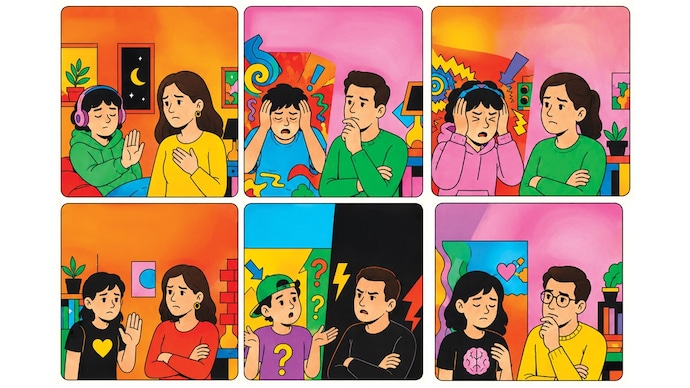
That candour is not restricted just to affection. Children today are equally likely to state when they are upset or uncomfortable. “I need space” is a phrase parents today hear commonly. The children are not being rude, they are simply saying, “I need a few minutes to calm down before I can engage again.”
Being honest and open about their feelings are traits that are especially noticeable among the cohort now known as Generation Alpha, generally defined as those born between 2010 and 2025 and currently ranging from toddlers to their early teens. They are being raised largely by Millennials, or Gen Y, born between 1981 and 1996, as well as older Gen Z parents, born in the late 1990s. Many authority figures shaping their lives belong to Gen X, born between 1965 and 1980.
NEW EMOTIONAL VOCABULARY
What makes Gen Alpha different? Their early, immersive exposure to digital technology is encouraging a more expressive, immediate style of communication while also shaping emotional resilience, identity and social interactions, according to an Indian study, ‘Navigating the Digital Paradox’, published last year in the International Journal for Multidisciplinary Research. Children today also live in an information environment where nearly every claim can be verified, every rule questioned and every feeling named. This has given them both the vocabulary and the confidence to express their thoughts and emotions.
“Children aren’t actually feeling emotions differently, they are simply being taught to label and express them much earlier and more openly,” says Dharini Kothari, a psychological counsellor specialising in the mental health of teens and adults. Psychological and self-help terms now appear frequently in everyday conversations. “Today’s children have greater exposure to words like ‘triggered’, ‘boundaries’ and ‘positive manifestation’ through schools, parents and social media,” says Kareena Mehta, founder and psychotherapist at the Mumbai-based Kare Counselling. However, when children use such terms, it is most likely not with its full clinical meaning; most often, it reflects an attempt to understand emotions using the language available to them.
THE GENERATION GAP
For Gen X, though, the language of boundaries and personal space can sometimes sound individualistic, even selfish. The once-familiar parental line—“Because I said so!”—is losing its authority. It comes from a time when adults were not expected to explain themselves and children were taught to listen, greet elders, accept affection and not talk back. “Older generations were raised on a diet of obedience, emotional restraint and the collective needs of the joint family,” says Kothari. So, when a child refuses to hug a visiting relative, a teenager questions a household rule or a student says a classroom feels unsafe, it is often seen as defiance.
But, as Aishwarya Rao, director, Vivekalaya Group of Institutions, Coimbatore, says, “The expectation of dialogue is not defiance. It is a logical response to the information environment Gen Alpha has grown up in.” Children today are more likely to ask why they must accept something simply because older generations did, notes Aanandita Vaghani, founder and mental health counsellor at UnFix Your Feelings. For many younger parents, the emphasis on boundaries is also intentional. “I absolutely tell my three-year-old that if he does not want to be hugged, he does not have to accept it,” says Dipti Kapadia, 38, a homemaker from Delhi.
This is a generation unafraid to voice its preferences, ask questions and have its say in decisions that affect them. “Gen Alpha has a strong need for emotional validation, attention and a sense of identity, along with a desire for freedom and self-expression at a very young age,” says Dr Abhinit Kumar, senior consultant, psychiatry, ShardaCare Healthcity, Greater Noida. Yet, as Mehta notes, children still seek comfort, love and support from their families, just not at the expense of personal space and self-expression.
AWARENESS VS FRAGILITY
But greater emotional awareness should not be mistaken for fragility. “Many adults describe this generation as emotionally fragile, but that view may be unfair,” says Dr Amit Sen, child and adolescent psychiatrist, co-founder and director of Children First, Delhi. “They are not necessarily weaker but simply navigating a far more complex world.” They are doing so under pressures earlier generations did not face in the same way: constant social comparison, intense parental involvement and an unrelenting flow of information, from world events to mental health.
Awareness can also become a burden, says Sharmila Bakshi, head of senior school, Vasant Valley School, Delhi. A child who can clearly explain why something feels wrong may still be learning how to cope with disappointment, uncertainty and discomfort. “Alongside awareness, there is a tendency to amplify small emotional triggers into larger crises, often leading to heightened stress and breakdowns that earlier generations did not experience in the same way,” she adds. Teachers and parents see this pattern more often. The concern is not that children are speaking more openly about emotions, but that some have fewer chances to work through manageable discomfort on their own.
Vaghani cautions against treating every difficult feeling as a problem to be solved. Not every discomfort is harm, she says, and not every setback requires adult intervention. In some cases, children may be developing what she calls a “low distress window”—a reduced capacity to sit with ordinary discomfort, boredom or delayed gratification.
That is not to say the challenges are imaginary. A 2024 study published in the National Journal of Community Medicine found that 35.3 per cent of adolescents surveyed in an urban area of Delhi had anxiety disorders, with social anxiety being common. Another 2024 study in the Indian Journal of Psychiatry reported high levels of common mental disorders, including anxiety, among adolescents in an urban resettlement colony in Delhi.
What is the way forward? Mehezabin Dordi, clinical psychologist at Sir H.N. Reliance Foundation Hospital, Mumbai, sees the challenge this way: “The goal is not to make children less emotional; it is to help them be strong and able to deal with things while still being able to feel their emotions and talk about them.” That is the balance Gen Alpha is trying to strike—and one that parents and teachers must learn to support.

