Enforcement Directorate | Chargesheet blitz
The agency ramps up chargesheets and asset returns, rebuilding its investigative credibility
On May 17, 2019, the Enforcement Directorate (ED) lodged a money-laundering case against former Haryana chief minister Bhupinder Singh Hooda, in connection with corruption charges allegedly involving the coerced sale of about 1,417 acres of land across sectors 58 to 67 of Gurugram at below-market rates. The case followed a trajectory that has come to define the agency: raids conducted, headlines generated, assets attached—and then, silence. This March, the ED finally filed a chargesheet—formally known as a prosecution complaint (PC)—against Hooda at a special court for Prevention of Money Laundering Act (PMLA) cases, bringing to a close to an investigation that spanned six long years.
On May 17, 2019, the Enforcement Directorate (ED) lodged a money-laundering case against former Haryana chief minister Bhupinder Singh Hooda, in connection with corruption charges allegedly involving the coerced sale of about 1,417 acres of land across sectors 58 to 67 of Gurugram at below-market rates. The case followed a trajectory that has come to define the agency: raids conducted, headlines generated, assets attached—and then, silence. This March, the ED finally filed a chargesheet—formally known as a prosecution complaint (PC)—against Hooda at a special court for Prevention of Money Laundering Act (PMLA) cases, bringing to a close to an investigation that spanned six long years.
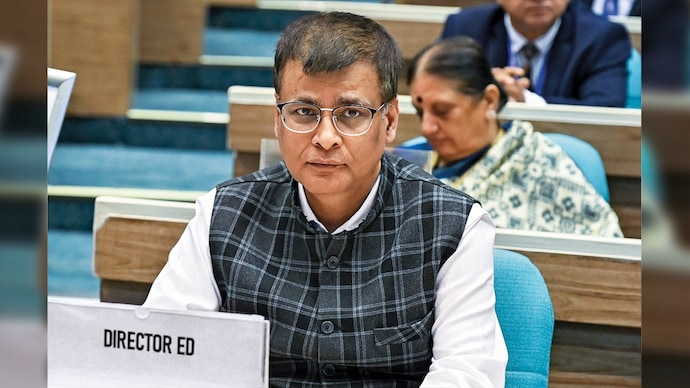
Hooda’s case is not an outlier. It is the latest example of sweeping changes that Rahul Navin, director of ED, is enforcing in the way the directorate proceeds with its cases. Officers say that he has got the agency to act on a war footing and file chargesheets in the over 6,000 pending cases it is investigating so that they can reach the court and trial can begin. This was after the ED faced tremendous criticism, especially by the Opposition parties, for a glaring structural gap: it was swift to register cases and attach assets, but chronically slow to bring matters to trial. In the nine years between 2005 and 2014, it filed a mere 84 PCs—fewer than 10 a year. Even between 2014 and 2024, the annual average was 132. Experts say there was also a darker dimension to the institutional backlog. When investigations remained permanently open without chargesheets, individual officers exercised enormous informal power over accused persons, with allegations that payments were sought in exchange for relief from summons. When Navin set out to break this slothful pattern, he moved first through the institutional machinery he had at hand: the Quarterly Conference of Zonal Officers, the forums at which zonal heads review performance with national leadership. At these conferences—held across FY25 and FY26—a singular directive was hammered home across field formations: treat the filing of a PC as the true measure of investigative completion. Mature cases were to be identified, evidence consolidated and chargesheets filed without avoidable delay.
THE PC PUSH
Navin set a target of 500 PCs for FY26. It was a break from the past, especially when he made it clear that this was an accountability benchmark, with field formations directed to review pending Enforcement Case Information Reports (ECIRs) systematically and identify matters amenable to prosecution. “The need for this enhanced target is to proactively conclude long-pending investigations and to systematically reduce the lifecycle of new investigations to a reasonable timeframe of one to two years, except in exceptionally complex cases,” says a senior officer who attended the conference. The results were striking. While the directorate closed 85 cases in FY24 and 198 in FY25, the figure jumped to 685 in FY26—more than an eight-fold increase in two years. Statistical closures—a category specifically introduced to acknowledge cases where the final PC has been filed and only the trial phase remains—jumped from 93 to 429 in a single year.
So, how did Navin and his team bring about such a dramatic turnaround in prosecution? The officer says it was not easy to meet the stiff targets, especially given that the ED’s manpower has remained 2,000 since 2011, even as investigations have increased manifold in both number and complexity. So, the directorate began leveraging data analysis software, used Open Source Intelligence (OSINT) techniques, advanced cyber forensic tools, and integrated access to domestic and international intelligence platforms, including the National Intelligence Grid (NATGRID), the financial intelligence unit (FINnet 2.0) and the Inter-operable Criminal Justice System (ICJS). These enabled ED officers to triangulate financial intelligence from multiple databases simultaneously, trace cryptocurrency flows through blockchain analytics, and access corporate and property records in real time. Dedicated capacity-building sessions were conducted at the 33rd Quarterly Conference of Zonal Officers to standardise these tools across all offices.
Then, to speed up the process of chargesheets, the ED made a deliberate pivot from what the directorate’s own internal documents describe as a ‘person/summon-centric approach’ to a ‘technology-centric approach’ to investigation. For years, critics argued that the ED’s primary instrument was the compulsory appearance under Section 50 of the PMLA—a lever that placed enormous informal power in the hands of investigating officers. Filing the chargesheet moves the case from the investigator’s desk to the court’s docket, thereby removing the weapon of discretion in the hands of ED investigators. Meanwhile, to remove other means of corruption within the department, as well as by the unscrupulous elements, the ED brought in measures such as QR code-based verification of summons and structured approval mechanisms, wherein senior officers approve the issuance of summons based on need and necessity. That resulted in fewer cases of suspects being threatened in the past two years, as officers are now tasked with focusing more on restitution, filing chargesheets and collecting evidence in old as well as new cases.
RETURNING THE MONEY
If the filing of a PC is the most visible metric of institutional change, restitution—the return of attached assets to the victims of financial crime—is its most tangible proof. In FY26, the ED restituted assets worth Rs 32,678 crore to victims and legitimate claimants, more than double the Rs 15,263 crore in FY25. As on March 31, 2026, cumulative restitution stands at Rs 63,213 crore—returned to banks, depositors, homebuyers and investors defrauded across decades. These included properties worth Rs 15,582 crore that were restituted to the Justice Lodha Committee for distribution to duped investors of PACL Ltd, the agricultural land Ponzi scheme that mobilised over Rs 48,000 crore.
Navin, in a statement on recent measures to increase transparency and accountability in the agency, said, “The Directorate of Enforcement remains steadfast in its mission to combat money laundering and safeguard the financial integrity of the nation. The outcome reflects the product of dedication, integrity and sustained effort of the officers and staff of the directorate, to whom I extend my sincere appreciation. We remain committed to evolving in line with the global best practices and addressing emerging challenges with resolve and professionalism.”
Yet, as experts point out, filing a chargesheet is not the end of the road but a handover to another institution with its own pressures and pathologies. Of the roughly 60 cases that have reached final verdict since 2014, the ED may boast a conviction rate of over 93 per cent. But the denominator tells the real story: only 60 cases fully adjudicated out of thousands registered. As on March 31, with 6,146 cases still pending, the backlog remains formidable.
The courts present their own bottleneck. Repeated bail applications consume substantial hearing time. Sequential discharge petitions by co-accused stagger the framing of charges. Fugitive economic offenders, who have left the country and show no intent to return, cannot be prosecuted in absentia. Constitutional challenges pending before the Supreme Court have stayed proceedings in multiple cases. Several states, including Rajasthan, Chhattisgarh and Jharkhand, lack adequate numbers of PMLA special courts. The directorate is now pressing for dedicated fast-track special courts for PMLA matters and for legislative clarity on several procedural ambiguities. The political will to deliver these institutional upgrades, which require state government cooperation and legislative action, remains to be tested.
—The writer is Senior Editor and Head of the National Bureau, AajTak and India Today TV

