CBSE evaluation | A screenful of bungles
Designed to modernise evaluation, the Central Board of Secondary Education's On-Screen Marking system instead sparked controversy over wrong answer sheets and unexplained scores. As inquiries begin, the focus shifts to accountability and rebuilding trust
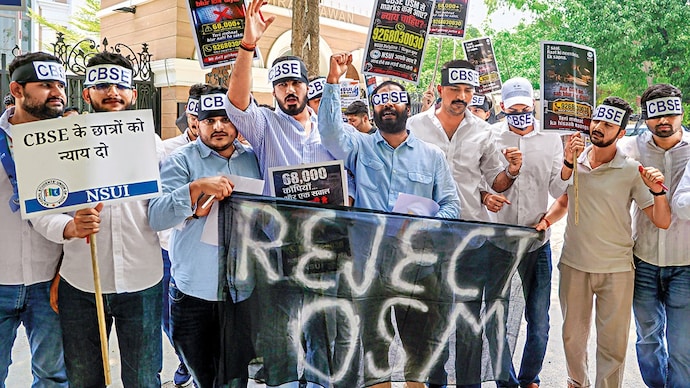
On June 2, the Union government removed Central Board of Secondary Education (CBSE) chairman Rahul Singh and secretary Himanshu Gupta with immediate effect. It was the clearest sign that the row over the board’s new On-Screen Marking (OSM) system had stopped being a result-season grievance and become a governance crisis. The Appointments Committee of the Cabinet installed Lokhande Prashant Sitaram, a 2001-batch IAS officer from the Union home ministry, as the new chairperson, and Varun Bhardwaj of the Indian Information Service as secretary.
On June 2, the Union government removed Central Board of Secondary Education (CBSE) chairman Rahul Singh and secretary Himanshu Gupta with immediate effect. It was the clearest sign that the row over the board’s new On-Screen Marking (OSM) system had stopped being a result-season grievance and become a governance crisis. The Appointments Committee of the Cabinet installed Lokhande Prashant Sitaram, a 2001-batch IAS officer from the Union home ministry, as the new chairperson, and Varun Bhardwaj of the Indian Information Service as secretary.
Gupta has been repatriated to his parent cadre on “administrative grounds” and barred from another central posting until December 2030. The move makes him the chief bureaucratic casualty of the fiasco, even though, on May 28, Union education minister Dharmendra Pradhan accepted responsibility for it. The Cabinet Secretariat has now constituted a one-man committee under S. Radha Chauhan, who heads the Capacity Building Commission, to inquire into the procurement of the OSM system and report within a month.
THE PERILS OF HASTE
Meanwhile, students who remain unconvinced by their marks are filing for verification and re-evaluation through a window that opened on June 2 and closes on June 6, even as OSM, pitched as a faster, cleaner, more efficient way to grade, has drawn some of the heaviest public criticism.
OSM was meant to be a modernisation initiative. Students still wrote their papers by hand, what changed was the evaluation layer. Answer books were scanned at regional offices, uploaded to a secure portal and marked question by question by human examiners on screen, with totals calculated automatically.
When the CBSE announced the nationwide rollout in February, it listed 10 benefits and called the system an “environmentally sustainable digital evaluation” process. “The concept itself is sound and aligns with global trends,” says Professor V. Ramgopal Rao, group vice-chancellor of BITS Pilani. “The issue appears to be not the idea but the implementation.”
Educators had flagged the gaps—moderation, dipping results, untrained evaluators and shaky digital infrastructure—during consultative meetings, and the warnings proved prescient. A CBSE governing body meeting in June 2025 had explicitly suggested that OSM be rolled out only after pilots in some subjects across regional offices. That advice was set aside.
Instead, the CBSE ran a three-day dry run in January with just five Delhi schools and pressed ahead. Even the dry run was not reassuring. Participants documented dozens of faults on day one. A second report on the third day listed at least 36 concerns.
Jyoti Gupta, director of The Shri Ram Universal School in Ghaziabad, and director-principal, K.R. Mangalam World School, GK-II, Delhi, argues the sequencing was wrong. “It should have been done in a phased manner, with a pilot in one or more regions and then rolled out,” she says, adding that most evaluators were trained only on the first day of evaluation at the centres themselves. “If the process started a couple of months earlier, it would have been in place.”
The cracks had showed almost immediately after the results were declared on May 13. Students who sought scanned copies of their answer books reported blurred pages, missing sheets, mismatched totals and, in the most alarming cases, scripts that were not theirs. Among them was Delhi student Vedant Shrivastava, who had scored in the 80s and 90s in other subjects but found his Physics marks inexplicably low.
With no clear grievance channel available, he posted his complaint on social media, drawing both support and abuse. The CBSE later reviewed his answer sheet and revised his Physics score to 74. Vedant, however, remains unconvinced and is awaiting re-evaluation. His case became the first clear confirmation that the wrong-script error was real.
By late May, around 294,000 students had sought scanned copies of 856,000 answer books, more than double the previous year. The board eventually conceded roughly 20 cases of answer-sheet mix-ups, said about 68,000 of 9.8 million scripts had to be rescanned for quality, and that over 13,000 still could not be made legible and were marked manually. The re-evaluation portal, when it opened, buckled under the load, crashing repeatedly and failing to process payments.
CURIOUS CASE OF A BID
What the CBSE did not disclose in February was the speed behind the OSM rollout. The contract had been awarded just 66 days earlier, on December 5, 2025, to Hyderabad-based Coempt EduTeck, not on technical strength but on price. The firm quoted about Rs 25.75 per booklet against the roughly Rs 65 by Tata Consultancy Services, the only other technically qualified bidder. Under the CBSE’s quality-and-cost model, with technical scores weighted at 70 per cent and price at 30, a marginal technical edge—91 against TCS’s 89 out of total score of 100—combined with a steep undercut proved decisive.
Coempt’s past also raised scrutiny. The company was earlier known as Globarena Technologies, the firm behind the 2019 Telangana intermediate results disaster in which over 380,000 of 974,000 students failed and more than 20 died by suicide. CBSE officials defended the choice, noting the firm runs digital evaluation in Telangana, Karnataka and West Bengal, was never blacklisted and was simply the lowest bidder.
It was a 17-year-old who turned that defence into a question. Sarthak Sidhant, a Class 12 student from Jharkhand and one of the 1.7 million affected, scraped CBSE’s tender records from the public procurement portal and tracked how conditions shifted across three rounds. His central charge, laid out in a detailed blog, is that the board repeatedly rewrote eligibility and technical criteria until Coempt could clear the bar. On June 2, Sarthak appeared before a parliamentary standing committee at its invitation and presented his findings—an uncommon platform for a young student.
WHERE THE BUCK STOPS
CBSE and Coempt have denied the allegations. The key question now is whether the tender changes were deliberate attempts to favour a particular bidder or routine revisions made during the process. That is exactly what the Chauhan committee’s investigation is expected to determine.
The crisis has exposed a fundamental problem—the gap between those who design reforms and those who run them. “The people closest to the evaluation process identify issues much earlier than administrators or technology vendors,” Rao notes, yet that feedback rarely shapes the design in time. Surabhi Bhargav, principal of Cambridge School, Noida, makes the same point about readiness: “Examiners should not merely be trained to use the software. Their feedback should also shape how the system evolves.”
Accountability, too, has blurred precisely because so many hands touched the system. Technology providers owe platform reliability and security. The board owes testing, oversight and grievance redressal. Policymakers owe adequate safeguards before any large-scale launch. When all three fail at once, responsibility diffuses.
The inquiry will determine whether the OSM saga was merely a case of reckless haste or something more troubling. But for many students, the verdict is already in: a system meant to make evaluation more reliable left them fighting to verify their own results.

