Patriarchy causes climate change: Dia Mirza's comment divides internet
Dia Mirza's comments linking patriarchy to climate change have sparked a heated online debate. Here's what the actor said, the context behind her remarks, and why social media users are divided.
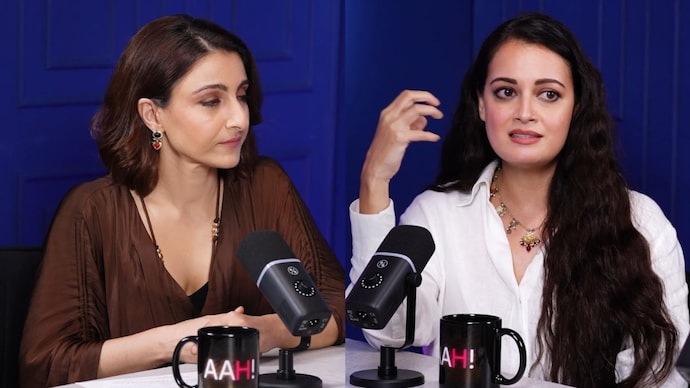
Actor Dia Mirza has found herself at the centre of an online debate after saying that “patriarchy is the cause of climate change” during a recent appearance on Soha Ali Khan’s podcast. The remark quickly went viral on social media, with users split over the actor’s attempt to connect environmental degradation to patriarchal systems and structures of power.
The comment came during a discussion on climate change and humanity’s relationship with nature, featuring environmental journalist, author and photographer Arati Kumar-Rao. While some users defended Mirza’s perspective as part of a broader conversation about environmental justice, others criticised the statement, arguing that it oversimplified the causes of climate change.
Watch the video here:
What did Dia Mirza actually say?
During the podcast, Mirza joined environmental journalist, author and photographer Arati Kumar-Rao for a discussion on climate change, environmental degradation and society’s relationship with nature.
Expanding on her views, Mirza said, “It is the men in this world. It is the men who have driven the climate change, and they are totally responsible for the chaos.”
The conversation explored how large-scale ecological damage may be linked to systems of domination and control. Mirza argued that the exploitation of nature is connected to a mindset that prioritises dominance, aggressive development and the subjugation of natural resources.
Kumar-Rao added that “patriarchy is not just about men, and feminism is not just about women”, arguing that women can uphold patriarchal systems while men can support feminist principles. The discussion drew on ideas associated with ecofeminism, a philosophical movement that links environmental exploitation with the historical subordination of women.
Why are social media users criticising the remarks?
The comments quickly went viral on platforms including X and Reddit, where many users challenged Mirza’s argument.
Some critics accused the participants of hypocrisy, arguing that wealthy celebrities should not lecture ordinary citizens about climate change while benefiting from lifestyles that may carry significantly larger carbon footprints. Several users pointed to the podcast setting and questioned whether public figures were best placed to discuss environmental responsibility.
Others argued that attributing climate change to patriarchy oversimplifies a complex global issue. These users contended that industrialisation, fossil fuel dependence, government policies, economic systems and corporate emissions play a more direct role in driving environmental damage.
Some commenters also argued that much of the infrastructure built over the past two centuries was developed without a full understanding of long-term environmental consequences. They suggested that focusing on gender politics distracts from the technological and policy solutions needed to address climate change.
Dia Mirza’s long-standing environmental advocacy
Mirza has spent years championing environmental causes alongside her acting career. Associated with the United Nations Environment Programme (UNEP), she has frequently spoken about sustainability, air pollution and climate action.
The actor has previously said that her environmental advocacy intensified after attending a UNEP conference in Bangkok, where she was introduced to research and data on air pollution that had yet to enter mainstream public discourse in India.
As she approaches 25 years in the film industry, Mirza continues to balance her screen career with environmental activism. Her latest remarks have once again brought that work into the spotlight, while also fuelling a broader conversation online about climate change, accountability and the role of social systems in shaping environmental outcomes.
Actor Dia Mirza has found herself at the centre of an online debate after saying that “patriarchy is the cause of climate change” during a recent appearance on Soha Ali Khan’s podcast. The remark quickly went viral on social media, with users split over the actor’s attempt to connect environmental degradation to patriarchal systems and structures of power.
The comment came during a discussion on climate change and humanity’s relationship with nature, featuring environmental journalist, author and photographer Arati Kumar-Rao. While some users defended Mirza’s perspective as part of a broader conversation about environmental justice, others criticised the statement, arguing that it oversimplified the causes of climate change.
Watch the video here:
What did Dia Mirza actually say?
During the podcast, Mirza joined environmental journalist, author and photographer Arati Kumar-Rao for a discussion on climate change, environmental degradation and society’s relationship with nature.
Expanding on her views, Mirza said, “It is the men in this world. It is the men who have driven the climate change, and they are totally responsible for the chaos.”
The conversation explored how large-scale ecological damage may be linked to systems of domination and control. Mirza argued that the exploitation of nature is connected to a mindset that prioritises dominance, aggressive development and the subjugation of natural resources.
Kumar-Rao added that “patriarchy is not just about men, and feminism is not just about women”, arguing that women can uphold patriarchal systems while men can support feminist principles. The discussion drew on ideas associated with ecofeminism, a philosophical movement that links environmental exploitation with the historical subordination of women.
Why are social media users criticising the remarks?
The comments quickly went viral on platforms including X and Reddit, where many users challenged Mirza’s argument.
Some critics accused the participants of hypocrisy, arguing that wealthy celebrities should not lecture ordinary citizens about climate change while benefiting from lifestyles that may carry significantly larger carbon footprints. Several users pointed to the podcast setting and questioned whether public figures were best placed to discuss environmental responsibility.
Others argued that attributing climate change to patriarchy oversimplifies a complex global issue. These users contended that industrialisation, fossil fuel dependence, government policies, economic systems and corporate emissions play a more direct role in driving environmental damage.
Some commenters also argued that much of the infrastructure built over the past two centuries was developed without a full understanding of long-term environmental consequences. They suggested that focusing on gender politics distracts from the technological and policy solutions needed to address climate change.
Dia Mirza’s long-standing environmental advocacy
Mirza has spent years championing environmental causes alongside her acting career. Associated with the United Nations Environment Programme (UNEP), she has frequently spoken about sustainability, air pollution and climate action.
The actor has previously said that her environmental advocacy intensified after attending a UNEP conference in Bangkok, where she was introduced to research and data on air pollution that had yet to enter mainstream public discourse in India.
As she approaches 25 years in the film industry, Mirza continues to balance her screen career with environmental activism. Her latest remarks have once again brought that work into the spotlight, while also fuelling a broader conversation online about climate change, accountability and the role of social systems in shaping environmental outcomes.

