Baby Do Die Do review: Huma Qureshi powers this pulpy revenge thriller with style
Baby Do Die Do review: Baby Karmarkar, a deaf and mute contract killer, hunts her sister's murderers in a pulpy revenge saga. Huma Qureshi anchors the film as it blends old-school Bollywood excess with confident storytelling.
If Baby Do Die Do left you wondering what on earth it means, you are not alone. The title is simply the English translation of its protagonist's name – Baby Karmarkar. Read it aloud, and it becomes Baby 'Kar, Mar, Kar' or, in English, 'Do, Die, Do'. Confusing at first, but once the film gets going, the quirky title begins to make perfect sense. Here, Baby believes she can do it, die for it and then do it again. And much like its title, the film is also loud, pulpy, unapologetically filmy and proudly embraces every bit of its madness.
At a time when every crime thriller wants to be gritty and every action film wants to look Hollywood, director Nachiket Samant goes in the opposite direction. He leans into old-school Bollywood storytelling, complete with revenge, romance, gangsters, supari killers, larger-than-life villains and even an umbrella that doubles up as a sniper rifle. The only hitch is that if you have grown up reading enough pulp fiction or watching enough Bollywood revenge dramas, you will probably guess the film's biggest twist well before it arrives. Thankfully, Baby Do Die Do proves that execution often matters more than surprise.
The film opens with twin sisters sneaking into a five-star hotel out of curiosity, only to witness a murder that changes their lives forever. Years later, Baby, who is deaf and mute, grows up to become one of the city's most feared contract killers, eliminating targets one by one while chasing the people responsible for her sister's death. Somewhere along the way, she unexpectedly discovers love, forcing her to question the life she has built around revenge.
The story itself is familiar, but the screenplay keeps things moving at a brisk pace. At just over two hours, the film never loses your attention. The writing smartly balances revenge, romance and humour, while the editing ensures there isn't a dull moment. Even when you know where the story is headed, it remains entertaining because the treatment is consistently engaging. There is something refreshingly old-school about the film.
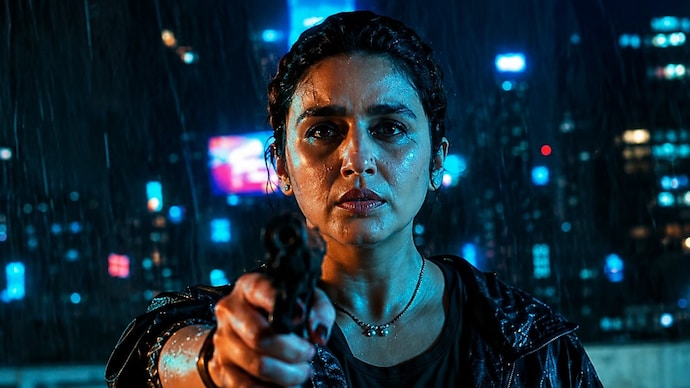
The biggest reason to watch the film, however, is Huma Qureshi. As Baby, she delivers one of her finest performances. Communicating through silence, lip-reading, text messages and expressions, she never lets the audience pity her. Baby hates being labelled handicapped, carries herself with confidence and emerges as the smartest person in almost every room she walks into. She also packs a punch and kick, when needed.
Huma's gone absolutely without makeup, and didn't even shy away from a few unflattering close-ups that highlighted lines on her face. She once again proves why she remains one of the finest actors working today, which is also why it's disappointing that she had to produce this film with her brother, Saqib Saleem, to land a role worthy of her talent. One only wishes more filmmakers trusted her with parts like these.
Rachit Singh is sincere as Siddhu, Baby's love interest, even if he doesn't quite match Huma's screen presence. His character is refreshingly sensitive, proudly calling himself gharelu and non-toxic, and their romance, especially the black-and-white flashback sequences, provides warmth amid the violence. Sikandar Kher continues to impress as the antagonist, while Chunky Pandey is a delightful surprise as a stone-faced contract-killing honcho, a far cry from the comic roles audiences have associated him with for years.
Seema Pahwa is brilliant as DCP Anjum Khan, who tells her colleague to be careful as they are 'police and not heroes'. Vidya Malvade, Himanshu Malik, Marudhar Shekhawat, Arun Kushwah, Rupesh Bane and Mangala Kenkre add more flavours to the narrative with their colourful characters.
The film also deserves credit for how it portrays disability. Baby never seeks sympathy; she simply wants respect. Similarly, Siddhu falls in love with her for who she is, not despite her disability.
Technically, Baby Do Die Do is polished. Tojo Xavier's cinematography captures a gritty, lived-in Mumbai that feels integral to the story, while Samant's direction keeps the pace. The screenplay extracts maximum value from a straightforward premise, proving that even a familiar revenge saga can feel fresh when mounted with conviction. The only misstep is the repeated use of glitch-style camera effects during dramatic scenes, which feel unnecessary and briefly pull you out of the narrative.
Also, the local train assassination sequence is particularly unsettling, especially given recent incidents on Mumbai's local trains. The film slips in a few cheeky moments, including what feels like a playful wink at Alpha. Releasing alongside Alia Bhatt's actioner, it is rather uncanny to see Saqib Saleem appear in the film with a queer club number titled 'Alpha Q'.
The ending also leaves room for a sequel, and Huma's good friend Sonakshi Sinha's gets her own Easter egg moment.
But the film's biggest achievement perhaps lies elsewhere. At a time when women-led films are often pushed to streaming, Baby Do Die Do reminds us that they deserve theatrical confidence too. Not every film needs to reinvent cinema; some just need to entertain. Led by the excellent Huma Qureshi and backed by confident, tightly written storytelling, Baby Do Die Do does exactly that.
So Baby, you didn't die... You definitely did!
If Baby Do Die Do left you wondering what on earth it means, you are not alone. The title is simply the English translation of its protagonist's name – Baby Karmarkar. Read it aloud, and it becomes Baby 'Kar, Mar, Kar' or, in English, 'Do, Die, Do'. Confusing at first, but once the film gets going, the quirky title begins to make perfect sense. Here, Baby believes she can do it, die for it and then do it again. And much like its title, the film is also loud, pulpy, unapologetically filmy and proudly embraces every bit of its madness.
At a time when every crime thriller wants to be gritty and every action film wants to look Hollywood, director Nachiket Samant goes in the opposite direction. He leans into old-school Bollywood storytelling, complete with revenge, romance, gangsters, supari killers, larger-than-life villains and even an umbrella that doubles up as a sniper rifle. The only hitch is that if you have grown up reading enough pulp fiction or watching enough Bollywood revenge dramas, you will probably guess the film's biggest twist well before it arrives. Thankfully, Baby Do Die Do proves that execution often matters more than surprise.
The film opens with twin sisters sneaking into a five-star hotel out of curiosity, only to witness a murder that changes their lives forever. Years later, Baby, who is deaf and mute, grows up to become one of the city's most feared contract killers, eliminating targets one by one while chasing the people responsible for her sister's death. Somewhere along the way, she unexpectedly discovers love, forcing her to question the life she has built around revenge.
The story itself is familiar, but the screenplay keeps things moving at a brisk pace. At just over two hours, the film never loses your attention. The writing smartly balances revenge, romance and humour, while the editing ensures there isn't a dull moment. Even when you know where the story is headed, it remains entertaining because the treatment is consistently engaging. There is something refreshingly old-school about the film.
The biggest reason to watch the film, however, is Huma Qureshi. As Baby, she delivers one of her finest performances. Communicating through silence, lip-reading, text messages and expressions, she never lets the audience pity her. Baby hates being labelled handicapped, carries herself with confidence and emerges as the smartest person in almost every room she walks into. She also packs a punch and kick, when needed.
Huma's gone absolutely without makeup, and didn't even shy away from a few unflattering close-ups that highlighted lines on her face. She once again proves why she remains one of the finest actors working today, which is also why it's disappointing that she had to produce this film with her brother, Saqib Saleem, to land a role worthy of her talent. One only wishes more filmmakers trusted her with parts like these.
Rachit Singh is sincere as Siddhu, Baby's love interest, even if he doesn't quite match Huma's screen presence. His character is refreshingly sensitive, proudly calling himself gharelu and non-toxic, and their romance, especially the black-and-white flashback sequences, provides warmth amid the violence. Sikandar Kher continues to impress as the antagonist, while Chunky Pandey is a delightful surprise as a stone-faced contract-killing honcho, a far cry from the comic roles audiences have associated him with for years.
Seema Pahwa is brilliant as DCP Anjum Khan, who tells her colleague to be careful as they are 'police and not heroes'. Vidya Malvade, Himanshu Malik, Marudhar Shekhawat, Arun Kushwah, Rupesh Bane and Mangala Kenkre add more flavours to the narrative with their colourful characters.
The film also deserves credit for how it portrays disability. Baby never seeks sympathy; she simply wants respect. Similarly, Siddhu falls in love with her for who she is, not despite her disability.
Technically, Baby Do Die Do is polished. Tojo Xavier's cinematography captures a gritty, lived-in Mumbai that feels integral to the story, while Samant's direction keeps the pace. The screenplay extracts maximum value from a straightforward premise, proving that even a familiar revenge saga can feel fresh when mounted with conviction. The only misstep is the repeated use of glitch-style camera effects during dramatic scenes, which feel unnecessary and briefly pull you out of the narrative.
Also, the local train assassination sequence is particularly unsettling, especially given recent incidents on Mumbai's local trains. The film slips in a few cheeky moments, including what feels like a playful wink at Alpha. Releasing alongside Alia Bhatt's actioner, it is rather uncanny to see Saqib Saleem appear in the film with a queer club number titled 'Alpha Q'.
The ending also leaves room for a sequel, and Huma's good friend Sonakshi Sinha's gets her own Easter egg moment.
But the film's biggest achievement perhaps lies elsewhere. At a time when women-led films are often pushed to streaming, Baby Do Die Do reminds us that they deserve theatrical confidence too. Not every film needs to reinvent cinema; some just need to entertain. Led by the excellent Huma Qureshi and backed by confident, tightly written storytelling, Baby Do Die Do does exactly that.
So Baby, you didn't die... You definitely did!

