Rs 370 ki biryani and the cost of a woman's consent
A viral comedy clip showed a Gurugram man joking about expecting an ROI (return on investment) after spending Rs 370 on a date. The backlash widened into a debate on consent, misogyny and the laughter that helped spread it.
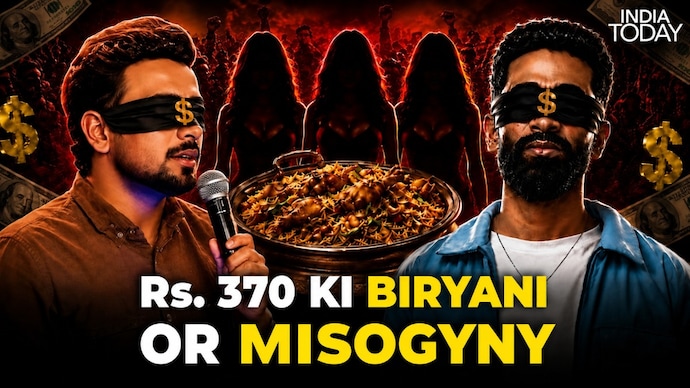
A Rs 370 biryani has done what years of gender discourse, awareness campaigns and social media debates often fail to do. It has exposed how cheaply some men value a woman’s consent and how quickly society rushes to defend them.
By now, most people know about the viral clip. A man from Gurugram spoke about spending Rs 370 on a date and expecting a 'return' on that investment. A return. On. Investment. Let that sink in.
As if he had bought shares in a company instead of sharing a meal with another human being. The audience laughed. The comedian, Pranit More, laughed. Yes, the same person who you must have seen on Bigg Boss 19 talking about “values,” and maybe believed him?
The clip was edited, uploaded and pushed out to millions. The Gurugram man, who cracked the joke, was fired from his job. Some men came to his defence. The HR of the company tried to paint him as a person who is extremely respectful at the workplace and deserves a second chance. Case closed?
Not quite. Because the problem was never the Rs 370. And it certainly wasn’t the biryani.
The problem was the belief system underneath the joke. The one that tells men money spent on women is an investment and investments deserve 'returns'. The joke worked because it rested on an idea so old, so familiar and so deeply embedded in society that an entire room laughed before anyone stopped to ask what exactly they were laughing at.
Here's Pranit More's apology:
Let’s call it what it was. A rape joke.
Or, if that makes people uncomfortable, a joke built on the threat of sexual coercion. A joke whose humour depended on the assumption that spending money on a woman is direct and mandatory access to her body.
The distinction matters only to those interested in policing language rather than examining behaviour. Predictably, the defence arrived within minutes. “It’s just a joke.” “It’s dark humour.” “People are too sensitive.” “It doesn’t reflect his mentality.” Sure.
But if it doesn’t reflect your mentality, why did it make you laugh? And if it doesn’t reflect your mentality, why did you upload it? (Looking at you, Pranit)
Nobody accidentally turns a clip into content. Someone watched it. Someone edited it. Someone approved it. Someone thought, “This is funny.” Someone thought, “People will love this.” When you reward a comment with laughter, airtime and virality, you are no longer a bystander. You are an active participant. You are an enabler.
What makes the entire episode even more uncomfortable is the longer clip circulating online. In it, the man goes on to explain how he expected an ROI on the money spent during the date. He describes taking the woman to a park and attempting to put his hand inside her leggings. The entitlement is staggering. He narrates the story with the confidence of someone who believes the audience is on his side.
Judging by the laughter, many people in the room did seem to find it funny. Which is why the bigger question is not why one man said it, but why an entire room laughed at it.
Watch the clip again. There is no awkward silence. No visible discomfort. No collective intake of breath. Just laughter. Almost like One body. One soul. One punchline. And that should worry us far more than the man himself.
Because misogyny rarely survives through individual villains. It survives through collective approval. It survives when women comedians are judged less for their material and more for their bodies, clothes, relationships and appearance. It survives when women creators who respond to abuse become the story instead of the abuse itself.
Take Kusha Kapila or Apoorva Mukhija for example.
Kusha’s personal life became public property the moment she got divorced. Apoorva has repeatedly found herself at the centre of outrage cycles for simply responding to the kind of comments male creators often ignore or laugh off. Their reactions are dissected more than the behaviour directed at them.
A woman gets angry and she is bitter. A woman pushes back and she is arrogant. A woman refuses to laugh along and she is attention-seeking. A woman calls out misogyny, and suddenly she is a misandrist.
Male creators, meanwhile, often receive a far more generous reading. “It’s just content.” “It’s just comedy.” “It doesn’t reflect who he really is.” and we are making the same mistake again with Pranit More. Calling someone out for their misogyny is the least a self-aware audience can do.
Funny how women are expected to take responsibility for every word they say while men are constantly excused for words that supposedly don’t represent them. When every discussion about men’s behaviour is interrupted by the inevitable chorus of “not all men.”
Of course, not all men!
But somehow there are always enough men to fill comment sections, comedy clubs, podcast studios and social media timelines. And it’s not limited to just men. There are enough women too who are conditioned to laugh at such comments because objecting is exhausting.
That is why the outrage around the Rs 370 clip feels both necessary and strangely insufficient.
Necessary because public pushback matters. It was heartening to see people across vastly different corners of the internet – from Kusha Kapila and Dolly Singh to even Elvish Yadav – agree that something about this was deeply wrong. Insufficient because this wasn’t an anomaly.
This is the same country where women are still asked what they wore before being asked what happened. The same country where conversations about consent are derailed by questions about what she drank, why she was there, why she stayed late or who was she with. The same country where marital rape still lacks criminal recognition.
Though perhaps even saying those two words together is enough to start another argument. So was the joke shocking? Disturbing, yes. Revealing, absolutely. But shocking? Not really.
The Rs 370 joke did not expose a fringe mindset. It exposed a mainstream one. It simply condensed centuries of entitlement into a sentence short enough for Instagram and crude enough to go viral.
And perhaps that is why so many people are uncomfortable. Because the villain isn’t just the man in the clip. It’s the culture that taught him the joke would work. It’s the people who rewarded it with laughter. It’s the decision to turn it into content.
And it’s every one of us who treats misogyny as humour, entitlement as confidence and harassment as banter until one day the joke stops sounding like a joke at all.
So no, this was never about a Rs 370 biryani. It was about the cost of a woman’s consent.
The biryani cost Rs 370. The joke cost far more.
A Rs 370 biryani has done what years of gender discourse, awareness campaigns and social media debates often fail to do. It has exposed how cheaply some men value a woman’s consent and how quickly society rushes to defend them.
By now, most people know about the viral clip. A man from Gurugram spoke about spending Rs 370 on a date and expecting a 'return' on that investment. A return. On. Investment. Let that sink in.
As if he had bought shares in a company instead of sharing a meal with another human being. The audience laughed. The comedian, Pranit More, laughed. Yes, the same person who you must have seen on Bigg Boss 19 talking about “values,” and maybe believed him?
The clip was edited, uploaded and pushed out to millions. The Gurugram man, who cracked the joke, was fired from his job. Some men came to his defence. The HR of the company tried to paint him as a person who is extremely respectful at the workplace and deserves a second chance. Case closed?
Not quite. Because the problem was never the Rs 370. And it certainly wasn’t the biryani.
The problem was the belief system underneath the joke. The one that tells men money spent on women is an investment and investments deserve 'returns'. The joke worked because it rested on an idea so old, so familiar and so deeply embedded in society that an entire room laughed before anyone stopped to ask what exactly they were laughing at.
Here's Pranit More's apology:
Let’s call it what it was. A rape joke.
Or, if that makes people uncomfortable, a joke built on the threat of sexual coercion. A joke whose humour depended on the assumption that spending money on a woman is direct and mandatory access to her body.
The distinction matters only to those interested in policing language rather than examining behaviour. Predictably, the defence arrived within minutes. “It’s just a joke.” “It’s dark humour.” “People are too sensitive.” “It doesn’t reflect his mentality.” Sure.
But if it doesn’t reflect your mentality, why did it make you laugh? And if it doesn’t reflect your mentality, why did you upload it? (Looking at you, Pranit)
Nobody accidentally turns a clip into content. Someone watched it. Someone edited it. Someone approved it. Someone thought, “This is funny.” Someone thought, “People will love this.” When you reward a comment with laughter, airtime and virality, you are no longer a bystander. You are an active participant. You are an enabler.
What makes the entire episode even more uncomfortable is the longer clip circulating online. In it, the man goes on to explain how he expected an ROI on the money spent during the date. He describes taking the woman to a park and attempting to put his hand inside her leggings. The entitlement is staggering. He narrates the story with the confidence of someone who believes the audience is on his side.
Judging by the laughter, many people in the room did seem to find it funny. Which is why the bigger question is not why one man said it, but why an entire room laughed at it.
Watch the clip again. There is no awkward silence. No visible discomfort. No collective intake of breath. Just laughter. Almost like One body. One soul. One punchline. And that should worry us far more than the man himself.
Because misogyny rarely survives through individual villains. It survives through collective approval. It survives when women comedians are judged less for their material and more for their bodies, clothes, relationships and appearance. It survives when women creators who respond to abuse become the story instead of the abuse itself.
Take Kusha Kapila or Apoorva Mukhija for example.
Kusha’s personal life became public property the moment she got divorced. Apoorva has repeatedly found herself at the centre of outrage cycles for simply responding to the kind of comments male creators often ignore or laugh off. Their reactions are dissected more than the behaviour directed at them.
A woman gets angry and she is bitter. A woman pushes back and she is arrogant. A woman refuses to laugh along and she is attention-seeking. A woman calls out misogyny, and suddenly she is a misandrist.
Male creators, meanwhile, often receive a far more generous reading. “It’s just content.” “It’s just comedy.” “It doesn’t reflect who he really is.” and we are making the same mistake again with Pranit More. Calling someone out for their misogyny is the least a self-aware audience can do.
Funny how women are expected to take responsibility for every word they say while men are constantly excused for words that supposedly don’t represent them. When every discussion about men’s behaviour is interrupted by the inevitable chorus of “not all men.”
Of course, not all men!
But somehow there are always enough men to fill comment sections, comedy clubs, podcast studios and social media timelines. And it’s not limited to just men. There are enough women too who are conditioned to laugh at such comments because objecting is exhausting.
That is why the outrage around the Rs 370 clip feels both necessary and strangely insufficient.
Necessary because public pushback matters. It was heartening to see people across vastly different corners of the internet – from Kusha Kapila and Dolly Singh to even Elvish Yadav – agree that something about this was deeply wrong. Insufficient because this wasn’t an anomaly.
This is the same country where women are still asked what they wore before being asked what happened. The same country where conversations about consent are derailed by questions about what she drank, why she was there, why she stayed late or who was she with. The same country where marital rape still lacks criminal recognition.
Though perhaps even saying those two words together is enough to start another argument. So was the joke shocking? Disturbing, yes. Revealing, absolutely. But shocking? Not really.
The Rs 370 joke did not expose a fringe mindset. It exposed a mainstream one. It simply condensed centuries of entitlement into a sentence short enough for Instagram and crude enough to go viral.
And perhaps that is why so many people are uncomfortable. Because the villain isn’t just the man in the clip. It’s the culture that taught him the joke would work. It’s the people who rewarded it with laughter. It’s the decision to turn it into content.
And it’s every one of us who treats misogyny as humour, entitlement as confidence and harassment as banter until one day the joke stops sounding like a joke at all.
So no, this was never about a Rs 370 biryani. It was about the cost of a woman’s consent.
The biryani cost Rs 370. The joke cost far more.

