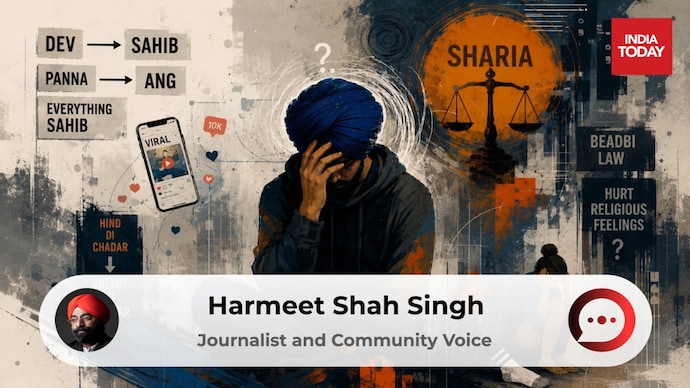
When Sikhs debate beadbi, what is defining it theologically — Sikhi or Sharia?
The Sikh debate over 'beadbi' (sacrilege) has consumed the headlines. Beneath it sits a harder question: when a community's historical words are replaced one by one, without discussion or sanction, and the replacements keep pointing in an alien direction, what do we call that?
Punjab Chief Minister Bhagwant Mann is accused by his opponents of beadbi (sacrilege), charges he vehemently denies.
Separately, arguments are also being drawn in favour of and against the new Jaagat Jot Sri Guru Granth Sahib Satkar legislation, the Punjab state law enacted to severely penalise acts of beadbi against Sri Guru Granth Sahib, the living Guru of the Sikhs.
But this piece is not getting into any of that. It is the theology of beadbi that has attracted my attention.
THE VOCABULARY IS SHIFTING, AND NOBODY ANNOUNCED IT
Over the past quarter-century, a consequential set of changes has been introduced into Sikh parlance by a particular school of thought.
Most of these changes arrived without announcement, debate, or sanction.
They spread through social media, WhatsApp forwards, and urban gurdwara culture, and by the time anyone noticed, they had already acquired the force of convention.
Many of these shifts share a common direction: away from the original Indic/Punjabi and toward something that sits more comfortably in a different theological universe altogether.
That observation is worth holding in mind as we go through them one by one.
Consider the names of the Gurus. A section has done away with the word Dev when referring to Guru Nanak Dev, Guru Angad Dev, and Guru Arjan Dev, replacing it with Sahib.
This is not a matter of Sahib being a lesser word. It carries its own elevated meaning and appears across Sri Guru Granth Sahib (SGGS) with deep divine significance.
The concern is different.
Dev in Gurbani carries a specific, luminous meaning of its own.
Guru Arjan Dev, in Raag Gauri (209), describes the infinite Prabhu as the illuminating Dev:
"O (Illuminating) Dev! Through your grace, the True Guru became merciful unto me, and I now remain absorbed in unshakeable equipoise."
This is not incidental usage. Dev here is a theological descriptor, the radiant, luminous divine presence. Dev is rooted in the civilisational soil from which Sikhi grew.
When it is replaced on purpose and strategically with Sahib in the Gurus' names, the direction of travel deserves to be named.
The shift, though unwarranted, is now prevalent in cities like Delhi, where that specific school of thought has found an audience. It has fortunately not become entrenched in Punjab.
PANNA BECOMES ANG
A parallel switch has happened with how we refer to the sacred pages of Sri Guru Granth Sahib.
In the digitised version of Sri Guru Granth Sahib Darpan by the late Professor Sahib Singh (1892-1977), one of the most authoritative scholars and tikakaar (exegetes) of Gurbani, the word used for a page is Panna. That was the established, organic Punjabi expression for what every reader understood as a page of Sri Guru Granth Sahib.
Over the past quarter-century and more, Panna has been replaced in common usage by Ang, meaning limb of the body.
How exactly this shift came about is not entirely clear. Whether it emerged from a formal scholarly or institutional process, or spread through devotional practice and gradually took hold, is a question that deserves honest examination. The sentiment behind it, that the SGGS pages are not merely paper but a living presence, is understandable.
What merits reflection is how a word embedded in the usage of a scholar of Professor Sahib Singh's stature came to be set aside, and what that tells us about how revisionism enters Sikh vocabulary and then hardens into assumption.
NEO-PANTHAK SCHOLARS AND THE HIND DI CHADAR CONTROVERSY
Then came a more charged episode in the age of social media.
A handful of "neo-Panthak" scholars, mostly originating in the West, began cherry-picking lines from the works of poets in the court of Guru Gobind Singh to float a specific narrative about Guru Tegh Bahadur. Their central claim: he was not "Hind Di Chadar", the shield of Hind, but "Srisht Ki Chadar", the shield of all creation.
The switch went viral on reels. Its reach was so overwhelming that it influenced even careful readers, people like me who would not ordinarily accept any claim on face value.
The argument had an apparent intellectual mould.
Calling Guru Tegh Bahadur Hind Di Chadar was, these scholars suggested, a geographical reduction of a universal sacrifice. Srisht, the whole of creation, was presented as the grander, more accurate frame.
This narrative captured the community's imagination. Critical thinking, once quietened by the force of the viral moment, eventually reasserted itself in some quarters. And what it found, when reading Kavi Sainapati's Sri Gur Sobha in its entirety, rather than in fragments, was something the cherry-picked version had obscured.
The same poet who is cited for the Srisht framing also wrote this, with a clear historical perspective:
"Then appeared Guru Tegh Bahadur on the firmament...
"Who sheltered the whole creation with his grace...
"He upheld the right to religious freedom and deeds...
"Which immortalised his saga in the age of Kalyuga...
"His sacrifice came to be praised throughout the world...
"As he had safeguarded religious freedom all over...
"His deed came to be hailed in the three worlds...
"As the Divine Lord had stood by the Divine Guru...
"The right to put Tilak, wear Janeu and sit in religious congregation...
"Remained in practice permanently with Divine Guru's grace...
"As he departed for heavenly abode in the cause of religion...
"His successor came to be called Guru Gobind Singh."
Tilak and Janeu, specifically Hindu religious markers that came under existential threat during Aurangzeb's rule. The historical Hind in Hind Di Chadar, therefore, is not a reductionist geography. It is the precise, located historical reality in which Guru Tegh Bahadur's martyrdom took place, a reality the poet Sainapati himself contextualises in the specific religious customs that were under assault.
The neo-Panthak spin abstracted away the very specificity that gives martyrdom its context. One must ask what purpose that abstraction serves, and whose reading of Sikh history it most conveniently accommodates.
The irony is layered.
The community's vocabulary for its own history was being revised, and dissent from the revision was labelled irreverence online by Sikh trolls.
THE SIGN IN SOUTHALL, THE WOMAN IN PUNJAB, AND THE SOCKS
I saw a sign inside a gurdwara in Southall, London that instructs the sangat to receive karah prashad from a seated sewadar and consume it while sitting.
In many historical gurdwaras across Punjab and even elsewhere, prashad is received while walking out of the sanctum. Both traditions are practised with sincerity. Both claim reverence. In the Southall gurdwara, the Punjab tradition, followed with complete devotion, could technically become irreverence or even beadbi.
Then there is the case reported from early 2025: a woman was detained in Punjab on charges of alleged beadbi inside a gurdwara.
Among the details cited was that she had entered the sacred hall with unwashed feet and dirty socks. She was, the report noted, suffering from mental illness.
The language used around her was the language of moral violation. The socks became evidence of transgression.
Now consider this: the tabla's drumheads are stretched animal skin. Gut strings have been used in traditional stringed instruments in kirtan. Leather inside the sanctum, in musical form, has never attracted the same scrutiny as fabric on the feet of a mentally unwell woman.
The application of beadbi follows no consistent theological logic. It follows social hierarchy, the distribution of institutional power, and maybe politics as well.
It is also worth asking whether the growing preoccupation with bodily purity at the threshold of a holy place, the feet, the covering, the cleanliness of approach, draws from Sikhi's own spiritual tradition or from Sharia's framework of ritual purity, which places precisely these concerns at the centre of its devotional life.
WHAT GURBANI ACTUALLY SAYS ABOUT HONOUR AND DISHONOUR
Search Sri Guru Granth Sahib for beadbi as contemporary religious and political discourse deploys it, and something different surfaces.
The Bani offers precise, luminous words, such as maan (honour), apmaan (dishonour), patt (dignity), apatt (disgrace), napak (impurity), ninda (slander), khuari (wretchedness). These point inward, toward conduct, character, and relationship with the Divine.
Guru Arjan Dev writes in Sri Guru Granth Sahib (292):
"Pain and pleasure, honour and dishonour, all are merely narratives created in the play of existence. The Creator observes this play, and when it ends, only the One remains."
Kabir, whose voice the Gurus chose to preserve, addresses this directly (SGGS/324):
"When I realised the One permeates all, why should I care for society's opinions? I have abandoned concern for worldly honour."
Guru Amardas identifies the truly disgraced not by what they wear on their feet or how they name a sacred page, but by the company they keep and the corruption they accommodate (SGGS/1417).
That standard, the one the Bani actually sets, is the one contemporary beadbi discourse most consistently passes over.
THE THEOLOGY THAT THE LAW CANNOT REPLACE
Punjab's new anti-sacrilege legislation may carry genuine feeling behind it. The Bargari desecrations of 2015 and a wave of sacrilegious incidents in the past few years did leave wounds.
The theological questions this piece has been circling, though, require a reckoning of a different order.
Sections of the community change Dev to Sahib without debate, impose Sahib as a suffix on any city, any town or village in Punjab that carries the Gurus' footprint, go viral with a revision of Hind Di Chadar, and have a mentally ill woman detained for her socks. Those sections may have an ideological crisis on their hands, one that tilts toward Sharia.
Gurbani is a living engagement with truth that has survived Mughal, Afghan and colonial persecution, and the Partition.
The woman who stumbled into a gurdwara in confusion did not diminish that truth.
The accumulated manipulations of Sikh theological language, introduced incrementally over decades, deserve far more urgent scrutiny than her socks ever did.
The Guru's light needs us to read the Bani with the same rigour political and religious leaders bring to the press releases and the spin doctors to the reels.
(The writer is a career journalist currently serving as Communications and Advocacy Director at UNITED SIKHS (UK), a charity registered in England and Wales)
Punjab Chief Minister Bhagwant Mann is accused by his opponents of beadbi (sacrilege), charges he vehemently denies.
Separately, arguments are also being drawn in favour of and against the new Jaagat Jot Sri Guru Granth Sahib Satkar legislation, the Punjab state law enacted to severely penalise acts of beadbi against Sri Guru Granth Sahib, the living Guru of the Sikhs.
But this piece is not getting into any of that. It is the theology of beadbi that has attracted my attention.
THE VOCABULARY IS SHIFTING, AND NOBODY ANNOUNCED IT
Over the past quarter-century, a consequential set of changes has been introduced into Sikh parlance by a particular school of thought.
Most of these changes arrived without announcement, debate, or sanction.
They spread through social media, WhatsApp forwards, and urban gurdwara culture, and by the time anyone noticed, they had already acquired the force of convention.
Many of these shifts share a common direction: away from the original Indic/Punjabi and toward something that sits more comfortably in a different theological universe altogether.
That observation is worth holding in mind as we go through them one by one.
Consider the names of the Gurus. A section has done away with the word Dev when referring to Guru Nanak Dev, Guru Angad Dev, and Guru Arjan Dev, replacing it with Sahib.
This is not a matter of Sahib being a lesser word. It carries its own elevated meaning and appears across Sri Guru Granth Sahib (SGGS) with deep divine significance.
The concern is different.
Dev in Gurbani carries a specific, luminous meaning of its own.
Guru Arjan Dev, in Raag Gauri (209), describes the infinite Prabhu as the illuminating Dev:
"O (Illuminating) Dev! Through your grace, the True Guru became merciful unto me, and I now remain absorbed in unshakeable equipoise."
This is not incidental usage. Dev here is a theological descriptor, the radiant, luminous divine presence. Dev is rooted in the civilisational soil from which Sikhi grew.
When it is replaced on purpose and strategically with Sahib in the Gurus' names, the direction of travel deserves to be named.
The shift, though unwarranted, is now prevalent in cities like Delhi, where that specific school of thought has found an audience. It has fortunately not become entrenched in Punjab.
PANNA BECOMES ANG
A parallel switch has happened with how we refer to the sacred pages of Sri Guru Granth Sahib.
In the digitised version of Sri Guru Granth Sahib Darpan by the late Professor Sahib Singh (1892-1977), one of the most authoritative scholars and tikakaar (exegetes) of Gurbani, the word used for a page is Panna. That was the established, organic Punjabi expression for what every reader understood as a page of Sri Guru Granth Sahib.
Over the past quarter-century and more, Panna has been replaced in common usage by Ang, meaning limb of the body.
How exactly this shift came about is not entirely clear. Whether it emerged from a formal scholarly or institutional process, or spread through devotional practice and gradually took hold, is a question that deserves honest examination. The sentiment behind it, that the SGGS pages are not merely paper but a living presence, is understandable.
What merits reflection is how a word embedded in the usage of a scholar of Professor Sahib Singh's stature came to be set aside, and what that tells us about how revisionism enters Sikh vocabulary and then hardens into assumption.
NEO-PANTHAK SCHOLARS AND THE HIND DI CHADAR CONTROVERSY
Then came a more charged episode in the age of social media.
A handful of "neo-Panthak" scholars, mostly originating in the West, began cherry-picking lines from the works of poets in the court of Guru Gobind Singh to float a specific narrative about Guru Tegh Bahadur. Their central claim: he was not "Hind Di Chadar", the shield of Hind, but "Srisht Ki Chadar", the shield of all creation.
The switch went viral on reels. Its reach was so overwhelming that it influenced even careful readers, people like me who would not ordinarily accept any claim on face value.
The argument had an apparent intellectual mould.
Calling Guru Tegh Bahadur Hind Di Chadar was, these scholars suggested, a geographical reduction of a universal sacrifice. Srisht, the whole of creation, was presented as the grander, more accurate frame.
This narrative captured the community's imagination. Critical thinking, once quietened by the force of the viral moment, eventually reasserted itself in some quarters. And what it found, when reading Kavi Sainapati's Sri Gur Sobha in its entirety, rather than in fragments, was something the cherry-picked version had obscured.
The same poet who is cited for the Srisht framing also wrote this, with a clear historical perspective:
"Then appeared Guru Tegh Bahadur on the firmament...
"Who sheltered the whole creation with his grace...
"He upheld the right to religious freedom and deeds...
"Which immortalised his saga in the age of Kalyuga...
"His sacrifice came to be praised throughout the world...
"As he had safeguarded religious freedom all over...
"His deed came to be hailed in the three worlds...
"As the Divine Lord had stood by the Divine Guru...
"The right to put Tilak, wear Janeu and sit in religious congregation...
"Remained in practice permanently with Divine Guru's grace...
"As he departed for heavenly abode in the cause of religion...
"His successor came to be called Guru Gobind Singh."
Tilak and Janeu, specifically Hindu religious markers that came under existential threat during Aurangzeb's rule. The historical Hind in Hind Di Chadar, therefore, is not a reductionist geography. It is the precise, located historical reality in which Guru Tegh Bahadur's martyrdom took place, a reality the poet Sainapati himself contextualises in the specific religious customs that were under assault.
The neo-Panthak spin abstracted away the very specificity that gives martyrdom its context. One must ask what purpose that abstraction serves, and whose reading of Sikh history it most conveniently accommodates.
The irony is layered.
The community's vocabulary for its own history was being revised, and dissent from the revision was labelled irreverence online by Sikh trolls.
THE SIGN IN SOUTHALL, THE WOMAN IN PUNJAB, AND THE SOCKS
I saw a sign inside a gurdwara in Southall, London that instructs the sangat to receive karah prashad from a seated sewadar and consume it while sitting.
In many historical gurdwaras across Punjab and even elsewhere, prashad is received while walking out of the sanctum. Both traditions are practised with sincerity. Both claim reverence. In the Southall gurdwara, the Punjab tradition, followed with complete devotion, could technically become irreverence or even beadbi.
Then there is the case reported from early 2025: a woman was detained in Punjab on charges of alleged beadbi inside a gurdwara.
Among the details cited was that she had entered the sacred hall with unwashed feet and dirty socks. She was, the report noted, suffering from mental illness.
The language used around her was the language of moral violation. The socks became evidence of transgression.
Now consider this: the tabla's drumheads are stretched animal skin. Gut strings have been used in traditional stringed instruments in kirtan. Leather inside the sanctum, in musical form, has never attracted the same scrutiny as fabric on the feet of a mentally unwell woman.
The application of beadbi follows no consistent theological logic. It follows social hierarchy, the distribution of institutional power, and maybe politics as well.
It is also worth asking whether the growing preoccupation with bodily purity at the threshold of a holy place, the feet, the covering, the cleanliness of approach, draws from Sikhi's own spiritual tradition or from Sharia's framework of ritual purity, which places precisely these concerns at the centre of its devotional life.
WHAT GURBANI ACTUALLY SAYS ABOUT HONOUR AND DISHONOUR
Search Sri Guru Granth Sahib for beadbi as contemporary religious and political discourse deploys it, and something different surfaces.
The Bani offers precise, luminous words, such as maan (honour), apmaan (dishonour), patt (dignity), apatt (disgrace), napak (impurity), ninda (slander), khuari (wretchedness). These point inward, toward conduct, character, and relationship with the Divine.
Guru Arjan Dev writes in Sri Guru Granth Sahib (292):
"Pain and pleasure, honour and dishonour, all are merely narratives created in the play of existence. The Creator observes this play, and when it ends, only the One remains."
Kabir, whose voice the Gurus chose to preserve, addresses this directly (SGGS/324):
"When I realised the One permeates all, why should I care for society's opinions? I have abandoned concern for worldly honour."
Guru Amardas identifies the truly disgraced not by what they wear on their feet or how they name a sacred page, but by the company they keep and the corruption they accommodate (SGGS/1417).
That standard, the one the Bani actually sets, is the one contemporary beadbi discourse most consistently passes over.
THE THEOLOGY THAT THE LAW CANNOT REPLACE
Punjab's new anti-sacrilege legislation may carry genuine feeling behind it. The Bargari desecrations of 2015 and a wave of sacrilegious incidents in the past few years did leave wounds.
The theological questions this piece has been circling, though, require a reckoning of a different order.
Sections of the community change Dev to Sahib without debate, impose Sahib as a suffix on any city, any town or village in Punjab that carries the Gurus' footprint, go viral with a revision of Hind Di Chadar, and have a mentally ill woman detained for her socks. Those sections may have an ideological crisis on their hands, one that tilts toward Sharia.
Gurbani is a living engagement with truth that has survived Mughal, Afghan and colonial persecution, and the Partition.
The woman who stumbled into a gurdwara in confusion did not diminish that truth.
The accumulated manipulations of Sikh theological language, introduced incrementally over decades, deserve far more urgent scrutiny than her socks ever did.
The Guru's light needs us to read the Bani with the same rigour political and religious leaders bring to the press releases and the spin doctors to the reels.
(The writer is a career journalist currently serving as Communications and Advocacy Director at UNITED SIKHS (UK), a charity registered in England and Wales)

