Democracy fails when accountability arrives at convenience, if it arrives at all
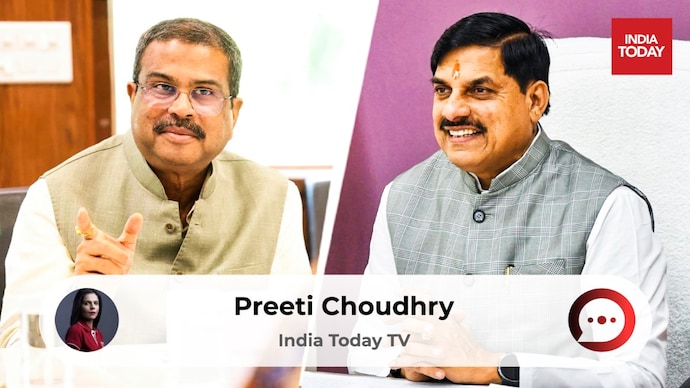
Journalism loses its purpose when it fails to create accountability and democracy is weakened when public anger is ignored, as seen in the absence of meaningful consequences for Dharmendra Pradhan and Mohan Yadav.
Should the Education Minister be replaced in a possible Cabinet reshuffle? No, that would send a terrible message.
Before politics, ideology, or identity blur judgment, two propositions should stand beyond debate -- not as questions, but as absolutes:
Journalism must make an impact.
People's anger must be seen, heard and validated.
The moment either of these becomes negotiable, two of democracy's most vital institutions begin to fail: the press and civil society. Journalism that does not produce impact is reduced to performance. A society that refuses to acknowledge public anger turns democracy into ritual rather than representation. If journalism cannot force accountability, it is useless. If citizens' grievances remain unanswered, democracy is a farce.
These lofty democratic ideas fray at the edges the moment personal politics, ideology and identity take centre stage.
Case in point: Education Minister Dharmendra Pradhan.
There is growing speculation that a Cabinet reshuffle is on the cards before the Monsoon Session of Parliament. Nothing has been confirmed, but one name consistently features in the conversation: Education Minister Dharmendra Pradhan.
Could he go? No one knows.
Should he go? In the wake of the NEET paper leak and the widespread concerns over irregularities in the CBSE on-screen evaluation system, many would argue that he should.
But if he does go, should it be because the government has finally decided to effect a change, or should it have been when the public demanded accountability?
While moral reference points would suggest the latter, we all know the scales tip where one's political ideology stands and for most, political ideology stands where political convenience sits.
The Education Minister should have stepped down when NEET aspirants took to the streets, flooded social media and filled television studios demanding answers after yet another examination scandal. He should have accepted responsibility when distraught CBSE students described the confusion, inconsistency and distress caused by the rollout of the digital marking system.
Ministerial accountability is meaningful only when it responds to public anger, not when it is dictated by political decisions or convenience. A resignation months later, folded into a Cabinet reshuffle, is not accountability. It is disrespect. Accountability loses its moral force when it arrives too late, where citizens are reduced to spectators rather than participants.
So, there is little point now. It should have happened before the opposition asked for it and much before a few cockroaches squatted at Jantar Mantar. It should have happened when the failure was evident and the people rightfully called it out.
When democratic certainties can no longer be treated as absolutes, what we witness is not merely the failure of an individual minister. It is an incident recorded in real time where one of democracy's most potent weapons fails to fire, in the case of Mr Dharmendra Pradhan, civil society.
Shifting focus to Madhya Pradesh Chief Minister Mohan Yadav: much before the national capital was plastered with hoardings heralding him as the man championing the cause of the Indian cheetah, a leading newspaper carried what would have been a damning report -- allegations of corruption.
Investigative reports allegedly revealed that since Mohan Yadav took office as Chief Minister in December 2023, his family members, along with their associated real-estate companies, purchased at least 137 plots spanning 168 acres in and around Ujjain.
The allegations, which ought to have triggered a thorough and independent investigation, were instead swiftly dismissed and rubbished by his party. The conversation on social media quickly shifted away from the substance of the report to claims that it was merely a "hit job" orchestrated by a disgruntled leader from Madhya Pradesh. In the process, the central question -- the veracity of the allegations, or the lack thereof -- slipped through the crevices of partisan politics.
The newspaper that published the investigation continued to pursue the story with follow-up reports. Yet the story gradually retreated from the front page to the inside pages before disappearing from public view altogether. The news cycle moved on; institutions did not.
In the end, the expos made virtually no impact. No meaningful inquiry followed, no institutional reckoning took place and no political accountability was demanded. Its disappearance from public discourse documented not merely the fading of a news story, but the failure of one of democracy's strongest pillars -- the ability of journalism to compel accountability and make an impact.
So, all the debate and discussion on India's rise or fall in international press freedom rankings, or how robust civil society appears in academic assessments, is ultimately useless until these two democratic tests cease to fail.
A free press is meaningful only when it makes an impact.
A healthy civil society exists only when public anger is not just acknowledged, but acted upon.
Should the Education Minister be replaced in a possible Cabinet reshuffle? No, that would send a terrible message.
Before politics, ideology, or identity blur judgment, two propositions should stand beyond debate -- not as questions, but as absolutes:
Journalism must make an impact.
People's anger must be seen, heard and validated.
The moment either of these becomes negotiable, two of democracy's most vital institutions begin to fail: the press and civil society. Journalism that does not produce impact is reduced to performance. A society that refuses to acknowledge public anger turns democracy into ritual rather than representation. If journalism cannot force accountability, it is useless. If citizens' grievances remain unanswered, democracy is a farce.
These lofty democratic ideas fray at the edges the moment personal politics, ideology and identity take centre stage.
Case in point: Education Minister Dharmendra Pradhan.
There is growing speculation that a Cabinet reshuffle is on the cards before the Monsoon Session of Parliament. Nothing has been confirmed, but one name consistently features in the conversation: Education Minister Dharmendra Pradhan.
Could he go? No one knows.
Should he go? In the wake of the NEET paper leak and the widespread concerns over irregularities in the CBSE on-screen evaluation system, many would argue that he should.
But if he does go, should it be because the government has finally decided to effect a change, or should it have been when the public demanded accountability?
While moral reference points would suggest the latter, we all know the scales tip where one's political ideology stands and for most, political ideology stands where political convenience sits.
The Education Minister should have stepped down when NEET aspirants took to the streets, flooded social media and filled television studios demanding answers after yet another examination scandal. He should have accepted responsibility when distraught CBSE students described the confusion, inconsistency and distress caused by the rollout of the digital marking system.
Ministerial accountability is meaningful only when it responds to public anger, not when it is dictated by political decisions or convenience. A resignation months later, folded into a Cabinet reshuffle, is not accountability. It is disrespect. Accountability loses its moral force when it arrives too late, where citizens are reduced to spectators rather than participants.
So, there is little point now. It should have happened before the opposition asked for it and much before a few cockroaches squatted at Jantar Mantar. It should have happened when the failure was evident and the people rightfully called it out.
When democratic certainties can no longer be treated as absolutes, what we witness is not merely the failure of an individual minister. It is an incident recorded in real time where one of democracy's most potent weapons fails to fire, in the case of Mr Dharmendra Pradhan, civil society.
Shifting focus to Madhya Pradesh Chief Minister Mohan Yadav: much before the national capital was plastered with hoardings heralding him as the man championing the cause of the Indian cheetah, a leading newspaper carried what would have been a damning report -- allegations of corruption.
Investigative reports allegedly revealed that since Mohan Yadav took office as Chief Minister in December 2023, his family members, along with their associated real-estate companies, purchased at least 137 plots spanning 168 acres in and around Ujjain.
The allegations, which ought to have triggered a thorough and independent investigation, were instead swiftly dismissed and rubbished by his party. The conversation on social media quickly shifted away from the substance of the report to claims that it was merely a "hit job" orchestrated by a disgruntled leader from Madhya Pradesh. In the process, the central question -- the veracity of the allegations, or the lack thereof -- slipped through the crevices of partisan politics.
The newspaper that published the investigation continued to pursue the story with follow-up reports. Yet the story gradually retreated from the front page to the inside pages before disappearing from public view altogether. The news cycle moved on; institutions did not.
In the end, the expos made virtually no impact. No meaningful inquiry followed, no institutional reckoning took place and no political accountability was demanded. Its disappearance from public discourse documented not merely the fading of a news story, but the failure of one of democracy's strongest pillars -- the ability of journalism to compel accountability and make an impact.
So, all the debate and discussion on India's rise or fall in international press freedom rankings, or how robust civil society appears in academic assessments, is ultimately useless until these two democratic tests cease to fail.
A free press is meaningful only when it makes an impact.
A healthy civil society exists only when public anger is not just acknowledged, but acted upon.

