Engine trouble: Why European engine firms are making a beeline to India
A Franco-British contest is underway for India's future jet fighters.
Nearly two decades ago, India began buying over $20 billion worth of defence hardware from the US— transport aircraft, helicopters and naval patrol aircraft. These sales came post the exuberance of the 2008 India-US nuclear deal which buried decades of mutual suspicion.
A senior bureaucrat in the Ministry of Defence reminded me of a South Block caveat— US helicopters, transport aircraft, yes, but no US fighter jets. “Because the US will never let India fight the wars it wants to fight.”
Arms sales are tools of geopolitical leverage even more so in the case of the US— Washington DC is careful about recipients of US arms. Even close allies are not allowed to independently service and support the equipment. Buyers are locked in a permanent state of dependence. Spares support is decided by the US administration. Routinely released public announcement of “support packages” for US arms unsubtly rub one fact in— without US support, the hardware is useless.
This is the case with jet engines, one of the most technically demanding engineering feats. This is why only four countries — the US, UK, France and Russia— have fully independent expertise to develop turbojets. Their expertise has produced technology breakthroughs like single crystal (SX) blades— turbine blades cast as one continuous, flawless crystal, enabling the blade to operate at temperatures exceeding 1,500 degrees Celsius.
Jet engines are huge geopolitical carrots — President Donald Trump sweetened a recent outreach to President Erdogan with an offer of GE-414 engines for Turkiye’s fifth generation ‘Kaan’ fighter.
China developed its own jet engines after decades of effort— the WS-10 powers the J-10/J-11 jets and the WS-15 powers the J-20 stealth jet. China, however, still relies on Russian engines for most of its fighter fleet and imports Western engines for commercial aircraft like the C919. India’s first indigenous jet fighter, the HF-24 Marut relied on a chronically underpowered Rolls-Royce engine. An indigenous jet engine program was never successfully pursued— jet engines remained India’s Achilles heel. Over the past few decades, India has license-built French, British and Russian jet engines for its jets, but never absorbed the technology to design and build its own engines.
A fourth engine-making country entered India’s imported engine club a few yeas ago, when Indian opted for US engines to power the Light Combat Aircraft (LCA) Tejas.
The GE-404 engines were meant to be a stopgap arrangement, until the arrival of an indigenous Kaveri jet engine. Over a decade ago, India’s defence establishment found the Kaveri engine to be underpowered. But rather than doubling down on its development by investing more resources into the program, the establishment took an easier flight path, they made the US engine the default setting.
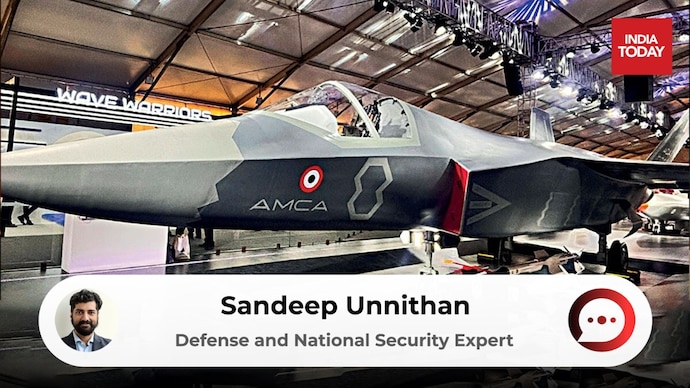
A ‘Lakshman Rekha’ was crossed. US engines ended up as the power plant for all of India’s fourth generation fighter jet programs— the LCA Mark 1A, the LCA-Mark 2, the proposed Twin Engined Deck Based Fighter (TEDBF) and the first 40 fifth generation Advanced Medium Combat Aircraft (AMCA) jets.
This dependence means the US for the first time has leverage over India’s fighter jets. What has followed are overdue engine deliveries and consequently, delayed fighter acquisitions. The IAF is facing an acute shortage of fighter squadrons as it is unable to replace retiring aircraft with new machines. The service plans to acquire at least 324 aircraft or 18 squadrons of the Tejas in all variants. All of these aircraft are to be powered by GE engines.
This April, Hindustan Aeronautics Ltd (HAL) penalised GE for delayed engine deliveries. The US firm has delivered only six of the 99 F404-IN20 engines ordered under a $700 million deal to power the Tejas Mk1A fighters. This resulted in a two-year delay in the delivery of the Mk1A jets. The newest shocker to hit the defence ministry — the price of GE Aerospace’s F414-INS6 turbofan — intended to power the first prototypes of the next-generation AMCA stealth fighter — has nearly tripled from its original prices of around Rs 70-80 crore per unit. Reports suggest each engine could now cost over Rs 200 core each.
GE attributes the cost surge to supply chain disruptions from Covid-19, shortages of aerospace-grade raw materials, and geopolitical pressures affecting supplier nations.
Perhaps there is some truth in this. But there is also the view that India’s US engine commitment has led to what is known in Indian politics as the ‘TINA factor’— There Is No Alternative. The engagement with the US is set to deepen despite the disputes. This year, GE Aerospace and HAL concluded a technical agreement to co-produce GE-F414 engines in India with nearly 80 per cent of manufacturing technology transfer.
A formal agreement is expected by the year end. Ten F414 prototypes were delivered last year for Tejas Mark II aircraft with first flights due in 2025. The F414 engines will also power the first 40 AMCA jets. And since fighter jets are built around their engines, the AMCA has been designed around the GE-414. Installing a new engine would mean further delays in redesigning the aircraft, testing and certification. It will further delay a fifth-generation fighter program that has been in the development pipeline for over a decade.
Last year, India decided to break with the US for developing fifth generation fighter aircraft engines. It announced that French jet engine maker Safran had been selected to partner with the DRDO to co-develop a brand-new, clean-sheet jet 120 kN thrust-class engine with India. The engine will be developed for the AMCA Mark II which will enter service a decade from now.
The DRDO considered both GE and Rolls-Royce for the fifth-generation fighter engine but ultimately chose the French engine company. A deal clincher was the fact that India would own the intellectual property for the power plant. This month, British engine maker Rolls-Royce brought in a counter-offer — a brand new 120 kN thrust-class engine to be jointly designed and manufactured in India, with the first test flight by 2034 and series production by 2036.
“ It is good that both European majors are in the fray. Rolls Royce’s technical offer is probably substantial. And they are the ones who helped the Chinese with the investment casting (needed for single crystal blade manufacture) part. But the degree of trust and warmth the French and Safran have with India is likely greater. Saurav Jha, CEO of D-Propulse, an Indian defence start up making rotating detonation engines (RDE).
If the Safran deal materialises as outlined, India could finally have its long-cherished dream of its own fighter jet engine for fifth generation aircraft. But it has to first cross the chasm of getting fourth-generation jet engines out of a finicky strategic partner the United States.
Nearly two decades ago, India began buying over $20 billion worth of defence hardware from the US— transport aircraft, helicopters and naval patrol aircraft. These sales came post the exuberance of the 2008 India-US nuclear deal which buried decades of mutual suspicion.
A senior bureaucrat in the Ministry of Defence reminded me of a South Block caveat— US helicopters, transport aircraft, yes, but no US fighter jets. “Because the US will never let India fight the wars it wants to fight.”
Arms sales are tools of geopolitical leverage even more so in the case of the US— Washington DC is careful about recipients of US arms. Even close allies are not allowed to independently service and support the equipment. Buyers are locked in a permanent state of dependence. Spares support is decided by the US administration. Routinely released public announcement of “support packages” for US arms unsubtly rub one fact in— without US support, the hardware is useless.
This is the case with jet engines, one of the most technically demanding engineering feats. This is why only four countries — the US, UK, France and Russia— have fully independent expertise to develop turbojets. Their expertise has produced technology breakthroughs like single crystal (SX) blades— turbine blades cast as one continuous, flawless crystal, enabling the blade to operate at temperatures exceeding 1,500 degrees Celsius.
Jet engines are huge geopolitical carrots — President Donald Trump sweetened a recent outreach to President Erdogan with an offer of GE-414 engines for Turkiye’s fifth generation ‘Kaan’ fighter.
China developed its own jet engines after decades of effort— the WS-10 powers the J-10/J-11 jets and the WS-15 powers the J-20 stealth jet. China, however, still relies on Russian engines for most of its fighter fleet and imports Western engines for commercial aircraft like the C919. India’s first indigenous jet fighter, the HF-24 Marut relied on a chronically underpowered Rolls-Royce engine. An indigenous jet engine program was never successfully pursued— jet engines remained India’s Achilles heel. Over the past few decades, India has license-built French, British and Russian jet engines for its jets, but never absorbed the technology to design and build its own engines.
A fourth engine-making country entered India’s imported engine club a few yeas ago, when Indian opted for US engines to power the Light Combat Aircraft (LCA) Tejas.
The GE-404 engines were meant to be a stopgap arrangement, until the arrival of an indigenous Kaveri jet engine. Over a decade ago, India’s defence establishment found the Kaveri engine to be underpowered. But rather than doubling down on its development by investing more resources into the program, the establishment took an easier flight path, they made the US engine the default setting.
A ‘Lakshman Rekha’ was crossed. US engines ended up as the power plant for all of India’s fourth generation fighter jet programs— the LCA Mark 1A, the LCA-Mark 2, the proposed Twin Engined Deck Based Fighter (TEDBF) and the first 40 fifth generation Advanced Medium Combat Aircraft (AMCA) jets.
This dependence means the US for the first time has leverage over India’s fighter jets. What has followed are overdue engine deliveries and consequently, delayed fighter acquisitions. The IAF is facing an acute shortage of fighter squadrons as it is unable to replace retiring aircraft with new machines. The service plans to acquire at least 324 aircraft or 18 squadrons of the Tejas in all variants. All of these aircraft are to be powered by GE engines.
This April, Hindustan Aeronautics Ltd (HAL) penalised GE for delayed engine deliveries. The US firm has delivered only six of the 99 F404-IN20 engines ordered under a $700 million deal to power the Tejas Mk1A fighters. This resulted in a two-year delay in the delivery of the Mk1A jets. The newest shocker to hit the defence ministry — the price of GE Aerospace’s F414-INS6 turbofan — intended to power the first prototypes of the next-generation AMCA stealth fighter — has nearly tripled from its original prices of around Rs 70-80 crore per unit. Reports suggest each engine could now cost over Rs 200 core each.
GE attributes the cost surge to supply chain disruptions from Covid-19, shortages of aerospace-grade raw materials, and geopolitical pressures affecting supplier nations.
Perhaps there is some truth in this. But there is also the view that India’s US engine commitment has led to what is known in Indian politics as the ‘TINA factor’— There Is No Alternative. The engagement with the US is set to deepen despite the disputes. This year, GE Aerospace and HAL concluded a technical agreement to co-produce GE-F414 engines in India with nearly 80 per cent of manufacturing technology transfer.
A formal agreement is expected by the year end. Ten F414 prototypes were delivered last year for Tejas Mark II aircraft with first flights due in 2025. The F414 engines will also power the first 40 AMCA jets. And since fighter jets are built around their engines, the AMCA has been designed around the GE-414. Installing a new engine would mean further delays in redesigning the aircraft, testing and certification. It will further delay a fifth-generation fighter program that has been in the development pipeline for over a decade.
Last year, India decided to break with the US for developing fifth generation fighter aircraft engines. It announced that French jet engine maker Safran had been selected to partner with the DRDO to co-develop a brand-new, clean-sheet jet 120 kN thrust-class engine with India. The engine will be developed for the AMCA Mark II which will enter service a decade from now.
The DRDO considered both GE and Rolls-Royce for the fifth-generation fighter engine but ultimately chose the French engine company. A deal clincher was the fact that India would own the intellectual property for the power plant. This month, British engine maker Rolls-Royce brought in a counter-offer — a brand new 120 kN thrust-class engine to be jointly designed and manufactured in India, with the first test flight by 2034 and series production by 2036.
“ It is good that both European majors are in the fray. Rolls Royce’s technical offer is probably substantial. And they are the ones who helped the Chinese with the investment casting (needed for single crystal blade manufacture) part. But the degree of trust and warmth the French and Safran have with India is likely greater. Saurav Jha, CEO of D-Propulse, an Indian defence start up making rotating detonation engines (RDE).
If the Safran deal materialises as outlined, India could finally have its long-cherished dream of its own fighter jet engine for fifth generation aircraft. But it has to first cross the chasm of getting fourth-generation jet engines out of a finicky strategic partner the United States.

