How India survived history's biggest oil shock
The closure of the Strait of Hormuz forced India to manage its biggest external energy shock in years. The ceasefire has reopened the route, but the fiscal, currency and energy-security costs remain.
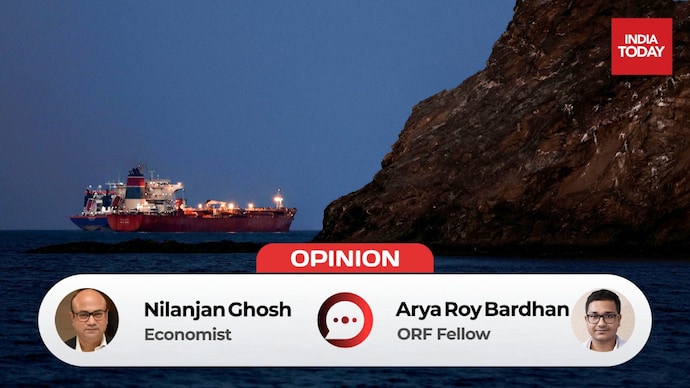


The unprecedented closure of the Strait of Hormuz in early 2026, triggered by the American and Israeli strikes on Iran, led to what the International Energy Agency (IEA) called the "largest supply disruption in the history of the global oil market". At this crucial juncture, when a fragile ceasefire reopens the Strait, it is important to review how India came through and to ask what the reprieve is actually worth. On Wednesday, however, US President Donald Trump declared that the US-Iran ceasefire was over.
While India imports around 88% of its crude oil needs, roughly 30% of the import volume passes through the Strait of Hormuz. This number provides a momentary respite, signifying a declining dependence on the Hormuz, through which previously 70% of crude imports passed. This was made possible by diversifying import channels from the US, Russia, West Africa, and Fujairah, UAE — all of which circumvented the Strait entirely — a trend the refiners further pursued during the war itself.
However, the situation with LPG makes things concerning. Ninety per cent of India's LPG imports transit the strait. Over half its LNG arrives from Qatar and the UAE via the same corridor; Qatar's Ras Laffan terminal was hit within days of the war, triggering force majeure. Fertiliser imports faced similar exposure. A chokepoint created at the Strait placed more than half of India's household fuel supply directly at risk.
LPG CRISIS: NEW DELHI'S RESPONSE MECHANISM
Instead of directly resorting to price control, New Delhi's first move was triage. Refineries were ordered to maximise LPG output, lifting domestic production by a quarter; commercial and industrial gas allocations were cut to protect India's 332 million domestic LPG connections, including 104 million subsidised Ujjwala accounts. A Natural Gas Control Order rationed fertiliser plants to 70% of normal supply rather than let a fuel shortage collapse into a food-price shock. Excise duty on petrol and diesel was cut by 10 per litre on March 27, and pump prices were frozen for 76 days, even as the underlying cost of crude more than doubled.
Restaurants, hotels and small industry absorbed the squeeze first; households absorbed it last, if at all, due to sectoral linkages. Where the state could not guarantee supply, households adjusted on their own, as seen in a spike in induction-stove sales amid fears of cylinder shortages.
The price data explain why the freeze was so costly to sustain. India's crude basket rose from $69 a barrel in February to $157 in March while global benchmarks touched $144. Global urea prices jumped 50%. Yet March's headline CPI came in at 3.40%, barely above February's 3.21%. Transport inflation registered zero, a measure of how much of the shock the government and refiners chose to eat rather than pass on. That gap could not be held indefinitely. CPI has since risen for five straight months, to 3.93% in May, as fuel-price hikes worked their way into transport costs, which flipped from zero to 1.75%.
Wholesale prices show the pipeline shock more starkly as WPI inflation reached 9.68% in May, with fuel and power costs up 30.33% and crude petroleum and natural gas up 61.51%. This divergence is a reminder that retail CPI was always the buffered number, not the raw one.
THE VISIBLE AND INVISIBLE COSTS
The shock-absorption strategy had a bill attached. The petroleum ministry put the combined daily under-recovery of oil marketing companies (OMCs) at Rs 2,400 crore on the day of the excise cut, with per-litre losses climbing to roughly Rs 105 on diesel and Rs 24 on petrol by early April. The State Bank of India estimated the excise cut itself would cost the exchequer close to Rs 1.1 lakh crore, or about $12 billion, in foregone revenue for the fiscal year.
The reckoning arrived on May 15, when the freeze lifted, and a series of four hikes (cumulatively around Rs 7.5 a litre) passed part of the burden to consumers, eleven weeks after the strait closed. The rupee, already sliding on tariff-related capital outflows, fell a further 4.9% after the Strait of Hormuz was closed, depreciating to 93 per dollar. The RBI spent $46 billion of reserves smoothing, not defending, the decline, prompting the IMF to reclassify India's exchange-rate regime from "stabilised" to "crawl-like". Reserves still stood at $682 billion, worth 11 months of import cover, when the ceasefire took effect.
However, this impact was not at all perceptible in domestic production parameters — on the contrary, it expanded. Full-year GDP grew at 7.7%, ahead of every forecast, and manufacturing — the sector most exposed to costlier fuel and feedstock — still expanded 10.7%, helped by public capex crowding in private investment. The strait's casualty was the trade balance (export minus import), where the current account deficit widened from roughly $95 billion to $120 billion over the year, attributable almost entirely to the oil import bill. The implication is clear: India paid for Hormuz in dollars and rupees, and not in growth or jobs, which provided the much-needed cushion to absorb the shock.
THE EXOGENOUS FORCES
Apart from India's own policy responses, a series of exogenous global interventions prevented the oil shock from having a cascading systemic impact on the Indian economy.
The IEA's record emergency release of around 400 million barrels from strategic reserves and China’s sharp reduction in crude imports (given its already massive built-up reserves) eased pressure on global markets. These were further complemented by Saudi Arabia and the UAE's diversion of millions of barrels of oil daily through pipelines that bypassed the Strait of Hormuz, and by the United States' increase in oil exports to record levels.
Since the world entered the crisis with a modest surplus of oil supply, these measures together prevented a far sharper spike in prices.
INFLATION CONTROL AND MACRO PRUDENCE
India also entered the crisis with initial economic cushions in place and macroeconomic parameters looking strong.
Inflation had fallen sharply during most of 2025, giving the RBI enough room to cut interest rates to boost private investment. With the onset of the crisis, the central bank resisted the temptation to raise rates to defend the rupee, recognising that higher interest rates would deter private investments and slow economic growth. Since inflation remained below 4%, comfortably within the RBI's tolerance range, the Monetary Policy Committee (MPC) treated the oil shock as temporary and kept its focus on supporting growth.
On the other hand, three sovereign upgrades (from R&I, S&P and Morningstar DBRS) in five months enhanced India's credibility, while fiscal consolidation to 4.4% of GDP bought room to cut excise duty without spooking bond markets. None of this was designed for Hormuz. Whether this should be attributed to visionary macroeconomic management or to dumb luck when the Hormuz Strait closed is a matter of speculation.
But the lesson is clear: A resilient economy, built on sound macroeconomic prudence, has a strong capacity to absorb exogenous shocks without triggering systemic disruptions. Had the closure held through summer, the reckoning would have been far worse.
A study by ORF projected a structural CPI shock of 4.48 percentage points, with prices of around 90% of tracked products rising more than 1% and crude oil alone responsible for 71% of the total impact. The chemical-fertiliser channel was the most dangerous, with a potential magnification of more than 90 times, threatening the next agricultural season. The IEA itself warned of a "red zone" in July and August, when the cushion of stock releases and demand destruction would have run out.
THE BATTLE IS OVER, BUT THE WAR CONTINUES
None of the concerns turned out to be true, fortunately, at least not yet. The June 15 memorandum reopens the Strait with a 60-day ceasefire window, the roadmap for which was laid out in the June 21 Geneva meeting. Oil prices have already eased, with Brent falling to around $72 a barrel. But this is only a pause, not a permanent settlement. Iran's nuclear programme remains unresolved, shipping companies are still charging higher war-risk premiums, and maritime traffic is yet to return to normal. Further, as the IEA has warned, the conflict will leave lasting scars on global energy security.
Even if peace holds, the economic costs cannot simply be reversed. Countries have already drawn down strategic oil reserves, governments have spent heavily to cushion the shock, and the rupee's depreciation will continue to raise India's import bill. Those costs remain even after oil tankers resume their normal routes.
The crisis also reinforced an important lesson for India. Long-term energy security cannot depend on a single route or a single region. India has already diversified nearly 70% of its crude imports, expanded long-term LNG and LPG partnerships with countries such as the US and Norway, and raised renewable energy to over half of its installed power capacity. These are structural safeguards that will remain valuable long after the ceasefire, because India's energy vulnerability was never about Iran alone. Peace in the Gulf may end the immediate crisis, but it does not eliminate the underlying risks.
(Nilanjan Ghosh is Vice President, and Arya Roy Bardhan is Junior Fellow at the Observer Research Foundation.)
The unprecedented closure of the Strait of Hormuz in early 2026, triggered by the American and Israeli strikes on Iran, led to what the International Energy Agency (IEA) called the "largest supply disruption in the history of the global oil market". At this crucial juncture, when a fragile ceasefire reopens the Strait, it is important to review how India came through and to ask what the reprieve is actually worth. On Wednesday, however, US President Donald Trump declared that the US-Iran ceasefire was over.
While India imports around 88% of its crude oil needs, roughly 30% of the import volume passes through the Strait of Hormuz. This number provides a momentary respite, signifying a declining dependence on the Hormuz, through which previously 70% of crude imports passed. This was made possible by diversifying import channels from the US, Russia, West Africa, and Fujairah, UAE — all of which circumvented the Strait entirely — a trend the refiners further pursued during the war itself.
However, the situation with LPG makes things concerning. Ninety per cent of India's LPG imports transit the strait. Over half its LNG arrives from Qatar and the UAE via the same corridor; Qatar's Ras Laffan terminal was hit within days of the war, triggering force majeure. Fertiliser imports faced similar exposure. A chokepoint created at the Strait placed more than half of India's household fuel supply directly at risk.
LPG CRISIS: NEW DELHI'S RESPONSE MECHANISM
Instead of directly resorting to price control, New Delhi's first move was triage. Refineries were ordered to maximise LPG output, lifting domestic production by a quarter; commercial and industrial gas allocations were cut to protect India's 332 million domestic LPG connections, including 104 million subsidised Ujjwala accounts. A Natural Gas Control Order rationed fertiliser plants to 70% of normal supply rather than let a fuel shortage collapse into a food-price shock. Excise duty on petrol and diesel was cut by 10 per litre on March 27, and pump prices were frozen for 76 days, even as the underlying cost of crude more than doubled.
Restaurants, hotels and small industry absorbed the squeeze first; households absorbed it last, if at all, due to sectoral linkages. Where the state could not guarantee supply, households adjusted on their own, as seen in a spike in induction-stove sales amid fears of cylinder shortages.
The price data explain why the freeze was so costly to sustain. India's crude basket rose from $69 a barrel in February to $157 in March while global benchmarks touched $144. Global urea prices jumped 50%. Yet March's headline CPI came in at 3.40%, barely above February's 3.21%. Transport inflation registered zero, a measure of how much of the shock the government and refiners chose to eat rather than pass on. That gap could not be held indefinitely. CPI has since risen for five straight months, to 3.93% in May, as fuel-price hikes worked their way into transport costs, which flipped from zero to 1.75%.
Wholesale prices show the pipeline shock more starkly as WPI inflation reached 9.68% in May, with fuel and power costs up 30.33% and crude petroleum and natural gas up 61.51%. This divergence is a reminder that retail CPI was always the buffered number, not the raw one.
THE VISIBLE AND INVISIBLE COSTS
The shock-absorption strategy had a bill attached. The petroleum ministry put the combined daily under-recovery of oil marketing companies (OMCs) at Rs 2,400 crore on the day of the excise cut, with per-litre losses climbing to roughly Rs 105 on diesel and Rs 24 on petrol by early April. The State Bank of India estimated the excise cut itself would cost the exchequer close to Rs 1.1 lakh crore, or about $12 billion, in foregone revenue for the fiscal year.
The reckoning arrived on May 15, when the freeze lifted, and a series of four hikes (cumulatively around Rs 7.5 a litre) passed part of the burden to consumers, eleven weeks after the strait closed. The rupee, already sliding on tariff-related capital outflows, fell a further 4.9% after the Strait of Hormuz was closed, depreciating to 93 per dollar. The RBI spent $46 billion of reserves smoothing, not defending, the decline, prompting the IMF to reclassify India's exchange-rate regime from "stabilised" to "crawl-like". Reserves still stood at $682 billion, worth 11 months of import cover, when the ceasefire took effect.
However, this impact was not at all perceptible in domestic production parameters — on the contrary, it expanded. Full-year GDP grew at 7.7%, ahead of every forecast, and manufacturing — the sector most exposed to costlier fuel and feedstock — still expanded 10.7%, helped by public capex crowding in private investment. The strait's casualty was the trade balance (export minus import), where the current account deficit widened from roughly $95 billion to $120 billion over the year, attributable almost entirely to the oil import bill. The implication is clear: India paid for Hormuz in dollars and rupees, and not in growth or jobs, which provided the much-needed cushion to absorb the shock.
THE EXOGENOUS FORCES
Apart from India's own policy responses, a series of exogenous global interventions prevented the oil shock from having a cascading systemic impact on the Indian economy.
The IEA's record emergency release of around 400 million barrels from strategic reserves and China’s sharp reduction in crude imports (given its already massive built-up reserves) eased pressure on global markets. These were further complemented by Saudi Arabia and the UAE's diversion of millions of barrels of oil daily through pipelines that bypassed the Strait of Hormuz, and by the United States' increase in oil exports to record levels.
Since the world entered the crisis with a modest surplus of oil supply, these measures together prevented a far sharper spike in prices.
INFLATION CONTROL AND MACRO PRUDENCE
India also entered the crisis with initial economic cushions in place and macroeconomic parameters looking strong.
Inflation had fallen sharply during most of 2025, giving the RBI enough room to cut interest rates to boost private investment. With the onset of the crisis, the central bank resisted the temptation to raise rates to defend the rupee, recognising that higher interest rates would deter private investments and slow economic growth. Since inflation remained below 4%, comfortably within the RBI's tolerance range, the Monetary Policy Committee (MPC) treated the oil shock as temporary and kept its focus on supporting growth.
On the other hand, three sovereign upgrades (from R&I, S&P and Morningstar DBRS) in five months enhanced India's credibility, while fiscal consolidation to 4.4% of GDP bought room to cut excise duty without spooking bond markets. None of this was designed for Hormuz. Whether this should be attributed to visionary macroeconomic management or to dumb luck when the Hormuz Strait closed is a matter of speculation.
But the lesson is clear: A resilient economy, built on sound macroeconomic prudence, has a strong capacity to absorb exogenous shocks without triggering systemic disruptions. Had the closure held through summer, the reckoning would have been far worse.
A study by ORF projected a structural CPI shock of 4.48 percentage points, with prices of around 90% of tracked products rising more than 1% and crude oil alone responsible for 71% of the total impact. The chemical-fertiliser channel was the most dangerous, with a potential magnification of more than 90 times, threatening the next agricultural season. The IEA itself warned of a "red zone" in July and August, when the cushion of stock releases and demand destruction would have run out.
THE BATTLE IS OVER, BUT THE WAR CONTINUES
None of the concerns turned out to be true, fortunately, at least not yet. The June 15 memorandum reopens the Strait with a 60-day ceasefire window, the roadmap for which was laid out in the June 21 Geneva meeting. Oil prices have already eased, with Brent falling to around $72 a barrel. But this is only a pause, not a permanent settlement. Iran's nuclear programme remains unresolved, shipping companies are still charging higher war-risk premiums, and maritime traffic is yet to return to normal. Further, as the IEA has warned, the conflict will leave lasting scars on global energy security.
Even if peace holds, the economic costs cannot simply be reversed. Countries have already drawn down strategic oil reserves, governments have spent heavily to cushion the shock, and the rupee's depreciation will continue to raise India's import bill. Those costs remain even after oil tankers resume their normal routes.
The crisis also reinforced an important lesson for India. Long-term energy security cannot depend on a single route or a single region. India has already diversified nearly 70% of its crude imports, expanded long-term LNG and LPG partnerships with countries such as the US and Norway, and raised renewable energy to over half of its installed power capacity. These are structural safeguards that will remain valuable long after the ceasefire, because India's energy vulnerability was never about Iran alone. Peace in the Gulf may end the immediate crisis, but it does not eliminate the underlying risks.
(Nilanjan Ghosh is Vice President, and Arya Roy Bardhan is Junior Fellow at the Observer Research Foundation.)

