Suave in Delhi, steadfast in Chennai: Vijay's quiet federal reset
CM Vijay's first two months in office suggest that Tamil Nadu's politics might be entering a new federal phase. While the state's positions on issues such as NEET, language and fiscal devolution remain unchanged, its engagement with the Prime Minister Narendra Modi-led Central government has become markedly more pragmatic.
The calendar at Fort St. George tells us it has been close to two months since May 10, 2026, when Tamil Nadu's political script underwent its most radical revision in nearly six decades. For the pundits who expected the new occupant of the Chief Minister's chair to treat state administration like a high-octane movie set complete with dramatic entry scenes and booming loudspeakers, the opening act has come as a subtle, rather quiet surprise. There have been no fiery soliloquies from the ramparts, no theatrical walkouts from national meetings, and absolutely no chest-thumping.
Instead, Tamil Nadu is witnessing a masterclass in suave transactional diplomacy. Chief Minister C Joseph Vijay has introduced a new dialect to Centre-State relations — one that has quietly retired the old, exhausting grammar of perpetual confrontation. For a national audience long accustomed to viewing Tamil Nadu as a stormy enclave of sub-nationalist friction, the shift is palpable.
The ideological battle lines remain firmly drawn, but the climate of engagement has fundamentally changed. The era of the megaphone has given way to the era of the memorandum, and Delhi is finding it rather difficult to say no to a young, sprightly gentleman who smiles, shakes hands, and systematically states his case.
THE DELHI DEBUT: CRAFT OVER CLAMOUR
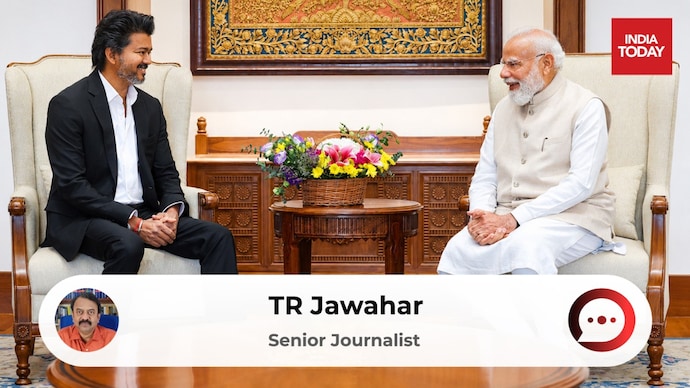
The first definitive indicator of this diplomatic reset arrived on May 27, 2026. On his maiden official visit to New Delhi, Chief Minister Vijay walked into the South Block for a twenty-five-minute meeting with Prime Minister Narendra Modi. There were no surrounding street protests, no hostile press briefings at the airport or Tamil Nadu House, and no grandstanding for the local cameras. It was a thoroughly professional affair.
Vijay presented a structured memorandum containing very specific, non-negotiable state interests: firm opposition to Karnataka's Mekedatu dam project, the immediate release of Tamil fishermen and their impounded boats from Sri Lankan custody, a renewed demand for NEET exemption, and the establishment of a DRDO centre in Tamil Nadu. He didn't go to New Delhi to declare an ideological war; he went to do business on behalf of his state.
This pragmatic craft was amplified during his second Delhi visit around June 11, 2026, for the 11th Governing Council meeting of NITI Aayog. Sitting at a table chaired by the Prime Minister, Vijay pitched a vision for Tamil Nadu to become a $1.5-trillion economy by 2036 in a precise professional presentation in the allotted few minutes.
He extended his outreach across the political aisle, holding meetings with opposition leaders like Sonia and Rahul Gandhi, while keeping institutional channels open with Home Minister Amit Shah.
His address to NITI Aayog perfectly encapsulated this dual track: "A developed India can be built only through empowered States, cooperative federalism, and inclusive development." The tone was constructive, yet the boundaries were explicitly marked. While previous administrations often used such national forums to stage dramatic walkouts or draft furious letters of dissent, Vijay chose to stay at the table, pressing for pending infrastructure funds with the calm composure of a seasoned corporate strategist.
LANGUAGE, NEET, AND THE ELIMINATION OF FRICTION
To the casual observer, Vijay's policy positions might look identical to the traditional Tamil Nadu political consensus. He remains unyielding on the core issues of language and education, yet the manner of handling them represents a structural departure from the past.
On the linguistic front, School Education Minister Raj Mohan recently clarified that a strict two-language policy (Tamil and English) remains a core principle of the Tamilaga Vettri Kazhagam (TVK) government, explicitly rejecting the three-language formula of the National Education Policy (NEP). On NEET, the administration's opposition remains firm, based on the argument that the centralised exam creates systemic inequalities for rural and economically weaker students. Even the Governor's address in the State Assembly, read verbatim, reflected this continuity of state policy.
The difference, however, lies in the complete absence of manufactured friction. Consider the brief controversy during the May swearing-in protocol, where initial reports alleged that the Thamizh Thai Vazhthu (the state anthem) had been subtly relegated after Vande Mataram and the National Anthem. In an earlier era, this would have triggered a three-week cycle of political hartals and competitive fasting. Under Vijay, the legal challenge was swiftly handled and quietly withdrawn by June once proper administrative priority was reaffirmed.
The old, exhausting "LKG-UKG fights" — to borrow a phrase from Vijay's own pre-election vocabulary — have been replaced by adult conversations. The state's linguistic and cultural identity is sought to be protected not by shouting down central ministers, or the customary display of black flags, but by ensuring that state protocols are executed with flawless institutional dignity. Where storms once raged, casual consistency now holds the line.
THE FEDERAL CANVAS: DEVOLUTION, DISINVESTMENT, AND DOLLARS
Beyond cultural symbolism, the TVK administration is focusing heavily on the dry, hard ledger books of federal finance. Here, Vijay's peaceable approach is being tested against core challenges, most notably the upcoming delimitation exercise under the Constitution (131st Amendment) Bill 2026.
The Chief Minister has drawn a firm red line against any population-based seat reallocation that penalizes southern states for their successful demographic management. He has rightly framed this not merely as a political issue, but as a cascading fiscal threat that could severely distort future financial devolution.
At the NITI Aayog council, Vijay went straight into the accounting details. He demanded the immediate release of Rs 3,284 crore in pending Samagra Shiksha education funds, explicitly asking that central assistance not be held hostage to NEP conditionalities. He followed this up with a request for Rs 2,283 crore for the Hogenakkal Phase-III water scheme, funding for the six-laning of the GST Road, a High-Speed Rail Corridor from Chennai to Kanyakumari, a second AIIMS in Coimbatore, and national recognition for the proposed Space Manufacturing Hub at Kulasekarapattinam.
Even on heavy industrial policy, the shift is telling. When the Centre announced plans to disinvest a 3% stake in the profit-making Neyveli Lignite Corporation (NLCIL), Vijay did not call for the familiar street blockades or tree-felling agitations. He addressed a formal, well-reasoned Demi-Official letter to Prime Minister Modi, pointing out that an enterprise built and expanded with the decades-long support of a host state should remain firmly under effective government ownership and control. It was an argument based on administrative merit and corporate logic, making it far more difficult for New Delhi to dismiss as routine regional bellyaching.
THE VANISHED SAFFRON: A NEW EQUATION IN TAMIL NADU
This fresh milieu has had a rather fascinating, almost comical impact on the local political landscape. For the past several years, political discourse in Tamil Nadu was defined by high-decibel shouting matches between the DMK and an aggressive, combative state BJP. Today, that entire dynamic has vanished faster than a bad box-office opening during a rainy season.
The tipping point arrived on June 5, 2026, when K Annamalai, after being omitted from the election candidate lists and holding brief meetings in Delhi, resigned his primary membership of the BJP. With his exit, the aggressive, street-fighting face of the saffron party in Tamil Nadu effectively collapsed. The local BJP finds itself in a state of sudden hibernation, virtually missing from the political frontlines. The party has lost its favourite target: the DMK's anti-Sanatana rhetoric. It is now left with absolutely nothing to counter Vijay's pious equidistance. Indeed, it would be ‘pseudo-secular’ to target someone who calls on Lord Muruga, Goddess Mookambika and Mother Mary with nary a contradiction while carrying the masses too on his side.
This significant shift has changed the rules of engagement for New Delhi. The central leadership of the BJP no longer possesses a local battering ram to deploy against Fort St George. Pragmatic cooperation with the TVK government has transformed from a political choice into an absolute administrative necessity.
The Centre can no longer play the role of an aggrieved long-distance critic; it must deal directly with a Chief Minister who has successfully separated his firm ideological opposition from day-to-day administrative functioning. Union Finance Minister Nirmala Sitharaman openly acknowledged this new reality, formally welcoming Vijay's constructive stance on Centre-State relations as a welcome opportunity for genuine cooperative federalism.
THE POINTER: FROM ONDRIYA ARASU TO INDIA ARASU
If one requires a single linguistic pointer to measure the vast distance travelled in the last sixty days, look no further than the terminology deployed by the state administration. The previous regime spent years fighting a semantic battle, insisting on using the term Ondriya Arasu (Union Government) in a manner that was frequently perceived by a national audience as a provocative, sub-nationalist dig. It was terminology used as a political weapon, designed to irritate Delhi rather than instruct it.
Under Chief Minister Vijay, that rhetorical gamesmanship has been quietly dropped in favour of India Arasu (Government of India). This is not a dilution of Tamil pride; it is a display of political maturity. By using standard, dignified terminology, the TVK administration has removed a completely unnecessary source of daily friction.
It is an acknowledgement of a simple, logical reality: you do not need to alter the name of the central government to fiercely defend your state's share of central taxes. This subtle linguistic shift has effectively dismantled a long-standing wall of rational hypocrisy—the bizarre stance of eagerly accepting secular, local community Pongal pots while aggressively rejecting any national connection to the very same harvest calendar celebrated across India. Vijay's vocabulary signals that Tamil Nadu is entirely confident in its unique identity and therefore feels absolutely no need to engage in petty semantic squabbles with New Delhi.
AN EARLY VERDICT: A GOOD AUGUR
Two months is admittedly a very brief running time in the five-year lifecycle of a government. The concrete "wins"—the actual release of the Rs 3,284 crore education bounty, a formal policy shift on NEET, or a final reversal on NLCIL disinvestment—are still navigating the bureaucratic pipelines of New Delhi. It would be an overstatement to declare total victory at this early stage. This is a steady start, an encouraging prelude, a "good augur" rather than a settled history.
Yet, the value of these two months lies in the complete rewriting of the political playbook. For years, the people of Tamil Nadu were told that the only way to safeguard their language, their culture, and their finances was through a state of permanent, exhausting outrage. We were treated to high-drama walkouts from the Governor's Makkal Bhavan, furious assembly resolutions that gathered dust in Delhi archives, and a constant, wearing sense of regional exceptionalism.
Chief Minister Vijay is demonstrating that there is an alternative, far more elegant path. One can be completely unyielding in language, uncompromising on delimitation, and fiercely protective of state autonomy without ever having to raise one's voice or stomp out of a meeting. He has replaced the old political megaphone with a precise corporate ledger.
The saffron brigade that once roared across local news channels has quietly faded into the background, and the new occupant of Fort St George simply smiles, shakes hands, states his case, and draws his red lines with ink rather than blood. It is a quiet, sophisticated strength that serves the material interests of Tamil Nadu far better than the old, loud storms. The pot is boiling, the ledger is balanced, and the state is moving forward with a calm, assured stride.
That by itself is a big 'Puratchi'— a revolution — offering real relief from the rational State's tiring tirades and trumpets that dominated decades of ear-splitting Dravidian Puratchi politics.
(TR Jawahar is a Chennai-based journalist and author of the book Why TN Is Forbidden Land: The State And Its State Of Affair Explained. His just-concluded exclusive 50-part series for indiatoday.in is a must-read for any student looking for a civilisational understanding of Tamil Nadu. Access his series, Time, Tide & Tamil, here)
The calendar at Fort St. George tells us it has been close to two months since May 10, 2026, when Tamil Nadu's political script underwent its most radical revision in nearly six decades. For the pundits who expected the new occupant of the Chief Minister's chair to treat state administration like a high-octane movie set complete with dramatic entry scenes and booming loudspeakers, the opening act has come as a subtle, rather quiet surprise. There have been no fiery soliloquies from the ramparts, no theatrical walkouts from national meetings, and absolutely no chest-thumping.
Instead, Tamil Nadu is witnessing a masterclass in suave transactional diplomacy. Chief Minister C Joseph Vijay has introduced a new dialect to Centre-State relations — one that has quietly retired the old, exhausting grammar of perpetual confrontation. For a national audience long accustomed to viewing Tamil Nadu as a stormy enclave of sub-nationalist friction, the shift is palpable.
The ideological battle lines remain firmly drawn, but the climate of engagement has fundamentally changed. The era of the megaphone has given way to the era of the memorandum, and Delhi is finding it rather difficult to say no to a young, sprightly gentleman who smiles, shakes hands, and systematically states his case.
THE DELHI DEBUT: CRAFT OVER CLAMOUR
The first definitive indicator of this diplomatic reset arrived on May 27, 2026. On his maiden official visit to New Delhi, Chief Minister Vijay walked into the South Block for a twenty-five-minute meeting with Prime Minister Narendra Modi. There were no surrounding street protests, no hostile press briefings at the airport or Tamil Nadu House, and no grandstanding for the local cameras. It was a thoroughly professional affair.
Vijay presented a structured memorandum containing very specific, non-negotiable state interests: firm opposition to Karnataka's Mekedatu dam project, the immediate release of Tamil fishermen and their impounded boats from Sri Lankan custody, a renewed demand for NEET exemption, and the establishment of a DRDO centre in Tamil Nadu. He didn't go to New Delhi to declare an ideological war; he went to do business on behalf of his state.
This pragmatic craft was amplified during his second Delhi visit around June 11, 2026, for the 11th Governing Council meeting of NITI Aayog. Sitting at a table chaired by the Prime Minister, Vijay pitched a vision for Tamil Nadu to become a $1.5-trillion economy by 2036 in a precise professional presentation in the allotted few minutes.
He extended his outreach across the political aisle, holding meetings with opposition leaders like Sonia and Rahul Gandhi, while keeping institutional channels open with Home Minister Amit Shah.
His address to NITI Aayog perfectly encapsulated this dual track: "A developed India can be built only through empowered States, cooperative federalism, and inclusive development." The tone was constructive, yet the boundaries were explicitly marked. While previous administrations often used such national forums to stage dramatic walkouts or draft furious letters of dissent, Vijay chose to stay at the table, pressing for pending infrastructure funds with the calm composure of a seasoned corporate strategist.
LANGUAGE, NEET, AND THE ELIMINATION OF FRICTION
To the casual observer, Vijay's policy positions might look identical to the traditional Tamil Nadu political consensus. He remains unyielding on the core issues of language and education, yet the manner of handling them represents a structural departure from the past.
On the linguistic front, School Education Minister Raj Mohan recently clarified that a strict two-language policy (Tamil and English) remains a core principle of the Tamilaga Vettri Kazhagam (TVK) government, explicitly rejecting the three-language formula of the National Education Policy (NEP). On NEET, the administration's opposition remains firm, based on the argument that the centralised exam creates systemic inequalities for rural and economically weaker students. Even the Governor's address in the State Assembly, read verbatim, reflected this continuity of state policy.
The difference, however, lies in the complete absence of manufactured friction. Consider the brief controversy during the May swearing-in protocol, where initial reports alleged that the Thamizh Thai Vazhthu (the state anthem) had been subtly relegated after Vande Mataram and the National Anthem. In an earlier era, this would have triggered a three-week cycle of political hartals and competitive fasting. Under Vijay, the legal challenge was swiftly handled and quietly withdrawn by June once proper administrative priority was reaffirmed.
The old, exhausting "LKG-UKG fights" — to borrow a phrase from Vijay's own pre-election vocabulary — have been replaced by adult conversations. The state's linguistic and cultural identity is sought to be protected not by shouting down central ministers, or the customary display of black flags, but by ensuring that state protocols are executed with flawless institutional dignity. Where storms once raged, casual consistency now holds the line.
THE FEDERAL CANVAS: DEVOLUTION, DISINVESTMENT, AND DOLLARS
Beyond cultural symbolism, the TVK administration is focusing heavily on the dry, hard ledger books of federal finance. Here, Vijay's peaceable approach is being tested against core challenges, most notably the upcoming delimitation exercise under the Constitution (131st Amendment) Bill 2026.
The Chief Minister has drawn a firm red line against any population-based seat reallocation that penalizes southern states for their successful demographic management. He has rightly framed this not merely as a political issue, but as a cascading fiscal threat that could severely distort future financial devolution.
At the NITI Aayog council, Vijay went straight into the accounting details. He demanded the immediate release of Rs 3,284 crore in pending Samagra Shiksha education funds, explicitly asking that central assistance not be held hostage to NEP conditionalities. He followed this up with a request for Rs 2,283 crore for the Hogenakkal Phase-III water scheme, funding for the six-laning of the GST Road, a High-Speed Rail Corridor from Chennai to Kanyakumari, a second AIIMS in Coimbatore, and national recognition for the proposed Space Manufacturing Hub at Kulasekarapattinam.
Even on heavy industrial policy, the shift is telling. When the Centre announced plans to disinvest a 3% stake in the profit-making Neyveli Lignite Corporation (NLCIL), Vijay did not call for the familiar street blockades or tree-felling agitations. He addressed a formal, well-reasoned Demi-Official letter to Prime Minister Modi, pointing out that an enterprise built and expanded with the decades-long support of a host state should remain firmly under effective government ownership and control. It was an argument based on administrative merit and corporate logic, making it far more difficult for New Delhi to dismiss as routine regional bellyaching.
THE VANISHED SAFFRON: A NEW EQUATION IN TAMIL NADU
This fresh milieu has had a rather fascinating, almost comical impact on the local political landscape. For the past several years, political discourse in Tamil Nadu was defined by high-decibel shouting matches between the DMK and an aggressive, combative state BJP. Today, that entire dynamic has vanished faster than a bad box-office opening during a rainy season.
The tipping point arrived on June 5, 2026, when K Annamalai, after being omitted from the election candidate lists and holding brief meetings in Delhi, resigned his primary membership of the BJP. With his exit, the aggressive, street-fighting face of the saffron party in Tamil Nadu effectively collapsed. The local BJP finds itself in a state of sudden hibernation, virtually missing from the political frontlines. The party has lost its favourite target: the DMK's anti-Sanatana rhetoric. It is now left with absolutely nothing to counter Vijay's pious equidistance. Indeed, it would be ‘pseudo-secular’ to target someone who calls on Lord Muruga, Goddess Mookambika and Mother Mary with nary a contradiction while carrying the masses too on his side.
This significant shift has changed the rules of engagement for New Delhi. The central leadership of the BJP no longer possesses a local battering ram to deploy against Fort St George. Pragmatic cooperation with the TVK government has transformed from a political choice into an absolute administrative necessity.
The Centre can no longer play the role of an aggrieved long-distance critic; it must deal directly with a Chief Minister who has successfully separated his firm ideological opposition from day-to-day administrative functioning. Union Finance Minister Nirmala Sitharaman openly acknowledged this new reality, formally welcoming Vijay's constructive stance on Centre-State relations as a welcome opportunity for genuine cooperative federalism.
THE POINTER: FROM ONDRIYA ARASU TO INDIA ARASU
If one requires a single linguistic pointer to measure the vast distance travelled in the last sixty days, look no further than the terminology deployed by the state administration. The previous regime spent years fighting a semantic battle, insisting on using the term Ondriya Arasu (Union Government) in a manner that was frequently perceived by a national audience as a provocative, sub-nationalist dig. It was terminology used as a political weapon, designed to irritate Delhi rather than instruct it.
Under Chief Minister Vijay, that rhetorical gamesmanship has been quietly dropped in favour of India Arasu (Government of India). This is not a dilution of Tamil pride; it is a display of political maturity. By using standard, dignified terminology, the TVK administration has removed a completely unnecessary source of daily friction.
It is an acknowledgement of a simple, logical reality: you do not need to alter the name of the central government to fiercely defend your state's share of central taxes. This subtle linguistic shift has effectively dismantled a long-standing wall of rational hypocrisy—the bizarre stance of eagerly accepting secular, local community Pongal pots while aggressively rejecting any national connection to the very same harvest calendar celebrated across India. Vijay's vocabulary signals that Tamil Nadu is entirely confident in its unique identity and therefore feels absolutely no need to engage in petty semantic squabbles with New Delhi.
AN EARLY VERDICT: A GOOD AUGUR
Two months is admittedly a very brief running time in the five-year lifecycle of a government. The concrete "wins"—the actual release of the Rs 3,284 crore education bounty, a formal policy shift on NEET, or a final reversal on NLCIL disinvestment—are still navigating the bureaucratic pipelines of New Delhi. It would be an overstatement to declare total victory at this early stage. This is a steady start, an encouraging prelude, a "good augur" rather than a settled history.
Yet, the value of these two months lies in the complete rewriting of the political playbook. For years, the people of Tamil Nadu were told that the only way to safeguard their language, their culture, and their finances was through a state of permanent, exhausting outrage. We were treated to high-drama walkouts from the Governor's Makkal Bhavan, furious assembly resolutions that gathered dust in Delhi archives, and a constant, wearing sense of regional exceptionalism.
Chief Minister Vijay is demonstrating that there is an alternative, far more elegant path. One can be completely unyielding in language, uncompromising on delimitation, and fiercely protective of state autonomy without ever having to raise one's voice or stomp out of a meeting. He has replaced the old political megaphone with a precise corporate ledger.
The saffron brigade that once roared across local news channels has quietly faded into the background, and the new occupant of Fort St George simply smiles, shakes hands, states his case, and draws his red lines with ink rather than blood. It is a quiet, sophisticated strength that serves the material interests of Tamil Nadu far better than the old, loud storms. The pot is boiling, the ledger is balanced, and the state is moving forward with a calm, assured stride.
That by itself is a big 'Puratchi'— a revolution — offering real relief from the rational State's tiring tirades and trumpets that dominated decades of ear-splitting Dravidian Puratchi politics.
(TR Jawahar is a Chennai-based journalist and author of the book Why TN Is Forbidden Land: The State And Its State Of Affair Explained. His just-concluded exclusive 50-part series for indiatoday.in is a must-read for any student looking for a civilisational understanding of Tamil Nadu. Access his series, Time, Tide & Tamil, here)

