Isro tests experimental Solve rocket motor to advance Gaganyaan mission
Isro has completed the first ground test of the solid motor for its experimental Solve launch vehicle. The result strengthens validation of Gaganyaan's crew module recovery system before crewed spaceflight.
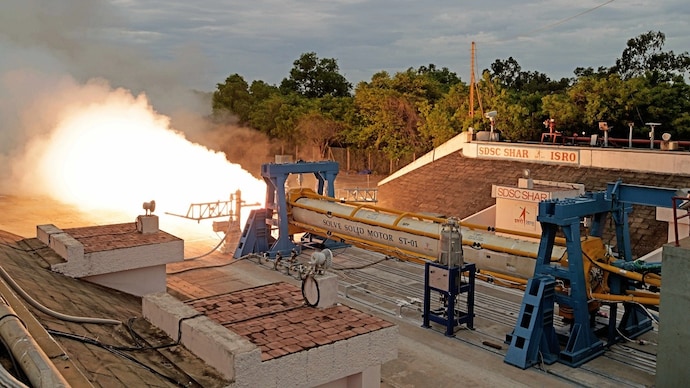
The Indian Space Research Organisation (Isro) has successfully conducted the first ground test of the solid motor that will power its experimental Sub-Orbital Launch Vehicle for Experiments (Solve), marking another major milestone in the development of technologies for India's maiden human spaceflight mission, Gaganyaan.
The static test was carried out at the Static Test Facility at the Satish Dhawan Space Centre (SDSC), Sriharikota. Isro said the motor performed as expected, with all key performance parameters meeting mission requirements.
The Solve rocket is being developed as a dedicated test platform to validate critical systems that will be used during Gaganyaan missions, particularly the crew module's parachute-based deceleration system.
Unlike an orbital launch vehicle, Solve is designed for sub-orbital flights. During these missions, the Gaganyaan crew module will be carried to an altitude of 10 to 17 kilometres before separating from the rocket.
Following separation, a carefully choreographed sequence of 10 parachutes will deploy to progressively slow the module before it splashes down safely into the sea.
The tests are intended to simulate a wide range of flight conditions that astronauts could encounter during future missions, allowing engineers to verify the reliability of the recovery system before India sends humans into space.
The solid propulsion stage of Solve has been derived from the PSLV strap-on booster motor, but incorporates several significant modifications to suit Gaganyaan's unique testing requirements.
These include the development of a slow burn-rate propellant to achieve the desired flight profile, a straight nozzle configuration, and a secondary injection thrust vector control system for improved steering during flight.
Isro said developing the Solve vehicle gives the agency greater flexibility to conduct repeated Gaganyaan test missions under varying conditions, enabling engineers to validate the crew module's performance before operational human spaceflight.
The latest achievement builds on a series of successful Gaganyaan qualification tests carried out over the past year, including integrated air-drop tests and parachute qualification trials.
The new test platform is expected to play a crucial role in validating astronaut recovery systems, one of the most critical safety elements of any human spaceflight programme.
Gaganyaan, India's first crewed space mission, aims to send a team of Indian astronauts into low-Earth orbit aboard an Indian rocket and safely return them to Earth, making India only the fourth nation to independently achieve human spaceflight.
The Indian Space Research Organisation (Isro) has successfully conducted the first ground test of the solid motor that will power its experimental Sub-Orbital Launch Vehicle for Experiments (Solve), marking another major milestone in the development of technologies for India's maiden human spaceflight mission, Gaganyaan.
The static test was carried out at the Static Test Facility at the Satish Dhawan Space Centre (SDSC), Sriharikota. Isro said the motor performed as expected, with all key performance parameters meeting mission requirements.
The Solve rocket is being developed as a dedicated test platform to validate critical systems that will be used during Gaganyaan missions, particularly the crew module's parachute-based deceleration system.
Unlike an orbital launch vehicle, Solve is designed for sub-orbital flights. During these missions, the Gaganyaan crew module will be carried to an altitude of 10 to 17 kilometres before separating from the rocket.
Following separation, a carefully choreographed sequence of 10 parachutes will deploy to progressively slow the module before it splashes down safely into the sea.
The tests are intended to simulate a wide range of flight conditions that astronauts could encounter during future missions, allowing engineers to verify the reliability of the recovery system before India sends humans into space.
The solid propulsion stage of Solve has been derived from the PSLV strap-on booster motor, but incorporates several significant modifications to suit Gaganyaan's unique testing requirements.
These include the development of a slow burn-rate propellant to achieve the desired flight profile, a straight nozzle configuration, and a secondary injection thrust vector control system for improved steering during flight.
Isro said developing the Solve vehicle gives the agency greater flexibility to conduct repeated Gaganyaan test missions under varying conditions, enabling engineers to validate the crew module's performance before operational human spaceflight.
The latest achievement builds on a series of successful Gaganyaan qualification tests carried out over the past year, including integrated air-drop tests and parachute qualification trials.
The new test platform is expected to play a crucial role in validating astronaut recovery systems, one of the most critical safety elements of any human spaceflight programme.
Gaganyaan, India's first crewed space mission, aims to send a team of Indian astronauts into low-Earth orbit aboard an Indian rocket and safely return them to Earth, making India only the fourth nation to independently achieve human spaceflight.

