As World Cup 2026 begins, space photos reveal a dramatically different Mexico
As the 2026 FIFA World Cup begins in Mexico, satellite images show how Guadalajara has changed since 1986. The pictures trace the city's expansion from farmland and volcanic terrain to a major tech hub hosting matches again.
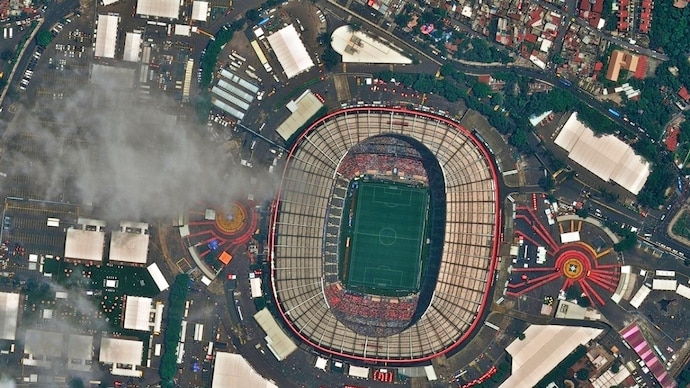
As the 2026 FIFA World Cup gets underway in Mexico, satellite images are offering a striking glimpse into how one of the tournament’s host cities has transformed over the four decades since it last welcomed football’s biggest event.
Guadalajara, Mexico’s second-largest metropolitan area, hosted World Cup matches in 1986 and is once again among the venues for the 2026 tournament. But images captured from space reveal a city that looks dramatically different from the one football fans knew 40 years ago.
When the World Cup came to Mexico in 1986, Guadalajara Stadium, now known as Estadio Akron, did not exist. Most matches were played at Jalisco Stadium, where one of the tournament’s most memorable encounters unfolded as France defeated Brazil in a dramatic quarterfinal penalty shootout.
Satellite imagery shows that the site occupied today by Guadalajara Stadium was farmland in 1986. The stadium, completed in 2010 as the home of Club Deportivo Guadalajara, now stands in the rapidly expanding municipality of Zapopan, northwest of the city.
The venue’s design was inspired by the nearby Sierra la Primavera volcanic complex, a rugged landscape of lava flows, volcanic domes, hot springs and steam vents.
Architects shaped the stadium to resemble a volcano emerging from the earth, with a grassy exterior and a white roof designed to evoke a volcanic cloud.
The surrounding landscape itself tells a geological story stretching back thousands of years. About 95,000 years ago, a massive volcanic eruption created a caldera roughly 11 kilometres wide.
Over time, tectonic activity, erosion and volcanic eruptions reshaped the terrain, leaving behind the distinctive domes and volcanic formations that characterise the region today.
While much of the volcanic landscape remains protected within the La Primavera Biosphere Reserve, urban expansion has surged around it. Guadalajara’s metropolitan population has more than doubled since 1986, growing from approximately 2.7 million residents to over 5.5 million today.
Zapopan has emerged as one of Mexico’s leading technology centres, earning the nickname “Mexico’s Silicon Valley.” Satellite images reveal sprawling industrial developments, including Guadalajara Technology Park, alongside extensive greenhouse agriculture that has expanded around the city’s outskirts.
World Cup excitement is particularly intense in Guadalajara, which is hosting the tournament for a third time. Earlier this year, the city unveiled a 9.5-metre bronze statue of football legend Pele to commemorate Brazil’s iconic 1970 World Cup campaign, during which several matches were played in the city.
Guadalajara will host four group-stage matches during the 2026 FIFA World Cup, bringing global attention back to a city whose transformation over the last four decades is clearly visible from space.
As the 2026 FIFA World Cup gets underway in Mexico, satellite images are offering a striking glimpse into how one of the tournament’s host cities has transformed over the four decades since it last welcomed football’s biggest event.
Guadalajara, Mexico’s second-largest metropolitan area, hosted World Cup matches in 1986 and is once again among the venues for the 2026 tournament. But images captured from space reveal a city that looks dramatically different from the one football fans knew 40 years ago.
When the World Cup came to Mexico in 1986, Guadalajara Stadium, now known as Estadio Akron, did not exist. Most matches were played at Jalisco Stadium, where one of the tournament’s most memorable encounters unfolded as France defeated Brazil in a dramatic quarterfinal penalty shootout.
Satellite imagery shows that the site occupied today by Guadalajara Stadium was farmland in 1986. The stadium, completed in 2010 as the home of Club Deportivo Guadalajara, now stands in the rapidly expanding municipality of Zapopan, northwest of the city.
The venue’s design was inspired by the nearby Sierra la Primavera volcanic complex, a rugged landscape of lava flows, volcanic domes, hot springs and steam vents.
Architects shaped the stadium to resemble a volcano emerging from the earth, with a grassy exterior and a white roof designed to evoke a volcanic cloud.
The surrounding landscape itself tells a geological story stretching back thousands of years. About 95,000 years ago, a massive volcanic eruption created a caldera roughly 11 kilometres wide.
Over time, tectonic activity, erosion and volcanic eruptions reshaped the terrain, leaving behind the distinctive domes and volcanic formations that characterise the region today.
While much of the volcanic landscape remains protected within the La Primavera Biosphere Reserve, urban expansion has surged around it. Guadalajara’s metropolitan population has more than doubled since 1986, growing from approximately 2.7 million residents to over 5.5 million today.
Zapopan has emerged as one of Mexico’s leading technology centres, earning the nickname “Mexico’s Silicon Valley.” Satellite images reveal sprawling industrial developments, including Guadalajara Technology Park, alongside extensive greenhouse agriculture that has expanded around the city’s outskirts.
World Cup excitement is particularly intense in Guadalajara, which is hosting the tournament for a third time. Earlier this year, the city unveiled a 9.5-metre bronze statue of football legend Pele to commemorate Brazil’s iconic 1970 World Cup campaign, during which several matches were played in the city.
Guadalajara will host four group-stage matches during the 2026 FIFA World Cup, bringing global attention back to a city whose transformation over the last four decades is clearly visible from space.

