Blue Origin blast: How far should rocket launch pads be from public? Ex-Isro chief answers
Blue Origin's New Glenn rocket exploded on May 28, 2026 during a static fire test in Florida, destroying the launch pad but killing no one. Former Isro chairman S Somanath explains why keeping spectators kilometres away from a rocket is a matter of survival.
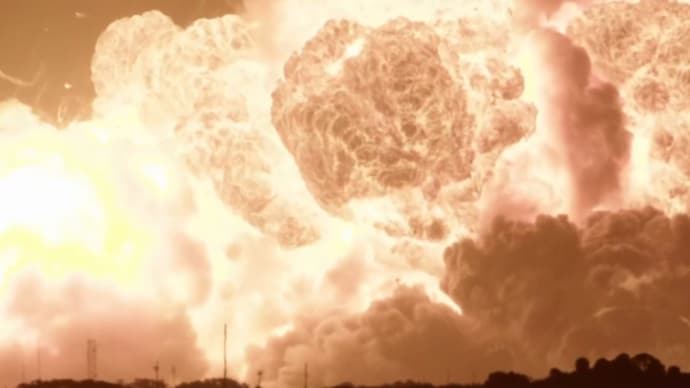
At Blue Origin’s Launch Complex 36 in Cape Canaveral, Florida, the countdown was supposed to end in data. On May 28, 2026, it ended in a fireball.
The New Glenn rocket developed by Jeff Bezos’s aerospace firm was bolted to the launchpad, its engines being tested on the ground in what should have been the most controlled moment in its entire journey to space.
Then the pad erupted in a fireball that could be seen for miles.
A static fire test, a routine pre-launch procedure in which a rocket’s engines are ignited while the vehicle remains bolted to the ground, ended in a fireball that swallowed the entire launchpad.
The New Glenn rocket, Blue Origin's heavy-lift vehicle designed to carry astronauts and cargo to the Moon as part of Nasa’s Artemis Program, was destroyed. The pad itself sustained serious damage.
What followed was the question that always follows a rocket explosion caught on camera: What was the casualty?
In Blue Origin's case, zero. There was no damage to life, only property.
WHY ROCKETS MUST BE AT A SAFE DISTANCE FROM SPECTATORS
Every modern spaceport in the world operates on a principle so fundamental that it is easy to forget it is a principle at all: the machine that leaves the Earth is, by design, incompatible with human presence at close range.
Dr S Somanath, the former chairman of the Indian Space Research Organisation (Isro) who led both the Chandrayaan-3 and Aditya-L1 missions, and who spent his entire career studying vibrations, including the forces that rockets generate, put it with characteristic directness.
“If you are too close to a rocket, you cannot live,” Dr Somanath told IndiaToday.in, on the sidelines of an event called Pint of Science.
That is not a metaphor. A rocket at full thrust generates acoustic energy, the scientific term for sound pressure, at levels that are biologically lethal within a certain radius.
The jet plume, or the column of superheated exhaust gases that drives the vehicle upward, reaches temperatures of several thousand degrees Celsius.
The overpressure wave, which is the pulse of compressed air that travels outward from an explosion or ignition like an invisible wall, is capable of rupturing eardrums, collapsing lungs, and shattering glass at distances that would strike most people as comfortably far.
This is why the viewing gallery at every launch site, the area where journalists, engineers, and invited guests watch liftoffs, is positioned kilometres away from the pad.
At the Satish Dhawan Space Centre in Sriharikota, the public viewing gallery sits approximately 6.5 kilometres from the launch pad, a distance calculated to keep spectators outside the combined reach of blast, heat, and debris in the event of a worst-case failure.
At Kennedy Space Center in Florida, the press site where journalists watch launches, sits approximately five kilometres from the nearest launch complex. For the most powerful rockets, exclusion zones extend much further.
THE SCIENCE OF BLAST ZONES
To understand why these distances are what they are, it helps to understand what a rocket actually does to the air around it.
When a rocket engine ignites, it burns enormous quantities of propellant, the fuel and oxidiser that combine in the combustion chamber to produce thrust.
The New Glenn rocket uses seven BE-4 engines, each burning liquid methane and liquid oxygen (LOx).
Liquid oxygen is a cryogenic oxidiser, which means it is stored at extremely low temperatures, around minus 183 degrees Celsius, to keep it in liquid form.
When mixed with methane and ignited, the chemical reaction releases energy on a scale that is difficult to describe in ordinary terms.
The hazard to people in the vicinity comes from three distinct sources.
The first is thermal radiation, or heat energy that travels outward from the flame as invisible electromagnetic waves, the same physical phenomenon that allows you to feel warmth from a fire across a room without touching it.
At close range to a rocket engine, this can cause severe burns in fractions of a second.
The second is the overpressure wave. When a large volume of gas is released rapidly, as happens in an explosion or in the exhaust of a rocket engine, the surrounding air is compressed outward in a wave.
This wave carries mechanical energy capable of causing internal injuries, particularly to organs that contain air pockets such as the lungs and ears.
The third is debris. Any structural failure, such as a pipe rupturing, a tank wall giving way, or a component fragmenting, turns pieces of metal into high-velocity projectiles.
A static fire test involves a vehicle filled with thousands of tonnes of propellant under extreme pressure.
The kinetic energy carried by debris from such a failure can be enormous.
Safe distance calculations account for all three simultaneously.
Engineers model the likely energy release in a worst-case scenario, which could be the complete, instantaneous release of all onboard propellant.
They then work backwards to determine at what distance the combined effect of heat, pressure, and debris falls below the threshold of survivable injury.
HOW SPACE AGENCIES CALCULATE SAFE DISTANCES
The methodology used to calculate launch exclusion zones draws on decades of accident investigation data, fluid dynamics modelling, and empirical testing.
Nasa, the European Space Agency, and Isro maintain their own detailed protocols, but the underlying physics is the same.
One critical concept is the blast radius, the distance within which the overpressure from an explosion exceeds a given threshold.
Physicists and safety engineers use a measurement called peak overpressure, expressed in kilopascals, to classify the severity of blast effects.
At approximately 35 kilopascals, glass windows shatter.
At 100 kilopascals, reinforced concrete structures can be damaged. Survivable human exposure in open air requires standing well outside even the lower thresholds.
For a vehicle the size of the New Glenn, approximately 98 metres tall, carrying hundreds of tonnes of cryogenic propellant, the calculations produce exclusion zones measured in kilometres, not metres.
Dr Somanath, whose career at Isro included overseeing the design of PSLV and GSLV launch systems, explained the acoustic dimension of the hazard with particular clarity.
“Rocket vibrations begin with acoustics. A rocket at Mach 10 is generating noise on a scale that is biologically lethal in proximity. The jet plume creates sound. The supersonic interaction of the body with air creates more. These sources are partly modelled, and partly understood,” Dr Somanath said.
Mach 10 means ten times the speed of sound. The noise produced by a rocket at that velocity is not merely unpleasant, it is a physical force.
Every 3 decibels (dB) of increase in sound level represents a doubling of acoustic energy.
A rocket at full thrust produces sound levels well above 180 decibels at close range.
Human hearing sustains permanent damage above roughly 140 decibels.
The distance required to reduce that figure to survivable levels is considerable.
WHAT DR SOMANATH SAYS ABOUT ROCKET VIBRATIONS
The conversation with Dr Somanath took place before a public science talk he gave as part of Pint of Science 2026 in May, before the Blue Origin test fire mishap.
He was relaxed, unhurried, and willing to explain the honest version of what rocket engineering involves.
His core point was that rockets are fundamentally acoustic machines. The danger they represent is not only the danger of an explosion. It is the danger of sound itself, at intensities that most people are not required to understand in everyday life.
“That noise becomes vibration. And that vibration reaches every joint, connection, fuel line and electronic component on board. A joint that opens and leaks cannot be sealed. In a mission carrying a satellite to orbit, any single failure of this kind ends everything, permanently and without appeal,” Dr Somanath tells IndiaToday.in.
He described the reverberation chambers used at Isro’s test facilities: enormous concrete buildings in which acoustic loads more severe than any actual launch are generated deliberately, to test whether every component can survive what it will face in flight.
These facilities use vibration shakers capable of generating 25 to 30 tons of force, subjecting rocket sections to conditions that would destroy most structures.
“Vibration failures are very, very common. Much of this is addressed on the ground. But sometimes, when confidence is low, we overdo it,” Dr Somanath tells IndiaToday.in.
The governing principle, he explained, is to test at a minimum of 3 dB above the predicted flight environment, or double the energy generated during a rocket launch.
The margin exists because the real world never matches the model exactly. It is also what keeps the people far from the pad alive when something goes wrong.
He noted that there have been real in-flight failures attributable to vibration: joints opening under acoustic loading, connectors detaching. When he hinted that a recent failure might be attributable to exactly this cause, he pulled back carefully.
“Possibly one of the failures of recent times could be attributed to that. I don't, and I can't claim or talk about it,” Dr Somanath tells IndiaToday.in.
HOW BLUE ORIGIN ENSURED THE SAFETY OF SPECTATORS
On May 28, when the New Glenn fireball lit up the Florida sky, there were no spectators within the hazard zone.
Launch Complex 36 was cleared of all non-essential personnel before the static fire test began, in accordance with established pre-test protocols.
The launch viewing area, several kilometres from the pad, was not in use for a ground test.
It is impossible to say with certainty that the exclusion zone prevented a specific casualty on that specific day.
Safety protocols eliminate exposure; they do not produce counterfactuals. But the principle at work is not speculative. It is engineering.
Blue Origin confirmed no fatalities following the incident. The explosion was dramatic enough to be seen from miles away.
The damage to Launch Complex 36 was described as significant, requiring extensive assessment before the programme could resume. The vehicle was a total loss.
And yet there were no deaths. The distance worked.
The decision to put the viewing gallery kilometres from the pad, to clear the area before ignition tests, to route access roads away from propellant storage. None of these are bureaucratic inconveniences.
They are the applied consequence of understanding exactly what a rocket does to the space around it.
THE FUTURE OF LAUNCH SAFETY
As rockets become more powerful and launches become more frequent, the science of launch safety is evolving.
New materials and computational modelling now allow engineers to predict blast zones with greater precision than was possible a decade ago.
Acoustic suppression systems, in which vast quantities of water are released onto the launchpad immediately before ignition, are now standard at major launch facilities.
The water absorbs acoustic energy, essentially converting destructive sound waves into heat, and reduces the structural load on both the vehicle and the pad.
But the fundamental limit remains. No amount of engineering eliminates the hazard of a catastrophic propellant release.
It only manages it, contains it, moves the dangerous boundary outward to a point where human beings are no longer within reach.
Dr Somanath, who designed against failure for his entire career, described isolation as the foundational principle of managing energy in complex systems.
“When there is too much vibration, you need to isolate. You create barriers so it does not pass to the other side,” Dr Somanath tells IndiaToday.in.
The launch exclusion zone is, in this sense, the largest and most consequential isolation barrier in spaceflight. It is the barrier between the machine and the person. Between the energy released and the body that cannot absorb it.
The New Glenn explosion will be investigated thoroughly.
The data from thousands of sensors monitoring the test in the milliseconds before the failure will be analysed.
The cause will eventually be found, whether it is a material defect, a design flaw, a control system error, or the kind of unpredicted vibration event that Dr Somanath described with such characteristic equanimity.
The programme will resume, the pad will be rebuilt, and another rocket will stand on another launchpad and make the same impossible noise.
And the viewing gallery will be exactly where it has always been. Far enough away.
At Blue Origin’s Launch Complex 36 in Cape Canaveral, Florida, the countdown was supposed to end in data. On May 28, 2026, it ended in a fireball.
The New Glenn rocket developed by Jeff Bezos’s aerospace firm was bolted to the launchpad, its engines being tested on the ground in what should have been the most controlled moment in its entire journey to space.
Then the pad erupted in a fireball that could be seen for miles.
A static fire test, a routine pre-launch procedure in which a rocket’s engines are ignited while the vehicle remains bolted to the ground, ended in a fireball that swallowed the entire launchpad.
The New Glenn rocket, Blue Origin's heavy-lift vehicle designed to carry astronauts and cargo to the Moon as part of Nasa’s Artemis Program, was destroyed. The pad itself sustained serious damage.
What followed was the question that always follows a rocket explosion caught on camera: What was the casualty?
In Blue Origin's case, zero. There was no damage to life, only property.
WHY ROCKETS MUST BE AT A SAFE DISTANCE FROM SPECTATORS
Every modern spaceport in the world operates on a principle so fundamental that it is easy to forget it is a principle at all: the machine that leaves the Earth is, by design, incompatible with human presence at close range.
Dr S Somanath, the former chairman of the Indian Space Research Organisation (Isro) who led both the Chandrayaan-3 and Aditya-L1 missions, and who spent his entire career studying vibrations, including the forces that rockets generate, put it with characteristic directness.
“If you are too close to a rocket, you cannot live,” Dr Somanath told IndiaToday.in, on the sidelines of an event called Pint of Science.
That is not a metaphor. A rocket at full thrust generates acoustic energy, the scientific term for sound pressure, at levels that are biologically lethal within a certain radius.
The jet plume, or the column of superheated exhaust gases that drives the vehicle upward, reaches temperatures of several thousand degrees Celsius.
The overpressure wave, which is the pulse of compressed air that travels outward from an explosion or ignition like an invisible wall, is capable of rupturing eardrums, collapsing lungs, and shattering glass at distances that would strike most people as comfortably far.
This is why the viewing gallery at every launch site, the area where journalists, engineers, and invited guests watch liftoffs, is positioned kilometres away from the pad.
At the Satish Dhawan Space Centre in Sriharikota, the public viewing gallery sits approximately 6.5 kilometres from the launch pad, a distance calculated to keep spectators outside the combined reach of blast, heat, and debris in the event of a worst-case failure.
At Kennedy Space Center in Florida, the press site where journalists watch launches, sits approximately five kilometres from the nearest launch complex. For the most powerful rockets, exclusion zones extend much further.
THE SCIENCE OF BLAST ZONES
To understand why these distances are what they are, it helps to understand what a rocket actually does to the air around it.
When a rocket engine ignites, it burns enormous quantities of propellant, the fuel and oxidiser that combine in the combustion chamber to produce thrust.
The New Glenn rocket uses seven BE-4 engines, each burning liquid methane and liquid oxygen (LOx).
Liquid oxygen is a cryogenic oxidiser, which means it is stored at extremely low temperatures, around minus 183 degrees Celsius, to keep it in liquid form.
When mixed with methane and ignited, the chemical reaction releases energy on a scale that is difficult to describe in ordinary terms.
The hazard to people in the vicinity comes from three distinct sources.
The first is thermal radiation, or heat energy that travels outward from the flame as invisible electromagnetic waves, the same physical phenomenon that allows you to feel warmth from a fire across a room without touching it.
At close range to a rocket engine, this can cause severe burns in fractions of a second.
The second is the overpressure wave. When a large volume of gas is released rapidly, as happens in an explosion or in the exhaust of a rocket engine, the surrounding air is compressed outward in a wave.
This wave carries mechanical energy capable of causing internal injuries, particularly to organs that contain air pockets such as the lungs and ears.
The third is debris. Any structural failure, such as a pipe rupturing, a tank wall giving way, or a component fragmenting, turns pieces of metal into high-velocity projectiles.
A static fire test involves a vehicle filled with thousands of tonnes of propellant under extreme pressure.
The kinetic energy carried by debris from such a failure can be enormous.
Safe distance calculations account for all three simultaneously.
Engineers model the likely energy release in a worst-case scenario, which could be the complete, instantaneous release of all onboard propellant.
They then work backwards to determine at what distance the combined effect of heat, pressure, and debris falls below the threshold of survivable injury.
HOW SPACE AGENCIES CALCULATE SAFE DISTANCES
The methodology used to calculate launch exclusion zones draws on decades of accident investigation data, fluid dynamics modelling, and empirical testing.
Nasa, the European Space Agency, and Isro maintain their own detailed protocols, but the underlying physics is the same.
One critical concept is the blast radius, the distance within which the overpressure from an explosion exceeds a given threshold.
Physicists and safety engineers use a measurement called peak overpressure, expressed in kilopascals, to classify the severity of blast effects.
At approximately 35 kilopascals, glass windows shatter.
At 100 kilopascals, reinforced concrete structures can be damaged. Survivable human exposure in open air requires standing well outside even the lower thresholds.
For a vehicle the size of the New Glenn, approximately 98 metres tall, carrying hundreds of tonnes of cryogenic propellant, the calculations produce exclusion zones measured in kilometres, not metres.
Dr Somanath, whose career at Isro included overseeing the design of PSLV and GSLV launch systems, explained the acoustic dimension of the hazard with particular clarity.
“Rocket vibrations begin with acoustics. A rocket at Mach 10 is generating noise on a scale that is biologically lethal in proximity. The jet plume creates sound. The supersonic interaction of the body with air creates more. These sources are partly modelled, and partly understood,” Dr Somanath said.
Mach 10 means ten times the speed of sound. The noise produced by a rocket at that velocity is not merely unpleasant, it is a physical force.
Every 3 decibels (dB) of increase in sound level represents a doubling of acoustic energy.
A rocket at full thrust produces sound levels well above 180 decibels at close range.
Human hearing sustains permanent damage above roughly 140 decibels.
The distance required to reduce that figure to survivable levels is considerable.
WHAT DR SOMANATH SAYS ABOUT ROCKET VIBRATIONS
The conversation with Dr Somanath took place before a public science talk he gave as part of Pint of Science 2026 in May, before the Blue Origin test fire mishap.
He was relaxed, unhurried, and willing to explain the honest version of what rocket engineering involves.
His core point was that rockets are fundamentally acoustic machines. The danger they represent is not only the danger of an explosion. It is the danger of sound itself, at intensities that most people are not required to understand in everyday life.
“That noise becomes vibration. And that vibration reaches every joint, connection, fuel line and electronic component on board. A joint that opens and leaks cannot be sealed. In a mission carrying a satellite to orbit, any single failure of this kind ends everything, permanently and without appeal,” Dr Somanath tells IndiaToday.in.
He described the reverberation chambers used at Isro’s test facilities: enormous concrete buildings in which acoustic loads more severe than any actual launch are generated deliberately, to test whether every component can survive what it will face in flight.
These facilities use vibration shakers capable of generating 25 to 30 tons of force, subjecting rocket sections to conditions that would destroy most structures.
“Vibration failures are very, very common. Much of this is addressed on the ground. But sometimes, when confidence is low, we overdo it,” Dr Somanath tells IndiaToday.in.
The governing principle, he explained, is to test at a minimum of 3 dB above the predicted flight environment, or double the energy generated during a rocket launch.
The margin exists because the real world never matches the model exactly. It is also what keeps the people far from the pad alive when something goes wrong.
He noted that there have been real in-flight failures attributable to vibration: joints opening under acoustic loading, connectors detaching. When he hinted that a recent failure might be attributable to exactly this cause, he pulled back carefully.
“Possibly one of the failures of recent times could be attributed to that. I don't, and I can't claim or talk about it,” Dr Somanath tells IndiaToday.in.
HOW BLUE ORIGIN ENSURED THE SAFETY OF SPECTATORS
On May 28, when the New Glenn fireball lit up the Florida sky, there were no spectators within the hazard zone.
Launch Complex 36 was cleared of all non-essential personnel before the static fire test began, in accordance with established pre-test protocols.
The launch viewing area, several kilometres from the pad, was not in use for a ground test.
It is impossible to say with certainty that the exclusion zone prevented a specific casualty on that specific day.
Safety protocols eliminate exposure; they do not produce counterfactuals. But the principle at work is not speculative. It is engineering.
Blue Origin confirmed no fatalities following the incident. The explosion was dramatic enough to be seen from miles away.
The damage to Launch Complex 36 was described as significant, requiring extensive assessment before the programme could resume. The vehicle was a total loss.
And yet there were no deaths. The distance worked.
The decision to put the viewing gallery kilometres from the pad, to clear the area before ignition tests, to route access roads away from propellant storage. None of these are bureaucratic inconveniences.
They are the applied consequence of understanding exactly what a rocket does to the space around it.
THE FUTURE OF LAUNCH SAFETY
As rockets become more powerful and launches become more frequent, the science of launch safety is evolving.
New materials and computational modelling now allow engineers to predict blast zones with greater precision than was possible a decade ago.
Acoustic suppression systems, in which vast quantities of water are released onto the launchpad immediately before ignition, are now standard at major launch facilities.
The water absorbs acoustic energy, essentially converting destructive sound waves into heat, and reduces the structural load on both the vehicle and the pad.
But the fundamental limit remains. No amount of engineering eliminates the hazard of a catastrophic propellant release.
It only manages it, contains it, moves the dangerous boundary outward to a point where human beings are no longer within reach.
Dr Somanath, who designed against failure for his entire career, described isolation as the foundational principle of managing energy in complex systems.
“When there is too much vibration, you need to isolate. You create barriers so it does not pass to the other side,” Dr Somanath tells IndiaToday.in.
The launch exclusion zone is, in this sense, the largest and most consequential isolation barrier in spaceflight. It is the barrier between the machine and the person. Between the energy released and the body that cannot absorb it.
The New Glenn explosion will be investigated thoroughly.
The data from thousands of sensors monitoring the test in the milliseconds before the failure will be analysed.
The cause will eventually be found, whether it is a material defect, a design flaw, a control system error, or the kind of unpredicted vibration event that Dr Somanath described with such characteristic equanimity.
The programme will resume, the pad will be rebuilt, and another rocket will stand on another launchpad and make the same impossible noise.
And the viewing gallery will be exactly where it has always been. Far enough away.

