Blue Origin redesigns launch pad destroyed in New Glenn explosion
Blue Origin has begun rebuilding Launch Complex 36A after the New Glenn explosion destroyed the pad systems. The redesigned hybrid setup is meant to speed up operations as the company investigates the blast and targets a return before end-2026.
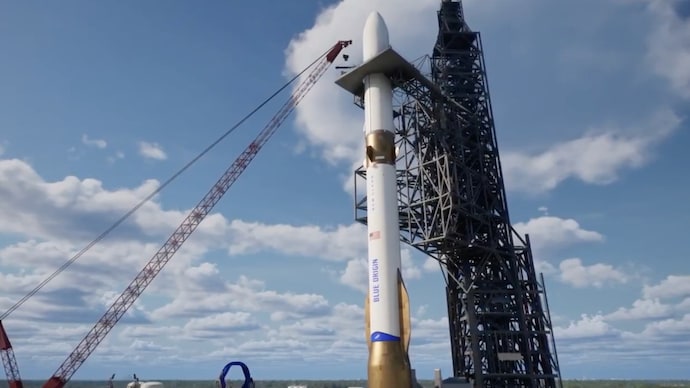
Just over a month after a massive explosion destroyed its New Glenn rocket and severely damaged its launch infrastructure, Blue Origin has begun rebuilding its launch pad, but this time with a completely different design aimed at making future launches faster and more efficient.
The company's 320-foot (98-metre) New Glenn rocket exploded on May 28 during a routine engine test at Launch Complex 36A (LC-36A) at Florida's Cape Canaveral Space Force Station.
The blast destroyed the rocket and heavily damaged critical ground equipment, including the launch pad's lightning tower and the transporter-erector, the giant structure used to carry the rocket to the pad and raise it into a vertical position before launch.
Blue Origin CEO Dave Limp announced that debris removal has been completed and reconstruction of the launch pad is now underway. However, the rebuilt pad will not be an exact replica of the original.
Instead, Blue Origin is introducing a new "horizontal-vertical hybrid" launch system, fundamentally changing how New Glenn rockets are prepared for flight.
Under the previous design, the transporter-erector carried the fully assembled rocket from the integration facility to the launch pad before lifting it into a vertical position.
The new approach eliminates the transporter-erector altogether.
Instead, engineers will assemble the rocket horizontally inside the integration facility and transport it to the launch pad. Once there, a large crane will lift the integrated rocket upright. The payload, such as satellites or spacecraft, will then be attached after the vehicle is standing vertically on the launch pad.
According to Limp, the new process not only simplifies operations but is also expected to increase Blue Origin's launch cadence, allowing the company to fly New Glenn missions more frequently.
Interestingly, Blue Origin had already planned to use this hybrid concept for the next-generation New Glenn 9X4 rocket.
The current 7X2 version of New Glenn is capable of carrying about 45 metric tonnes to low-Earth orbit. The future 9X4 variant will significantly boost that capacity to 70 metric tonnes while featuring a larger payload fairing to accommodate bigger satellites and deep-space missions.
The same hybrid launch architecture is also being incorporated into Launch Complex 36B, a second launch pad currently under development for the upgraded rocket.
Meanwhile, Blue Origin's investigation into the May 28 explosion is continuing. Limp said the rocket was equipped with extensive cameras and sensors that have provided engineers with a detailed record of the incident.
Early analysis suggests the anomaly originated in the aft section of the first stage, although investigators are still working to identify the exact root cause.
Despite the setback, Blue Origin remains confident it can return New Glenn to flight before the end of 2026, marking a crucial step in the company's efforts to compete with SpaceX in the growing commercial heavy-lift launch market.
Just over a month after a massive explosion destroyed its New Glenn rocket and severely damaged its launch infrastructure, Blue Origin has begun rebuilding its launch pad, but this time with a completely different design aimed at making future launches faster and more efficient.
The company's 320-foot (98-metre) New Glenn rocket exploded on May 28 during a routine engine test at Launch Complex 36A (LC-36A) at Florida's Cape Canaveral Space Force Station.
The blast destroyed the rocket and heavily damaged critical ground equipment, including the launch pad's lightning tower and the transporter-erector, the giant structure used to carry the rocket to the pad and raise it into a vertical position before launch.
Blue Origin CEO Dave Limp announced that debris removal has been completed and reconstruction of the launch pad is now underway. However, the rebuilt pad will not be an exact replica of the original.
Instead, Blue Origin is introducing a new "horizontal-vertical hybrid" launch system, fundamentally changing how New Glenn rockets are prepared for flight.
Under the previous design, the transporter-erector carried the fully assembled rocket from the integration facility to the launch pad before lifting it into a vertical position.
The new approach eliminates the transporter-erector altogether.
Instead, engineers will assemble the rocket horizontally inside the integration facility and transport it to the launch pad. Once there, a large crane will lift the integrated rocket upright. The payload, such as satellites or spacecraft, will then be attached after the vehicle is standing vertically on the launch pad.
According to Limp, the new process not only simplifies operations but is also expected to increase Blue Origin's launch cadence, allowing the company to fly New Glenn missions more frequently.
Interestingly, Blue Origin had already planned to use this hybrid concept for the next-generation New Glenn 9X4 rocket.
The current 7X2 version of New Glenn is capable of carrying about 45 metric tonnes to low-Earth orbit. The future 9X4 variant will significantly boost that capacity to 70 metric tonnes while featuring a larger payload fairing to accommodate bigger satellites and deep-space missions.
The same hybrid launch architecture is also being incorporated into Launch Complex 36B, a second launch pad currently under development for the upgraded rocket.
Meanwhile, Blue Origin's investigation into the May 28 explosion is continuing. Limp said the rocket was equipped with extensive cameras and sensors that have provided engineers with a detailed record of the incident.
Early analysis suggests the anomaly originated in the aft section of the first stage, although investigators are still working to identify the exact root cause.
Despite the setback, Blue Origin remains confident it can return New Glenn to flight before the end of 2026, marking a crucial step in the company's efforts to compete with SpaceX in the growing commercial heavy-lift launch market.

