Caracas sky turns blood-red days after deadly Venezuela earthquakes. Know why
Caracas sky turned a fierce blood-red six days after Venezuela's deadly earthquakes, alarming residents already reeling from disaster. Know the science behind this striking phenomenon.
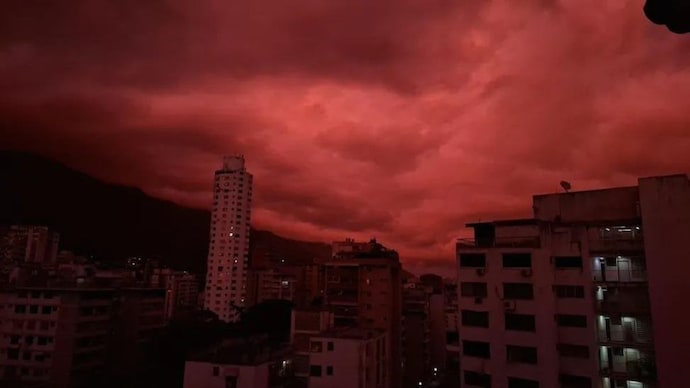
The sky over Caracas turned the colour of a wound on Tuesday evening. Not pink, not gold, but a deep, angry red that hung over rooftops already cracked from an earthquake six days earlier.
Videos flooded social media within minutes. Some called it a miracle. Others called it a warning. It was neither.
WHY DOES THE SKY TURN RED AT SUNSET?
Sunlight looks white, but it is actually a mix of every colour in the rainbow travelling together, each one moving as a wave of a different length. Blue and violet waves are short and tightly packed. Red and orange waves are longer and stretched out.
When sunlight enters Earth's atmosphere, it collides with tiny gas molecules, mostly nitrogen and oxygen.
These molecules fling blue light around in every direction far more easily than they do red light, a process the 19th century physicist Lord Rayleigh explained, and which now carries his name: Rayleigh scattering.
That is why the daytime sky looks blue. Blue light is being bounced all over it.
WHAT MAKES CARACAS SKY SO INTENSELY RED?
At sunrise and sunset, the Sun sits low on the horizon, so its light must cut through a much longer stretch of atmosphere before it reaches your eyes. Almost all the blue light gets scattered away long before it arrives. Only the red and orange survive the journey.
This is a candilazo, a term used across Venezuela and the Caribbean for a sunset that turns fierce, fiery red. It comes from candil, an old oil lamp whose warm glow the sky seems to borrow.
Caracas got an extra push from Saharan dust, fine mineral particles that cross the Atlantic from Africa every summer on trade winds.
These particles scatter light too, mopping up even more blue and letting red dominate further, which is why the display looked so dramatic.
IS THE RED SKY LINKED TO THE EARTHQUAKE?
Timing made the sight feel ominous. The double earthquake that struck Venezuela on June 24 left thousands dead and flattened buildings across Caracas and La Guaira.
Rubble and dust thrown up by collapsed structures can add fine particles to the air, which may have deepened the colour slightly.
But scientists are clear on this. The red sky was not an earthquake light, a phenomenon that is rare, brief and localised, nor was it a supernatural sign, nor evidence of any secret weapon, as some social media posts speculated.
It was ordinary atmospheric physics, witnessed at an extraordinary moment, made more vivid by dust already hanging in the air.
The sky did not know about the earthquake. It was only doing what skies have always done, when the Sun dips low and the dust rises high.
The sky over Caracas turned the colour of a wound on Tuesday evening. Not pink, not gold, but a deep, angry red that hung over rooftops already cracked from an earthquake six days earlier.
Videos flooded social media within minutes. Some called it a miracle. Others called it a warning. It was neither.
WHY DOES THE SKY TURN RED AT SUNSET?
Sunlight looks white, but it is actually a mix of every colour in the rainbow travelling together, each one moving as a wave of a different length. Blue and violet waves are short and tightly packed. Red and orange waves are longer and stretched out.
When sunlight enters Earth's atmosphere, it collides with tiny gas molecules, mostly nitrogen and oxygen.
These molecules fling blue light around in every direction far more easily than they do red light, a process the 19th century physicist Lord Rayleigh explained, and which now carries his name: Rayleigh scattering.
That is why the daytime sky looks blue. Blue light is being bounced all over it.
WHAT MAKES CARACAS SKY SO INTENSELY RED?
At sunrise and sunset, the Sun sits low on the horizon, so its light must cut through a much longer stretch of atmosphere before it reaches your eyes. Almost all the blue light gets scattered away long before it arrives. Only the red and orange survive the journey.
This is a candilazo, a term used across Venezuela and the Caribbean for a sunset that turns fierce, fiery red. It comes from candil, an old oil lamp whose warm glow the sky seems to borrow.
Caracas got an extra push from Saharan dust, fine mineral particles that cross the Atlantic from Africa every summer on trade winds.
These particles scatter light too, mopping up even more blue and letting red dominate further, which is why the display looked so dramatic.
IS THE RED SKY LINKED TO THE EARTHQUAKE?
Timing made the sight feel ominous. The double earthquake that struck Venezuela on June 24 left thousands dead and flattened buildings across Caracas and La Guaira.
Rubble and dust thrown up by collapsed structures can add fine particles to the air, which may have deepened the colour slightly.
But scientists are clear on this. The red sky was not an earthquake light, a phenomenon that is rare, brief and localised, nor was it a supernatural sign, nor evidence of any secret weapon, as some social media posts speculated.
It was ordinary atmospheric physics, witnessed at an extraordinary moment, made more vivid by dust already hanging in the air.
The sky did not know about the earthquake. It was only doing what skies have always done, when the Sun dips low and the dust rises high.

