Humans learnt the art of maintaining friend circles from chimpanzees
Scientists have found that one of humanity's most familiar social habits may have much deeper evolutionary roots than anyone realised.
Think about how you manage your friendships.
There are a handful of people you trust and confide in, then there is the wider ring of acquaintances you stay in touch with, but keep at a certain distance.
And then there's everyone else you offer an occasional greeting.
Turns out, this human trait of having friend circles might have been a habit inherited from a very distant ancestor.
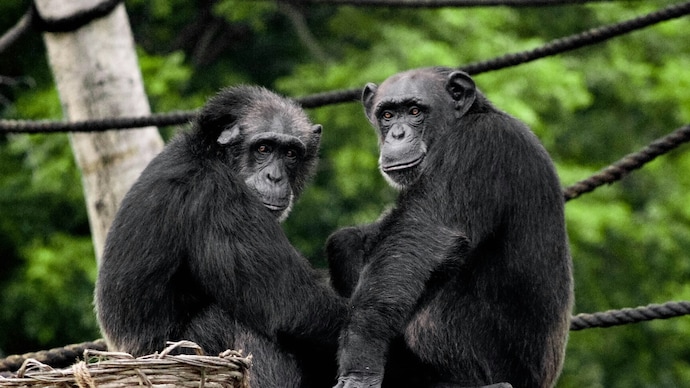
Scientists have found that chimpanzees and bonobos organise their social lives in almost exactly the same way.
A new study by researchers at Utrecht University and Universidad Carlos III de Madrid found that both species build layered social networks that closely mirror human friendship circles.
The discovery offers a rare window into the deep evolutionary roots of how social bonds are formed, and why some relationships matter more than others.
STUDYING AN APE'S SOCIAL LIFE
The researchers studied 24 groups of chimpanzees and bonobos, focusing on one of the most telling social behaviours among great apes: grooming.
When apes pick through each other's fur, they are not just cleaning but are also investing time and trust. It is, therefore, considered one of the clearest signals of who matters to whom.
Using a mathematical model, the team mapped how each individual spread its grooming time across the group.
After mapping the information, a pattern emerged which turned out to be eerily similar to how humans like to make and maintain different forms of friendships.
Scientists found that most apes devoted the bulk of their attention to a few close companions, while maintaining lighter, less frequent contact with many others. It was a tiered structure almost identical to the way humans organise their relationships.
Furthermore, apes in larger groups were also found to be more selective about where they invested their social effort, another trait that mirrors human behaviour.
SAME PATTERN, DIFFERENT PERSONALITIES
Scientists also found that both species, chimpanzees and bonobos, showed the same broad social architecture, but they arrived at it differently.
Bonobos spread their grooming more evenly, maintaining warmer connections across a wider circle, a more open, inclusive social style.
Chimpanzees, on the other hand, concentrated their effort on fewer, closer companions and were more guarded about who made it into their inner circle.
Age played a role too, but only in one species.
Chimpanzees became noticeably more selective as they got older, trimming their social investments down to a tight few. It's a pattern that will be recognised by anyone who has watched their own social life shrink with age.
But, bonobos showed no such narrowing of friend circles.
Lead researcher Edwin van Leeuwen quickly saw the bigger picture.
"Our findings suggest that the fundamental rules that guide how individuals allocate social effort apply across multiple species," he said. "This reveals deep evolutionary continuity in how complex societies are organised."
In other words, the instinct to invest in a few close relationships while keeping a wider, but thinner network of connections did not start with humans. We simply kept it going.
Think about how you manage your friendships.
There are a handful of people you trust and confide in, then there is the wider ring of acquaintances you stay in touch with, but keep at a certain distance.
And then there's everyone else you offer an occasional greeting.
Turns out, this human trait of having friend circles might have been a habit inherited from a very distant ancestor.
Scientists have found that chimpanzees and bonobos organise their social lives in almost exactly the same way.
A new study by researchers at Utrecht University and Universidad Carlos III de Madrid found that both species build layered social networks that closely mirror human friendship circles.
The discovery offers a rare window into the deep evolutionary roots of how social bonds are formed, and why some relationships matter more than others.
STUDYING AN APE'S SOCIAL LIFE
The researchers studied 24 groups of chimpanzees and bonobos, focusing on one of the most telling social behaviours among great apes: grooming.
When apes pick through each other's fur, they are not just cleaning but are also investing time and trust. It is, therefore, considered one of the clearest signals of who matters to whom.
Using a mathematical model, the team mapped how each individual spread its grooming time across the group.
After mapping the information, a pattern emerged which turned out to be eerily similar to how humans like to make and maintain different forms of friendships.
Scientists found that most apes devoted the bulk of their attention to a few close companions, while maintaining lighter, less frequent contact with many others. It was a tiered structure almost identical to the way humans organise their relationships.
Furthermore, apes in larger groups were also found to be more selective about where they invested their social effort, another trait that mirrors human behaviour.
SAME PATTERN, DIFFERENT PERSONALITIES
Scientists also found that both species, chimpanzees and bonobos, showed the same broad social architecture, but they arrived at it differently.
Bonobos spread their grooming more evenly, maintaining warmer connections across a wider circle, a more open, inclusive social style.
Chimpanzees, on the other hand, concentrated their effort on fewer, closer companions and were more guarded about who made it into their inner circle.
Age played a role too, but only in one species.
Chimpanzees became noticeably more selective as they got older, trimming their social investments down to a tight few. It's a pattern that will be recognised by anyone who has watched their own social life shrink with age.
But, bonobos showed no such narrowing of friend circles.
Lead researcher Edwin van Leeuwen quickly saw the bigger picture.
"Our findings suggest that the fundamental rules that guide how individuals allocate social effort apply across multiple species," he said. "This reveals deep evolutionary continuity in how complex societies are organised."
In other words, the instinct to invest in a few close relationships while keeping a wider, but thinner network of connections did not start with humans. We simply kept it going.

