Chinese detector hunts ghost particle: Trillions pass through you every second
China's JUNO observatory has reported its first major neutrino results from 59 days of data. The measurements show the detector can deliver exceptional precision as scientists pursue the particles' mass ordering.
Scientists working to unlock the secrets of one of the universe’s most mysterious particles have announced the first major scientific results from China’s massive underground neutrino observatory, marking a significant milestone in global particle physics research.
The findings come from the Jiangmen Underground Neutrino Observatory (JUNO), a state-of-the-art facility located 650 metres beneath a hill near Kaiping in China’s Guangdong province.
The results, published in the journal Nature, are based on data collected during the detector’s first 59 days of operation between August and November 2025.
Researchers say the measurements represent the most precise determination yet of two key parameters that describe how neutrinos behave as they travel through space.
Neutrinos are among the most abundant particles in the universe, yet they remain some of the least understood. Trillions of them pass through every human body each second without leaving a trace because they interact only very weakly with matter.
Produced in the Sun, exploding stars known as supernovas, and other energetic cosmic events, neutrinos are considered fundamental building blocks of nature.
According to Yifang Wang, spokesperson for the JUNO Collaboration and a physicist at the Chinese Academy of Sciences, the new results are important not only for the scientific data they provide but also because they demonstrate the exceptional performance of the new detector.
“This paper shows that the experiment has started from a solid foundation,” Wang said.
One of the biggest unanswered questions in neutrino physics concerns the particles’ mass ordering. Scientists know neutrinos have mass, but they still do not know which of the three mass states is the lightest and which is the heaviest. Determining this hierarchy is JUNO’s primary scientific goal.
While the latest findings do not yet answer that question, they confirm that the observatory can make highly accurate measurements. JUNO measured two neutrino oscillation parameters with roughly 1.6 times greater precision than previous experiments. Oscillation refers to the phenomenon in which neutrinos change between three different “flavours” as they travel.
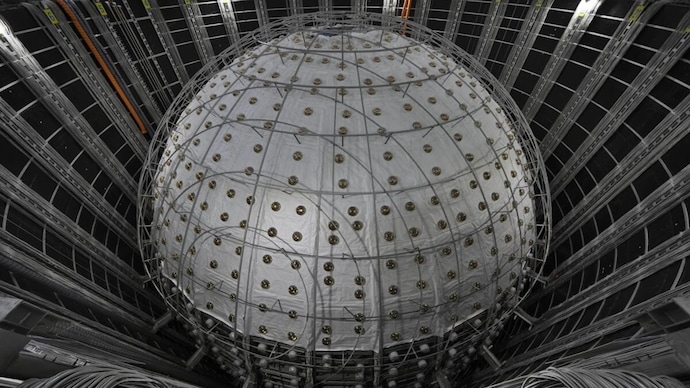
The observatory uses a gigantic spherical detector filled with 20,000 tonnes of a special organic liquid. The detector observes antineutrinos emitted by the Yangjiang and Taishan nuclear power plants, located about 52 kilometres away. When these particles interact with the liquid, tiny flashes of light are produced and recorded by sensitive instruments.
JUNO is one of three flagship neutrino projects expected to shape the field over the coming decades, alongside the Deep Underground Neutrino Experiment (DUNE) in the United States and Japan’s Hyper-Kamiokande.
Scientists hope future observations from JUNO will shed light on some of the biggest mysteries in physics, including why matter dominates over antimatter in the universe, the nature of dark matter and dark energy, and the inner workings of supernovas.
Costing more than $300 million and involving researchers from around the world, JUNO is expected to study neutrinos from the Sun, Earth, atmosphere and even future stellar explosions, bringing scientists closer to understanding some of the universe’s deepest secrets.
Scientists working to unlock the secrets of one of the universe’s most mysterious particles have announced the first major scientific results from China’s massive underground neutrino observatory, marking a significant milestone in global particle physics research.
The findings come from the Jiangmen Underground Neutrino Observatory (JUNO), a state-of-the-art facility located 650 metres beneath a hill near Kaiping in China’s Guangdong province.
The results, published in the journal Nature, are based on data collected during the detector’s first 59 days of operation between August and November 2025.
Researchers say the measurements represent the most precise determination yet of two key parameters that describe how neutrinos behave as they travel through space.
Neutrinos are among the most abundant particles in the universe, yet they remain some of the least understood. Trillions of them pass through every human body each second without leaving a trace because they interact only very weakly with matter.
Produced in the Sun, exploding stars known as supernovas, and other energetic cosmic events, neutrinos are considered fundamental building blocks of nature.
According to Yifang Wang, spokesperson for the JUNO Collaboration and a physicist at the Chinese Academy of Sciences, the new results are important not only for the scientific data they provide but also because they demonstrate the exceptional performance of the new detector.
“This paper shows that the experiment has started from a solid foundation,” Wang said.
One of the biggest unanswered questions in neutrino physics concerns the particles’ mass ordering. Scientists know neutrinos have mass, but they still do not know which of the three mass states is the lightest and which is the heaviest. Determining this hierarchy is JUNO’s primary scientific goal.
While the latest findings do not yet answer that question, they confirm that the observatory can make highly accurate measurements. JUNO measured two neutrino oscillation parameters with roughly 1.6 times greater precision than previous experiments. Oscillation refers to the phenomenon in which neutrinos change between three different “flavours” as they travel.
The observatory uses a gigantic spherical detector filled with 20,000 tonnes of a special organic liquid. The detector observes antineutrinos emitted by the Yangjiang and Taishan nuclear power plants, located about 52 kilometres away. When these particles interact with the liquid, tiny flashes of light are produced and recorded by sensitive instruments.
JUNO is one of three flagship neutrino projects expected to shape the field over the coming decades, alongside the Deep Underground Neutrino Experiment (DUNE) in the United States and Japan’s Hyper-Kamiokande.
Scientists hope future observations from JUNO will shed light on some of the biggest mysteries in physics, including why matter dominates over antimatter in the universe, the nature of dark matter and dark energy, and the inner workings of supernovas.
Costing more than $300 million and involving researchers from around the world, JUNO is expected to study neutrinos from the Sun, Earth, atmosphere and even future stellar explosions, bringing scientists closer to understanding some of the universe’s deepest secrets.

