Older than the Sun: Comet 3I/ATLAS that invaded Solar System was 10 billion years old
Scientists used the James Webb Space Telescope to study interstellar comet 3I/ATLAS after its 2025 pass around the Sun.
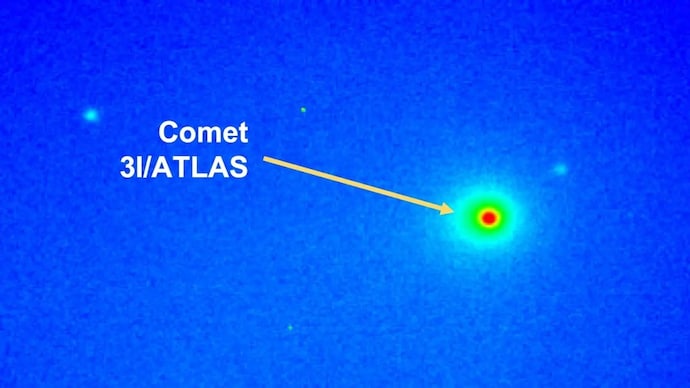
The interstellar comet 3I/ATLAS, only the third known visitor from beyond our solar system, has offered astronomers a rare glimpse into the conditions that existed billions of years before the Sun was born.
The comet is older than our Sun.
Using Nasa's powerful James Webb Space Telescope (JWST), researchers studied the comet after it swung around the Sun in December 2025. As the ancient object warmed, its frozen surface released gas and dust, creating a bright coma that allowed scientists to examine its chemical makeup in unprecedented detail.
The findings, published in the journal Nature on June 22, reveal that 3I/ATLAS possesses chemical signatures unlike any comet seen in our solar system.
“This was a unique opportunity to study an ancient object from the distant galaxy, probably pre-dating our Sun and solar system,” said lead author Martin Cordiner, an astrochemist at Nasa’s Goddard Space Flight Center.
Webb's Near-Infrared Spectrograph (NIRSpec) mapped water, carbon dioxide and carbon monoxide surrounding the comet. The observations uncovered extraordinarily high levels of deuterium, a heavy form of hydrogen, nearly 30 times greater than those measured in comets originating within our solar system.
The abundance of deuterium suggests that 3I/ATLAS formed in an extremely cold environment where ice remained largely unchanged for billions of years. Scientists believe the comet's parent star system may have existed in a dense, frozen molecular cloud and was exposed to radiation without experiencing long-term warming.
Researchers also found unusually low amounts of carbon-13 compared to the more common carbon-12 isotope. Since galaxies become progressively enriched with carbon-13 as generations of stars live and die, the finding points to a remarkably ancient origin.
Based on these isotopic fingerprints, astronomers estimate that 3I/ATLAS may have formed between 10 and 12 billion years ago, during the period known as the universe's “cosmic noon,” when star formation across the Milky Way was at its peak.
The comet's composition is helping scientists reconstruct the conditions of a planetary system that no longer exists.
A complementary study led by astronomer Cyrielle Opitom of the University of Edinburgh used the European Southern Observatory's Very Large Telescope to analyse additional carbon and nitrogen compounds in the comet.
“For us as scientists, finding these rare isotopes is fascinating,” said Nasa scientist Stefanie Milam. “The bigger picture is understanding how common the ingredients for life may be elsewhere in the galaxy.”
The discovery provides one of the clearest chemical snapshots yet of material formed long before our solar system came into existence.
The interstellar comet 3I/ATLAS, only the third known visitor from beyond our solar system, has offered astronomers a rare glimpse into the conditions that existed billions of years before the Sun was born.
The comet is older than our Sun.
Using Nasa's powerful James Webb Space Telescope (JWST), researchers studied the comet after it swung around the Sun in December 2025. As the ancient object warmed, its frozen surface released gas and dust, creating a bright coma that allowed scientists to examine its chemical makeup in unprecedented detail.
The findings, published in the journal Nature on June 22, reveal that 3I/ATLAS possesses chemical signatures unlike any comet seen in our solar system.
“This was a unique opportunity to study an ancient object from the distant galaxy, probably pre-dating our Sun and solar system,” said lead author Martin Cordiner, an astrochemist at Nasa’s Goddard Space Flight Center.
Webb's Near-Infrared Spectrograph (NIRSpec) mapped water, carbon dioxide and carbon monoxide surrounding the comet. The observations uncovered extraordinarily high levels of deuterium, a heavy form of hydrogen, nearly 30 times greater than those measured in comets originating within our solar system.
The abundance of deuterium suggests that 3I/ATLAS formed in an extremely cold environment where ice remained largely unchanged for billions of years. Scientists believe the comet's parent star system may have existed in a dense, frozen molecular cloud and was exposed to radiation without experiencing long-term warming.
Researchers also found unusually low amounts of carbon-13 compared to the more common carbon-12 isotope. Since galaxies become progressively enriched with carbon-13 as generations of stars live and die, the finding points to a remarkably ancient origin.
Based on these isotopic fingerprints, astronomers estimate that 3I/ATLAS may have formed between 10 and 12 billion years ago, during the period known as the universe's “cosmic noon,” when star formation across the Milky Way was at its peak.
The comet's composition is helping scientists reconstruct the conditions of a planetary system that no longer exists.
A complementary study led by astronomer Cyrielle Opitom of the University of Edinburgh used the European Southern Observatory's Very Large Telescope to analyse additional carbon and nitrogen compounds in the comet.
“For us as scientists, finding these rare isotopes is fascinating,” said Nasa scientist Stefanie Milam. “The bigger picture is understanding how common the ingredients for life may be elsewhere in the galaxy.”
The discovery provides one of the clearest chemical snapshots yet of material formed long before our solar system came into existence.

