Why is Delhi being hit by so many dust storms this year? It's linked to Aravallis
Delhi was hit by many massive dust storms in June, in a long line of summer dust events. Here is the simple science of why the Thar Desert, a broken Aravalli shield and extreme heat keep choking the capital.
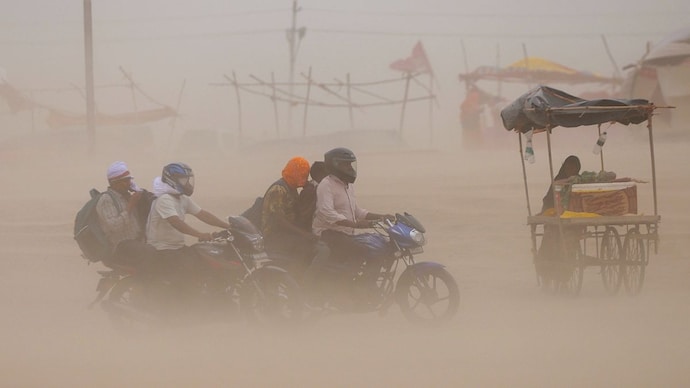
On June 23, a wall of dust rolled across Delhi in a matter of minutes, swallowing roads and turning the afternoon sky an eerie brown.
The India Meteorological Department (IMD) had warned of it only hours earlier.
For Delhi, such scenes have become an almost yearly summer ritual.
So why does the capital keep choking on dust? The answer lies in a tidy collision of geography, heat and physics.
THE SCIENCE BEHIND DELHI'S DUST STORMS
Delhi sits downwind of the Thar Desert in Rajasthan.
Through the scorching summer, the desert floor bakes into fine, loose sand that strong westerly winds lift and carry hundreds of kilometres towards the northern plains.
For centuries, the Aravalli Range stood as a natural barrier, slowing these gritty winds and trapping much of the sand before it could reach the city.
Decades of mining, tree-felling and unchecked construction have punched gaps in this ancient shield, letting more dust sail straight into the National Capital Region.
One of the biggest reasons is the slow collapse of the city's natural defence: the Aravallis.
The Aravalli Range is one of the planet's oldest mountain systems, a 650km spine of hills that runs from Delhi through Haryana and Rajasthan into Gujarat.
For ages, it has worked as a natural wall, blunting the hot, sand-laden winds that sweep in from the Thar Desert. That wall is now crumbling, and the problem has reached the courts.
In November 2025, the Supreme Court settled, for the first time, a single legal definition of what counts as the Aravallis and froze new mining leases across Delhi, Haryana, Rajasthan and Gujarat until a proper sustainable mining plan is ready, a move meant to curb the quarrying and building that have torn gaps in the range.
So why does Delhi keep choking on dust? The answer is a tidy collision of geography, heat and physics.
WHEN DELHI'S DUST STORMS STRUCK THIS YEAR
This pre-monsoon season has been an unusually active one, with the IMD issuing a steady run of dust and thunderstorm warnings from April onwards. The clearly documented episodes include:
April 3: A thick blanket of dust settled over Delhi-NCR in the morning, cutting visibility and pushing air quality into the unhealthy range, as the IMD forecast gusty winds of 40 to 50kmph.
Late April (around April 27 to 29): A dust storm and strong gusts swept the capital under an IMD alert, with airlines flagging possible flight disruptions as a cyclonic circulation, a swirl of winds that stirs up unsettled weather, moved in from the west.
May 30: A fierce dust storm born in the Thar swept across Rajasthan and into Delhi-NCR, turning the afternoon into near-darkness in places, with red and orange alerts and winds gusting towards 100kmph before rain finally settled in the air.
Early June (June 3 to 4): Heavy winds, lightning and rain brought a dramatic late-night turn, part of a broader spell of pre-monsoon activity through the first half of the month.
June 23: A severe storm struck around 2.30pm, prompting a red alert for Delhi, Haryana, Uttar Pradesh and Rajasthan, with squally winds near 100kmph before light rain and thunderstorms offered relief.
Between these, the IMD issued many more nowcasts, the short-term local warnings used for sudden weather, for dust-raising winds through May and June.
Delhi sees several such aandhi, the local word for these abrupt dust storms, every pre-monsoon season, though their strength and clustering shift from year to year.
HOW A STORM IS BORN
A dust storm is really a high-energy thunderstorm. It begins with fierce surface heating. As the ground in north-west India crosses 40 degrees Celsius, the air just above it turns hot and restless.
This sets up a steep lapse rate, the speed at which air cools as you climb higher.
The wider the gap between the hot ground and the cold air aloft, the more unstable the atmosphere becomes.
Scientists measure this stored energy as Convective Available Potential Energy, or CAPE, which is simply the fuel a storm draws on.
WHY THE WIND TURNS VIOLENT
Heat alone is not enough. A trigger is needed, usually a passing weather system such as a cyclonic circulation or a western disturbance, which nudges the hot surface air upwards.
Once a towering cumulonimbus, or rain-bearing cloud, builds up, it begins to release rain. In Delhi's dry summer air, much of that rain evaporates before it reaches the ground.
Evaporation cools the surrounding air and makes it heavy, and this dense air comes crashing down as a downdraft.
When it slams into the surface, it bursts outwards in every direction, lifting topsoil and hurling it across the city as a wall of dust. On June 23, these gusts touched 50 to 60kmph in parts of Delhi-NCR.
IS CLIMATE CHANGE TO BLAME?
Dust storms are natural, yet scientists say a warming planet is sharpening their edges.
Hotter summers store more energy in the atmosphere, feeding the very instability that drives these storms.
There is no firm agreement that they strike more often, but the heatwaves and volatile conditions behind their fury are clearly growing more pronounced.
The dust then mixes with the city's own pollution, pushing air quality to dangerous levels.
HOW CONSTRUCTION MAKES IT WORSE
The Thar may launch these storms, but Delhi does plenty to dirty its own air. Construction and demolition work is one of the city's biggest local sources of dust, and agencies such as the Delhi Pollution Control Committee (DPCC) rank it among the top contributors to particulate matter, the tiny solid particles that hang in the air and harm the lungs.
Digging, demolition and earth-moving throw up clouds of fine grit. Uncovered piles of sand and cement, trucks carrying debris without cover, and vehicles trundling over unpaved site roads grind material into a fine silt that settles on surrounding streets.
This is partly why road dust, much of it fed by building work and broken surfaces, is the single largest source of coarse PM10, the term for particles up to 10 micrometres wide, far thinner than a human hair.
Construction does not create the great storms from the desert. What it does is leave the city blanketed in loose dust that the wind can pick up. When a Thar storm sweeps in, its winds resuspend, or lift back into the air, all this local grit at once. Desert dust and city dust then combine, sending readings of PM10 and finer PM2.5 soaring and keeping the air hazardous long after the storm itself has passed.
A SEASON OF DUST
These storms are a pre-monsoon affair, peaking between March and June. They ease once the monsoon sweeps in, settling the dust and cooling the land.
This year, with the rains running nearly two weeks late, Delhi has had to wait longer for relief.
On June 23, a wall of dust rolled across Delhi in a matter of minutes, swallowing roads and turning the afternoon sky an eerie brown.
The India Meteorological Department (IMD) had warned of it only hours earlier.
For Delhi, such scenes have become an almost yearly summer ritual.
So why does the capital keep choking on dust? The answer lies in a tidy collision of geography, heat and physics.
THE SCIENCE BEHIND DELHI'S DUST STORMS
Delhi sits downwind of the Thar Desert in Rajasthan.
Through the scorching summer, the desert floor bakes into fine, loose sand that strong westerly winds lift and carry hundreds of kilometres towards the northern plains.
For centuries, the Aravalli Range stood as a natural barrier, slowing these gritty winds and trapping much of the sand before it could reach the city.
Decades of mining, tree-felling and unchecked construction have punched gaps in this ancient shield, letting more dust sail straight into the National Capital Region.
One of the biggest reasons is the slow collapse of the city's natural defence: the Aravallis.
The Aravalli Range is one of the planet's oldest mountain systems, a 650km spine of hills that runs from Delhi through Haryana and Rajasthan into Gujarat.
For ages, it has worked as a natural wall, blunting the hot, sand-laden winds that sweep in from the Thar Desert. That wall is now crumbling, and the problem has reached the courts.
In November 2025, the Supreme Court settled, for the first time, a single legal definition of what counts as the Aravallis and froze new mining leases across Delhi, Haryana, Rajasthan and Gujarat until a proper sustainable mining plan is ready, a move meant to curb the quarrying and building that have torn gaps in the range.
So why does Delhi keep choking on dust? The answer is a tidy collision of geography, heat and physics.
WHEN DELHI'S DUST STORMS STRUCK THIS YEAR
This pre-monsoon season has been an unusually active one, with the IMD issuing a steady run of dust and thunderstorm warnings from April onwards. The clearly documented episodes include:
April 3: A thick blanket of dust settled over Delhi-NCR in the morning, cutting visibility and pushing air quality into the unhealthy range, as the IMD forecast gusty winds of 40 to 50kmph.
Late April (around April 27 to 29): A dust storm and strong gusts swept the capital under an IMD alert, with airlines flagging possible flight disruptions as a cyclonic circulation, a swirl of winds that stirs up unsettled weather, moved in from the west.
May 30: A fierce dust storm born in the Thar swept across Rajasthan and into Delhi-NCR, turning the afternoon into near-darkness in places, with red and orange alerts and winds gusting towards 100kmph before rain finally settled in the air.
Early June (June 3 to 4): Heavy winds, lightning and rain brought a dramatic late-night turn, part of a broader spell of pre-monsoon activity through the first half of the month.
June 23: A severe storm struck around 2.30pm, prompting a red alert for Delhi, Haryana, Uttar Pradesh and Rajasthan, with squally winds near 100kmph before light rain and thunderstorms offered relief.
Between these, the IMD issued many more nowcasts, the short-term local warnings used for sudden weather, for dust-raising winds through May and June.
Delhi sees several such aandhi, the local word for these abrupt dust storms, every pre-monsoon season, though their strength and clustering shift from year to year.
HOW A STORM IS BORN
A dust storm is really a high-energy thunderstorm. It begins with fierce surface heating. As the ground in north-west India crosses 40 degrees Celsius, the air just above it turns hot and restless.
This sets up a steep lapse rate, the speed at which air cools as you climb higher.
The wider the gap between the hot ground and the cold air aloft, the more unstable the atmosphere becomes.
Scientists measure this stored energy as Convective Available Potential Energy, or CAPE, which is simply the fuel a storm draws on.
WHY THE WIND TURNS VIOLENT
Heat alone is not enough. A trigger is needed, usually a passing weather system such as a cyclonic circulation or a western disturbance, which nudges the hot surface air upwards.
Once a towering cumulonimbus, or rain-bearing cloud, builds up, it begins to release rain. In Delhi's dry summer air, much of that rain evaporates before it reaches the ground.
Evaporation cools the surrounding air and makes it heavy, and this dense air comes crashing down as a downdraft.
When it slams into the surface, it bursts outwards in every direction, lifting topsoil and hurling it across the city as a wall of dust. On June 23, these gusts touched 50 to 60kmph in parts of Delhi-NCR.
IS CLIMATE CHANGE TO BLAME?
Dust storms are natural, yet scientists say a warming planet is sharpening their edges.
Hotter summers store more energy in the atmosphere, feeding the very instability that drives these storms.
There is no firm agreement that they strike more often, but the heatwaves and volatile conditions behind their fury are clearly growing more pronounced.
The dust then mixes with the city's own pollution, pushing air quality to dangerous levels.
HOW CONSTRUCTION MAKES IT WORSE
The Thar may launch these storms, but Delhi does plenty to dirty its own air. Construction and demolition work is one of the city's biggest local sources of dust, and agencies such as the Delhi Pollution Control Committee (DPCC) rank it among the top contributors to particulate matter, the tiny solid particles that hang in the air and harm the lungs.
Digging, demolition and earth-moving throw up clouds of fine grit. Uncovered piles of sand and cement, trucks carrying debris without cover, and vehicles trundling over unpaved site roads grind material into a fine silt that settles on surrounding streets.
This is partly why road dust, much of it fed by building work and broken surfaces, is the single largest source of coarse PM10, the term for particles up to 10 micrometres wide, far thinner than a human hair.
Construction does not create the great storms from the desert. What it does is leave the city blanketed in loose dust that the wind can pick up. When a Thar storm sweeps in, its winds resuspend, or lift back into the air, all this local grit at once. Desert dust and city dust then combine, sending readings of PM10 and finer PM2.5 soaring and keeping the air hazardous long after the storm itself has passed.
A SEASON OF DUST
These storms are a pre-monsoon affair, peaking between March and June. They ease once the monsoon sweeps in, settling the dust and cooling the land.
This year, with the rains running nearly two weeks late, Delhi has had to wait longer for relief.

