Akash Ganga's heart: Euclid captures most detailed image of Milky Way galaxy
ESA's Euclid telescope has captured a vast, high-resolution view of the Milky Way's central bulge. The image could help future missions detect and weigh distant exoplanets more accurately.
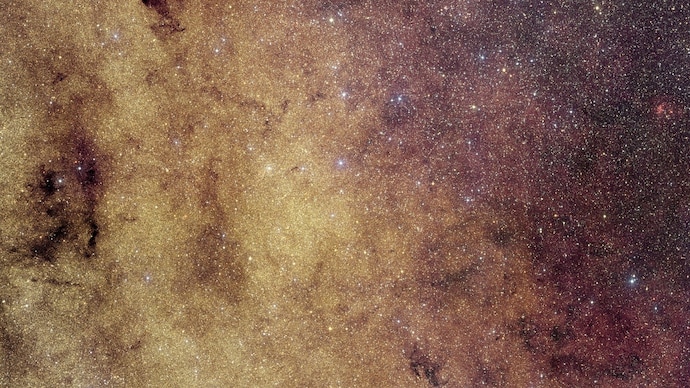
The European Space Agency's (ESA) Euclid space telescope has turned its powerful eyes inward for the first time, capturing one of the most detailed and expansive images ever taken of the heart of our home galaxy, the Milky Way, known in India as Akash Ganga.
The breathtaking mosaic reveals more than 60 million stars, dense molecular clouds, glowing nebulae and ancient star clusters packed into the galaxy's central bulge.
Although Euclid was designed to study the dark universe by mapping billions of distant galaxies, scientists briefly redirected the telescope toward the Milky Way's crowded centre. The result is a spectacular dataset that could transform the search for planets beyond our Solar System.
The image was captured on March 23, 2025, during a special 26-hour observing campaign. Euclid stitched together nine separate observations into a giant mosaic covering an area of sky larger than nine full Moons.
Despite the extraordinary density of stars, the telescope's visible-light camera was able to distinguish individual stars with remarkable clarity.
"This is exactly the kind of observation Euclid excels at—combining an enormous field of view with exquisite resolution," ESA said while releasing the image.
The telescope's capabilities rival those of the Hubble Space Telescope in sharpness, but Euclid can image an area 270 times larger in a single pointing.
Scientists estimate that ground-based observatories such as the Keck Observatory would require nearly 2,000 hours to collect equivalent data.
The galactic bulge is among the busiest stellar neighbourhoods in the Milky Way, making it an ideal laboratory for a technique known as gravitational microlensing, one of the most effective methods for discovering distant exoplanets.
Microlensing occurs when a foreground star passes directly in front of a more distant star. The nearer star acts like a natural magnifying glass, bending and amplifying the background star's light through gravity. If the foreground star hosts a planet, the planet's gravity creates a tiny additional distortion in the light, revealing its presence.
Over the past two decades, astronomers have discovered nearly 300 exoplanets using this technique, almost all toward the centre of the Milky Way. Euclid's latest image already contains 51 known planetary systems, giving researchers an unprecedented reference map for future discoveries.
Although Euclid observed the region for just one day, too short to detect new microlensing events, it provides something equally valuable. Future missions, particularly NASA's Nancy Grace Roman Space Telescope, will monitor the same region continuously for weeks.
By comparing Roman's future observations with Euclid's high-resolution image taken before stars align, astronomers will be able to precisely measure how stars move, confirm the existence of exoplanets and determine their masses with far greater accuracy.
Scientists are especially excited because microlensing is uniquely suited to finding cold, icy planets orbiting far from their stars, worlds that are often missed by other planet-hunting techniques that favour large, hot planets close to their host stars.
The European Space Agency's (ESA) Euclid space telescope has turned its powerful eyes inward for the first time, capturing one of the most detailed and expansive images ever taken of the heart of our home galaxy, the Milky Way, known in India as Akash Ganga.
The breathtaking mosaic reveals more than 60 million stars, dense molecular clouds, glowing nebulae and ancient star clusters packed into the galaxy's central bulge.
Although Euclid was designed to study the dark universe by mapping billions of distant galaxies, scientists briefly redirected the telescope toward the Milky Way's crowded centre. The result is a spectacular dataset that could transform the search for planets beyond our Solar System.
The image was captured on March 23, 2025, during a special 26-hour observing campaign. Euclid stitched together nine separate observations into a giant mosaic covering an area of sky larger than nine full Moons.
Despite the extraordinary density of stars, the telescope's visible-light camera was able to distinguish individual stars with remarkable clarity.
"This is exactly the kind of observation Euclid excels at—combining an enormous field of view with exquisite resolution," ESA said while releasing the image.
The telescope's capabilities rival those of the Hubble Space Telescope in sharpness, but Euclid can image an area 270 times larger in a single pointing.
Scientists estimate that ground-based observatories such as the Keck Observatory would require nearly 2,000 hours to collect equivalent data.
The galactic bulge is among the busiest stellar neighbourhoods in the Milky Way, making it an ideal laboratory for a technique known as gravitational microlensing, one of the most effective methods for discovering distant exoplanets.
Microlensing occurs when a foreground star passes directly in front of a more distant star. The nearer star acts like a natural magnifying glass, bending and amplifying the background star's light through gravity. If the foreground star hosts a planet, the planet's gravity creates a tiny additional distortion in the light, revealing its presence.
Over the past two decades, astronomers have discovered nearly 300 exoplanets using this technique, almost all toward the centre of the Milky Way. Euclid's latest image already contains 51 known planetary systems, giving researchers an unprecedented reference map for future discoveries.
Although Euclid observed the region for just one day, too short to detect new microlensing events, it provides something equally valuable. Future missions, particularly NASA's Nancy Grace Roman Space Telescope, will monitor the same region continuously for weeks.
By comparing Roman's future observations with Euclid's high-resolution image taken before stars align, astronomers will be able to precisely measure how stars move, confirm the existence of exoplanets and determine their masses with far greater accuracy.
Scientists are especially excited because microlensing is uniquely suited to finding cold, icy planets orbiting far from their stars, worlds that are often missed by other planet-hunting techniques that favour large, hot planets close to their host stars.

