Gaganyaan: Isro integrating Vyommitra in crew module, key safety tests underway
Isro has begun integrating Vyommitra for the uncrewed HLVM3-G1/OM1 mission. The exercise will test crew systems and ground safety measures before Gaganyatris fly.
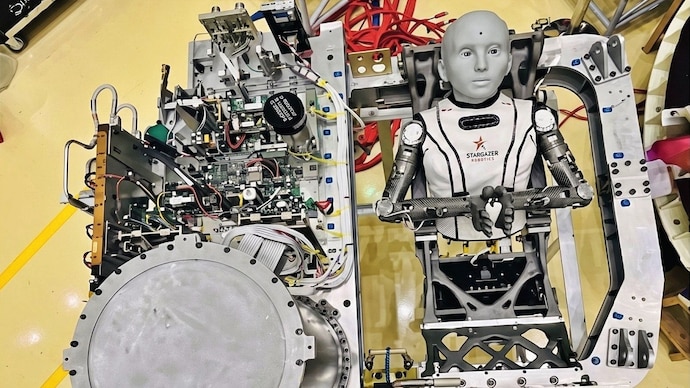
India’s human spaceflight ambitions are entering a decisive phase, with the Indian Space Research Organisation initiating pre-flight integration of its humanoid robot Vyommitra ahead of the maiden uncrewed mission of the HLVM3-G1/OM1.
Vyommitra, designed to simulate astronaut functions in space, will play a crucial role in testing life-support systems, crew interfaces and microgravity conditions during the upcoming mission.
The robot is expected to gather vital data that will help refine systems before Indian astronauts, referred to as Gaganyatris, are sent into orbit under the Gaganyaan mission.
The HLVM3 rocket, a human-rated version of India’s heavy-lift launch vehicle, will carry Vyommitra on this critical test flight.
Engineers are currently focused on integrating the robot with onboard systems, ensuring seamless communication, environmental monitoring and response simulations during the mission.
GROUND SAFETY MEASURES BEING READIED
Parallel to flight preparations, Isro is also advancing ground safety systems, a key requirement for any human spaceflight programme.
Among these is the Flight Crew Emergency Egress System, a specialised infrastructure designed to evacuate astronauts from the launch pad in case of emergencies such as fire, fuel leaks or other pre-launch hazards.
Unlike the onboard Crew Escape System, which activates during in-flight emergencies, the egress system is intended for use while the rocket remains on the launch pad. It functions as a rapid evacuation mechanism, allowing astronauts to exit the crew module and move to safety within seconds.
The system uses a zipline-based mechanism, enabling Gaganyatris to slide away quickly from the launch tower to a secure distance.
This ground-based “emergency exit” is a standard feature in global human spaceflight operations and is critical for ensuring crew safety during the most vulnerable pre-launch phase.
Isro has been conducting rigorous tests of the system to validate its speed, reliability and ability to function under extreme conditions. These trials are aimed at ensuring that astronauts can be evacuated safely even in worst-case scenarios.
The simultaneous progress on both flight hardware and safety infrastructure reflects India’s cautious and methodical approach to human spaceflight. With Vyommitra’s integration underway and safety systems being validated, the upcoming HLVM3-G1/OM1 mission is set to mark a major milestone.
WHEN WILL VYOMITRA LAUNCH?
Isro is yet to announce any date for the maiden test launch of the uncrewed Gaganyaan Mission.
India’s human spaceflight ambitions are entering a decisive phase, with the Indian Space Research Organisation initiating pre-flight integration of its humanoid robot Vyommitra ahead of the maiden uncrewed mission of the HLVM3-G1/OM1.
Vyommitra, designed to simulate astronaut functions in space, will play a crucial role in testing life-support systems, crew interfaces and microgravity conditions during the upcoming mission.
The robot is expected to gather vital data that will help refine systems before Indian astronauts, referred to as Gaganyatris, are sent into orbit under the Gaganyaan mission.
The HLVM3 rocket, a human-rated version of India’s heavy-lift launch vehicle, will carry Vyommitra on this critical test flight.
Engineers are currently focused on integrating the robot with onboard systems, ensuring seamless communication, environmental monitoring and response simulations during the mission.
GROUND SAFETY MEASURES BEING READIED
Parallel to flight preparations, Isro is also advancing ground safety systems, a key requirement for any human spaceflight programme.
Among these is the Flight Crew Emergency Egress System, a specialised infrastructure designed to evacuate astronauts from the launch pad in case of emergencies such as fire, fuel leaks or other pre-launch hazards.
Unlike the onboard Crew Escape System, which activates during in-flight emergencies, the egress system is intended for use while the rocket remains on the launch pad. It functions as a rapid evacuation mechanism, allowing astronauts to exit the crew module and move to safety within seconds.
The system uses a zipline-based mechanism, enabling Gaganyatris to slide away quickly from the launch tower to a secure distance.
This ground-based “emergency exit” is a standard feature in global human spaceflight operations and is critical for ensuring crew safety during the most vulnerable pre-launch phase.
Isro has been conducting rigorous tests of the system to validate its speed, reliability and ability to function under extreme conditions. These trials are aimed at ensuring that astronauts can be evacuated safely even in worst-case scenarios.
The simultaneous progress on both flight hardware and safety infrastructure reflects India’s cautious and methodical approach to human spaceflight. With Vyommitra’s integration underway and safety systems being validated, the upcoming HLVM3-G1/OM1 mission is set to mark a major milestone.
WHEN WILL VYOMITRA LAUNCH?
Isro is yet to announce any date for the maiden test launch of the uncrewed Gaganyaan Mission.

