To survive heatwave in tents, Gazans are running to polluted Mediterranean Sea
Thousands of people in Gaza are turning to a polluted Mediterranean Sea for relief from summer heat which is now turning the sea into a growing health and environmental crisis.
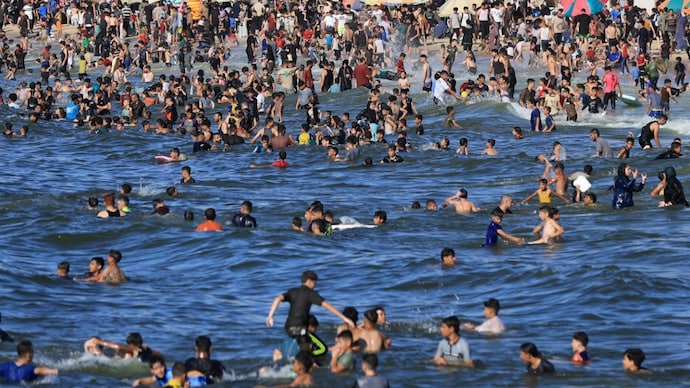
As summer temperatures climb across the Gaza Strip, thousands of displaced Palestinians are turning to the Mediterranean Sea for relief from the scorching heat, with temperatures touching 30°C.
But the waters that once offered recreation and respite have become heavily polluted with sewage and waste, highlighting a growing environmental and public health crisis in the war-ravaged territory.
Nearly all of Gaza's population has been displaced at some point since the war between Israel and Hamas began in October 2023, with many families now living in overcrowded tent camps or damaged buildings along the coast, where access to clean water, electricity and basic services remains severely limited.
TOWARDS POLLUTED WATERS
Before the war, Gaza City's sandy beaches were among the territory's most popular public spaces.
Today, many residents say the sea has become their only escape from sweltering tents that trap heat and provide little protection from insects and disease.
"The only outlet in the Gaza Strip, from north to south, is the sea," Wadie al-Ras, a displaced Palestinian standing on Gaza City's shoreline told news agency Reuters. "The tents we have been staying in since the war are a torment."
However, the sea itself is no longer safe.
Large volumes of untreated sewage and waste are flowing into coastal waters after extensive damage to Gaza's sanitation and wastewater infrastructure. Residents continue to enter the water because they have few alternatives for washing clothes, cooling off or bathing.
"The seawater is not clean. There's sewage in it, filled with dirt," Shehab al-Suwaireki, a displaced father of six, told Reuters. "We go in and wash and bathe then we get out."
THE HEALTH RISK
According to Gaza municipal officials, many water pumps, sewage stations and treatment facilities have stopped functioning or were severely damaged during the conflict, Reuters reported.
As a result, untreated wastewater is contaminating both coastal waters and other parts of the territory.
Health experts and aid agencies have repeatedly warned that poor sanitation and contaminated water increase the risk of skin infections, diarrhoeal illnesses and other waterborne diseases, particularly among children.
Similar concerns have been raised in recent months as garbage and sewage accumulated near displacement camps.
While fighting and military tensions continue to shape life in Gaza, the environmental consequences of the conflict are increasingly affecting everyday survival. For many families enduring temperatures above 30°C, the polluted Mediterranean has become both a refuge and a threat.
With clean water scarce and much of the territory's infrastructure in ruins, residents admit that they have little choice but to risk exposure to contaminated water as they try to cope with another difficult summer in Gaza.
As summer temperatures climb across the Gaza Strip, thousands of displaced Palestinians are turning to the Mediterranean Sea for relief from the scorching heat, with temperatures touching 30°C.
But the waters that once offered recreation and respite have become heavily polluted with sewage and waste, highlighting a growing environmental and public health crisis in the war-ravaged territory.
Nearly all of Gaza's population has been displaced at some point since the war between Israel and Hamas began in October 2023, with many families now living in overcrowded tent camps or damaged buildings along the coast, where access to clean water, electricity and basic services remains severely limited.
TOWARDS POLLUTED WATERS
Before the war, Gaza City's sandy beaches were among the territory's most popular public spaces.
Today, many residents say the sea has become their only escape from sweltering tents that trap heat and provide little protection from insects and disease.
"The only outlet in the Gaza Strip, from north to south, is the sea," Wadie al-Ras, a displaced Palestinian standing on Gaza City's shoreline told news agency Reuters. "The tents we have been staying in since the war are a torment."
However, the sea itself is no longer safe.
Large volumes of untreated sewage and waste are flowing into coastal waters after extensive damage to Gaza's sanitation and wastewater infrastructure. Residents continue to enter the water because they have few alternatives for washing clothes, cooling off or bathing.
"The seawater is not clean. There's sewage in it, filled with dirt," Shehab al-Suwaireki, a displaced father of six, told Reuters. "We go in and wash and bathe then we get out."
THE HEALTH RISK
According to Gaza municipal officials, many water pumps, sewage stations and treatment facilities have stopped functioning or were severely damaged during the conflict, Reuters reported.
As a result, untreated wastewater is contaminating both coastal waters and other parts of the territory.
Health experts and aid agencies have repeatedly warned that poor sanitation and contaminated water increase the risk of skin infections, diarrhoeal illnesses and other waterborne diseases, particularly among children.
Similar concerns have been raised in recent months as garbage and sewage accumulated near displacement camps.
While fighting and military tensions continue to shape life in Gaza, the environmental consequences of the conflict are increasingly affecting everyday survival. For many families enduring temperatures above 30°C, the polluted Mediterranean has become both a refuge and a threat.
With clean water scarce and much of the territory's infrastructure in ruins, residents admit that they have little choice but to risk exposure to contaminated water as they try to cope with another difficult summer in Gaza.

