Japan's Hayabusa2 sends first picture of peanut asteroid 100 million km from Earth
The image, released by the Japan Aerospace Exploration Agency (JAXA), shows asteroid Torifune, a roughly 450-metre-wide space rock that resembles two smaller asteroids joined together.
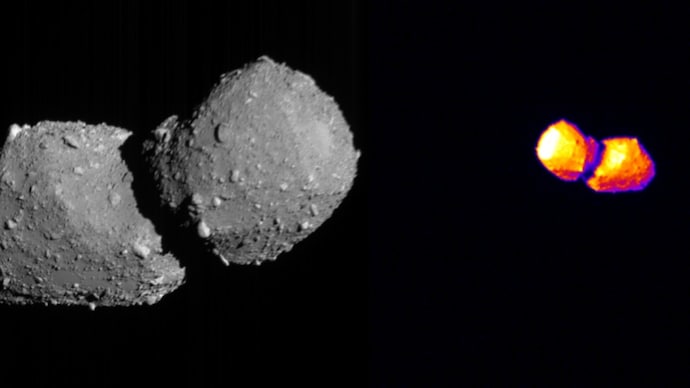
Japan's asteroid explorer Hayabusa2 has beamed back a remarkable close-up image of a rare, two-lobed asteroid during a flyby nearly 100 million kilometres from Earth, offering scientists a fresh look at one of the solar system's oldest rocky objects.
The image, released by the Japan Aerospace Exploration Agency (JAXA), shows asteroid Torifune, a roughly 450-metre-wide space rock that resembles two smaller asteroids joined together.
The spacecraft flew past the asteroid on July 5 as part of its extended mission after successfully returning samples from asteroid Ryugu to Earth in 2020.
WHY DOES THE ASTEROID HAVE TWO HEADS?
Scientists believe Torifune is a contact binary, which is an asteroid formed when two separate rocky bodies drifted together and gently merged billions of years ago.
Instead of colliding violently and breaking apart, the two objects stuck together, creating the distinctive shape.
Images captured by Hayabusa2's optical navigation camera reveal both lobes are covered with numerous boulders, providing researchers with clues about how small asteroids formed and evolved during the early history of the solar system.
Understanding these ancient space rocks could also shed light on the materials that helped build planets, including Earth.
NEW FEAT FOR HAYABUSA2
Hayabusa2 is already one of the world's most successful asteroid missions.
Launched in December 2014, it reached asteroid Ryugu in 2018, collected surface and subsurface samples, and safely returned them to Earth in December 2020.
Analyses of those samples have revealed water-bearing minerals and complex organic molecules, offering valuable insights into the origins of the solar system.
Rather than ending the mission after the sample return, JAXA extended Hayabusa2's journey.
The flyby of Torifune marks the first major scientific target of this extended mission and serves as a rehearsal for its next destination: asteroid 1998 KY26, which the spacecraft is expected to reach in 2031.
That tiny asteroid, only a few tens of metres across, spins once every 10 minutes, making it one of the fastest-rotating asteroids ever targeted by a spacecraft.
Researchers say observations of Torifune will help improve navigation techniques and deepen understanding of small asteroids, many of which occasionally pass close to Earth.
Such studies could prove valuable not only for planetary science but also for future planetary defence efforts aimed at understanding potentially hazardous asteroids before they ever pose a threat.
Japan's asteroid explorer Hayabusa2 has beamed back a remarkable close-up image of a rare, two-lobed asteroid during a flyby nearly 100 million kilometres from Earth, offering scientists a fresh look at one of the solar system's oldest rocky objects.
The image, released by the Japan Aerospace Exploration Agency (JAXA), shows asteroid Torifune, a roughly 450-metre-wide space rock that resembles two smaller asteroids joined together.
The spacecraft flew past the asteroid on July 5 as part of its extended mission after successfully returning samples from asteroid Ryugu to Earth in 2020.
WHY DOES THE ASTEROID HAVE TWO HEADS?
Scientists believe Torifune is a contact binary, which is an asteroid formed when two separate rocky bodies drifted together and gently merged billions of years ago.
Instead of colliding violently and breaking apart, the two objects stuck together, creating the distinctive shape.
Images captured by Hayabusa2's optical navigation camera reveal both lobes are covered with numerous boulders, providing researchers with clues about how small asteroids formed and evolved during the early history of the solar system.
Understanding these ancient space rocks could also shed light on the materials that helped build planets, including Earth.
NEW FEAT FOR HAYABUSA2
Hayabusa2 is already one of the world's most successful asteroid missions.
Launched in December 2014, it reached asteroid Ryugu in 2018, collected surface and subsurface samples, and safely returned them to Earth in December 2020.
Analyses of those samples have revealed water-bearing minerals and complex organic molecules, offering valuable insights into the origins of the solar system.
Rather than ending the mission after the sample return, JAXA extended Hayabusa2's journey.
The flyby of Torifune marks the first major scientific target of this extended mission and serves as a rehearsal for its next destination: asteroid 1998 KY26, which the spacecraft is expected to reach in 2031.
That tiny asteroid, only a few tens of metres across, spins once every 10 minutes, making it one of the fastest-rotating asteroids ever targeted by a spacecraft.
Researchers say observations of Torifune will help improve navigation techniques and deepen understanding of small asteroids, many of which occasionally pass close to Earth.
Such studies could prove valuable not only for planetary science but also for future planetary defence efforts aimed at understanding potentially hazardous asteroids before they ever pose a threat.

