Indian scientist builds mini-brain in 3D chip that could change AI, neuroscience
An Indian-origin researcher has led the development of a 3D platform where living neurons interact with embedded electronics. The study offers a new way to observe learning, memory and future bio-electronic computing.
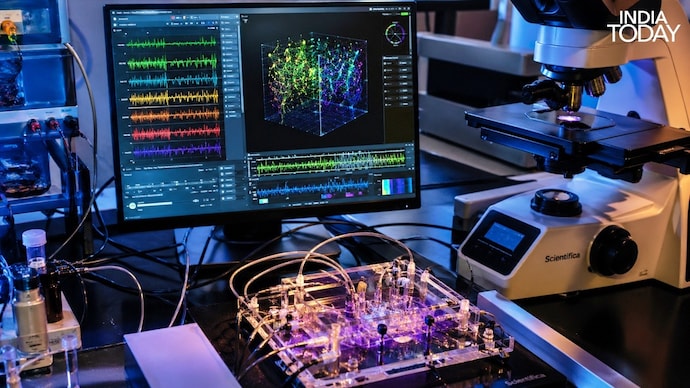
In a breakthrough that blurs the line between biology and machines, a team led by Indian-origin researcher Dr Kumar Mritunjay has developed a three-dimensional brain-like system that allows living neurons to interact with electronics in unprecedented ways.
The study, published in Nature Electronics, marks a major leap in how scientists study intelligence, learning, and brain behaviour.
Dr. Mritunjay, who completed his BTech at IIT Kharagpur before pursuing a dual PhD in Electrical and Computer Engineering and Neuroscience at Princeton University, led the effort to create a device where living brain cells grow and communicate inside a 3D electronic scaffold.
Unlike earlier “brain-on-a-chip” systems that were mostly flat, this new platform allows neurons to grow in all directions, closely mimicking how they exist in the human brain.
Tiny embedded sensors can both record electrical signals from the neurons and stimulate them, enabling a two-way interaction between living tissue and machines.
“This is like creating a small, controllable neural network that behaves more like a real brain,” researchers explained in the paper. The system can be observed over long periods, allowing scientists to study how neural connections evolve — a key feature of learning and memory.
One of the most significant aspects of the research is its ability to maintain stable neural activity over months. This long-term functionality makes it possible to track how neurons strengthen or weaken their connections, offering deeper insights into how brains adapt and process information.
The device is also programmable, meaning scientists can influence how the neural network behaves.
In effect, it opens the door to training biological systems in ways similar to artificial intelligence, but using real neurons instead of purely digital algorithms.
Experts say the implications are far-reaching. The technology could accelerate research into neurological disorders, improve brain-machine interfaces, and even inspire new forms of computing that combine the efficiency of biology with the precision of electronics.
The work also highlights the role of Indian researchers in cutting-edge global research.
Dr. Mritunjay’s journey, from IIT Kharagpur to Princeton University, points to the increasing role of Indian scientists in shaping the future of interdisciplinary science.
While the system is still in the research stage, it represents a powerful step toward hybrid bio-electronic technologies.
As scientists continue refining these systems, the idea of machines that can think, learn, and adapt like living brains is moving from science fiction to reality.
For now, this 3D neural platform stands as a glimpse into a future where biology and technology are no longer separate, but deeply intertwined.
In a breakthrough that blurs the line between biology and machines, a team led by Indian-origin researcher Dr Kumar Mritunjay has developed a three-dimensional brain-like system that allows living neurons to interact with electronics in unprecedented ways.
The study, published in Nature Electronics, marks a major leap in how scientists study intelligence, learning, and brain behaviour.
Dr. Mritunjay, who completed his BTech at IIT Kharagpur before pursuing a dual PhD in Electrical and Computer Engineering and Neuroscience at Princeton University, led the effort to create a device where living brain cells grow and communicate inside a 3D electronic scaffold.
Unlike earlier “brain-on-a-chip” systems that were mostly flat, this new platform allows neurons to grow in all directions, closely mimicking how they exist in the human brain.
Tiny embedded sensors can both record electrical signals from the neurons and stimulate them, enabling a two-way interaction between living tissue and machines.
“This is like creating a small, controllable neural network that behaves more like a real brain,” researchers explained in the paper. The system can be observed over long periods, allowing scientists to study how neural connections evolve — a key feature of learning and memory.
One of the most significant aspects of the research is its ability to maintain stable neural activity over months. This long-term functionality makes it possible to track how neurons strengthen or weaken their connections, offering deeper insights into how brains adapt and process information.
The device is also programmable, meaning scientists can influence how the neural network behaves.
In effect, it opens the door to training biological systems in ways similar to artificial intelligence, but using real neurons instead of purely digital algorithms.
Experts say the implications are far-reaching. The technology could accelerate research into neurological disorders, improve brain-machine interfaces, and even inspire new forms of computing that combine the efficiency of biology with the precision of electronics.
The work also highlights the role of Indian researchers in cutting-edge global research.
Dr. Mritunjay’s journey, from IIT Kharagpur to Princeton University, points to the increasing role of Indian scientists in shaping the future of interdisciplinary science.
While the system is still in the research stage, it represents a powerful step toward hybrid bio-electronic technologies.
As scientists continue refining these systems, the idea of machines that can think, learn, and adapt like living brains is moving from science fiction to reality.
For now, this 3D neural platform stands as a glimpse into a future where biology and technology are no longer separate, but deeply intertwined.

