India's SpaceX moment: Skyroot's Vikram-I could change India's space destiny
Skyroot Aerospace is preparing to launch its Vikram-I rocket from Sriharikota in Mission Aagaman. The flight could become a defining test for India's private push into orbital launches.
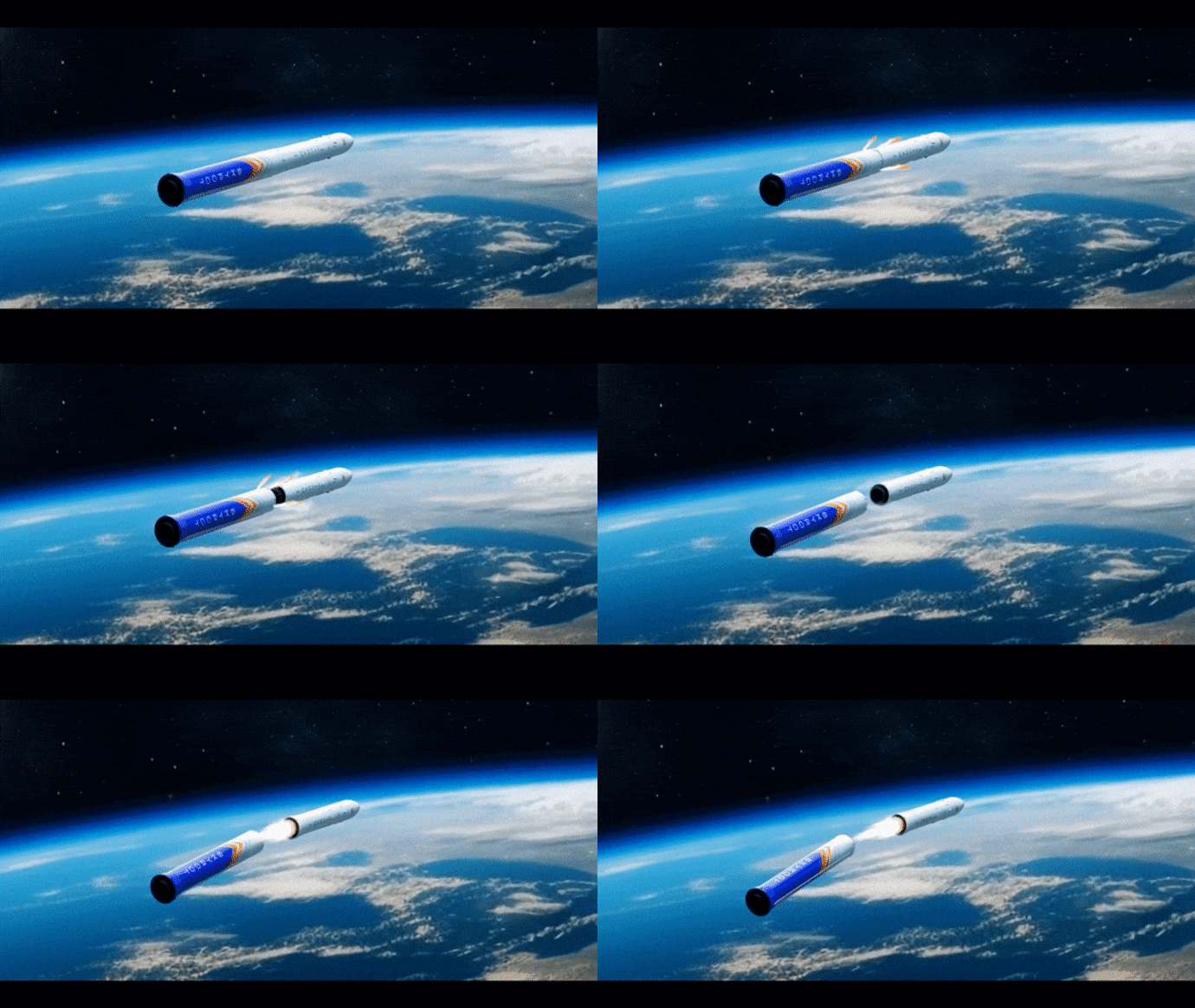
India is less than two weeks away from witnessing a launch that could redefine its space industry and usher in a new era of private spaceflight.
Between July 12 and August 4, Hyderabad-based startup Skyroot Aerospace will attempt to place its Vikram-I rocket into orbit from ISRO's Satish Dhawan Space Centre in Sriharikota. Dubbed Mission Aagaman, meaning arrival, the demonstration flight will be India's first privately developed orbital rocket launch attempt.
If successful, it will propel Skyroot into an elite global club of private companies capable of reaching orbit, a feat achieved by only a handful of firms worldwide, including the giant SpaceX, Blue Origin, Robketlab among others.
More importantly, the mission could mark the moment India's private space sector graduates from building components and technologies to independently launching satellites.
A LAUNCH YEARS IN THE MAKING
The seven-storey Vikram-I has already completed one of the biggest milestones before launch. All four stages have been stacked, transforming hundreds of components into a flight-ready launch vehicle.
According to Skyroot co-founder and CEO Pawan Chandana, the company is now focused on integrated vehicle checks at the launch pad.
"The rocket is now in a single piece. We are undergoing integrated checks where we verify the health of all systems, check every connection, and ensure everything is functioning as expected," Chandana told IndiaToday. in in an exclusive conversation.
Beyond the rocket itself, engineers are validating the entire launch ecosystem, from radars and telemetry to mission control and launch pad interfaces, to ensure seamless communication during flight.
Only after these checks, weather assessments and range clearances are complete will Vikram-I receive the final go-ahead for launch from Isro.
WHY IS VIKRAM-I BUILT FOR LEARNING?
Unlike a commercial satellite mission, Mission Aagaman is primarily an engineering demonstration.
While the rocket will carry multiple domestic and international payloads, they are all test payloads. The real cargo is data.
"The main objective is to understand how the rocket performs in an actual flight environment," Chandana said. "Ground testing can only tell us so much. The flight gives us the real data on propulsion, guidance, navigation, stage separation and the health of every system."
Like every new launch vehicle, from SpaceX's Falcon 1 to Rocket Lab's Electron, Vikram-I is expected to evolve over multiple flights before becoming a routine commercial launcher. The company's facility in Hyderabad is working 24 hours, seven days a week to churn out launch vehicles and work is already underway on the next rocket.
WHY VIKRAM-I'S LAUNCH MATTERS FOR INDIA?
The significance of Vikram-I extends well beyond Skyroot.
India opened its space sector to private companies only in 2020. In just six years, startups have developed rocket engines, satellites, propulsion systems and manufacturing capabilities. Yet one capability has remained elusive, reaching orbit independently.
If Vikram-I succeeds, Skyroot will become one of only a handful of private companies globally, including SpaceX, Rocket Lab, Firefly Aerospace, Orbex's peers and a few Chinese commercial firms, to have developed an orbital launch vehicle.
That achievement would signal that India is no longer merely participating in the global space economy but building the infrastructure needed to compete in it.
The success would also benefit ISRO.
For decades, the national space agency has balanced scientific missions, planetary exploration, navigation satellites, Earth observation, national security launches and commercial satellite deployments using a limited number of launch vehicles.
Private launch providers can shoulder part of that burden.
Small satellite operators often wait months, or even years, for launch opportunities because larger rockets prioritise heavier government payloads. Dedicated launch vehicles like Vikram-I allow customers to choose their own orbit and schedule instead of flying as secondary passengers.
That frees ISRO to concentrate on ambitious programmes such as Gaganyaan, the Bharatiya Antariksh Station, planetary missions and next-generation launch systems while the private sector serves the rapidly expanding commercial market.
India's space economy is projected to grow from about $8.4 billion today to nearly $44 billion by 2033, with indigenous launch capability expected to be a major driver of that expansion.
VIKRAM-I: BUILT FOR INDIA WITH HELP FROM ISRO
Although Vikram-I is privately developed, it will fly using ISRO's First Launch Pad at Sriharikota.
Skyroot has spent several years adapting the PSLV launch infrastructure to accommodate its smaller vehicle by designing custom fixtures and interfaces. Mission control will remain ISRO's infrastructure, while Skyroot's computers and flight systems will plug into it.
"Since PSLV is a much larger launch vehicle than Vikram-I, we had to develop custom interfaces and fixtures to adapt the launch pad for our rocket. These modifications allow our teams to access, assemble and operate Vikram-I safely from the existing infrastructure," Pawan added.
He further said that the teams have been working on these integrations with ISRO for the past few years, and all the required interfacing has now been completed successfully.
Unlike liquid-fuel rockets such as SpaceX's Falcon 9, Vikram-I will not undergo a traditional wet dress rehearsal because its first stage uses a solid rocket motor, eliminating the need for pre-launch propellant loading tests.
SUCCESS BEGINS AT LIFTOFF
For Pawan, expectations are grounded in engineering reality.
"A stable and safe liftoff itself is a major milestone," he said. "Every phase we successfully complete after that gives us more valuable flight data."
The company is already manufacturing its second Vikram-I vehicle and aims to conduct another launch before the end of the year, underscoring its ambition to establish a regular launch cadence.
Behind the excitement lies years of painstaking engineering.
"Rocket science is extremely difficult," Pawan said. "What keeps us awake is ensuring that every known issue has been addressed so that we can collect as much data as possible."
That philosophy captures the essence of Mission Aagaman.
Whether Vikram-I achieves every mission objective or simply demonstrates a flawless ascent, the rocket's liftoff will represent more than another launch from Sriharikota.
It will mark the arrival of a new generation of Indian space companies capable of designing, building and flying orbital-class rockets, opening a new chapter in the country's journey from a government-led space programme to a globally competitive commercial space ecosystem.
India is less than two weeks away from witnessing a launch that could redefine its space industry and usher in a new era of private spaceflight.
Between July 12 and August 4, Hyderabad-based startup Skyroot Aerospace will attempt to place its Vikram-I rocket into orbit from ISRO's Satish Dhawan Space Centre in Sriharikota. Dubbed Mission Aagaman, meaning arrival, the demonstration flight will be India's first privately developed orbital rocket launch attempt.
If successful, it will propel Skyroot into an elite global club of private companies capable of reaching orbit, a feat achieved by only a handful of firms worldwide, including the giant SpaceX, Blue Origin, Robketlab among others.
More importantly, the mission could mark the moment India's private space sector graduates from building components and technologies to independently launching satellites.
A LAUNCH YEARS IN THE MAKING
The seven-storey Vikram-I has already completed one of the biggest milestones before launch. All four stages have been stacked, transforming hundreds of components into a flight-ready launch vehicle.
According to Skyroot co-founder and CEO Pawan Chandana, the company is now focused on integrated vehicle checks at the launch pad.
"The rocket is now in a single piece. We are undergoing integrated checks where we verify the health of all systems, check every connection, and ensure everything is functioning as expected," Chandana told IndiaToday. in in an exclusive conversation.
Beyond the rocket itself, engineers are validating the entire launch ecosystem, from radars and telemetry to mission control and launch pad interfaces, to ensure seamless communication during flight.
Only after these checks, weather assessments and range clearances are complete will Vikram-I receive the final go-ahead for launch from Isro.
WHY IS VIKRAM-I BUILT FOR LEARNING?
Unlike a commercial satellite mission, Mission Aagaman is primarily an engineering demonstration.
While the rocket will carry multiple domestic and international payloads, they are all test payloads. The real cargo is data.
"The main objective is to understand how the rocket performs in an actual flight environment," Chandana said. "Ground testing can only tell us so much. The flight gives us the real data on propulsion, guidance, navigation, stage separation and the health of every system."
Like every new launch vehicle, from SpaceX's Falcon 1 to Rocket Lab's Electron, Vikram-I is expected to evolve over multiple flights before becoming a routine commercial launcher. The company's facility in Hyderabad is working 24 hours, seven days a week to churn out launch vehicles and work is already underway on the next rocket.
WHY VIKRAM-I'S LAUNCH MATTERS FOR INDIA?
The significance of Vikram-I extends well beyond Skyroot.
India opened its space sector to private companies only in 2020. In just six years, startups have developed rocket engines, satellites, propulsion systems and manufacturing capabilities. Yet one capability has remained elusive, reaching orbit independently.
If Vikram-I succeeds, Skyroot will become one of only a handful of private companies globally, including SpaceX, Rocket Lab, Firefly Aerospace, Orbex's peers and a few Chinese commercial firms, to have developed an orbital launch vehicle.
That achievement would signal that India is no longer merely participating in the global space economy but building the infrastructure needed to compete in it.
The success would also benefit ISRO.
For decades, the national space agency has balanced scientific missions, planetary exploration, navigation satellites, Earth observation, national security launches and commercial satellite deployments using a limited number of launch vehicles.
Private launch providers can shoulder part of that burden.
Small satellite operators often wait months, or even years, for launch opportunities because larger rockets prioritise heavier government payloads. Dedicated launch vehicles like Vikram-I allow customers to choose their own orbit and schedule instead of flying as secondary passengers.
That frees ISRO to concentrate on ambitious programmes such as Gaganyaan, the Bharatiya Antariksh Station, planetary missions and next-generation launch systems while the private sector serves the rapidly expanding commercial market.
India's space economy is projected to grow from about $8.4 billion today to nearly $44 billion by 2033, with indigenous launch capability expected to be a major driver of that expansion.
VIKRAM-I: BUILT FOR INDIA WITH HELP FROM ISRO
Although Vikram-I is privately developed, it will fly using ISRO's First Launch Pad at Sriharikota.
Skyroot has spent several years adapting the PSLV launch infrastructure to accommodate its smaller vehicle by designing custom fixtures and interfaces. Mission control will remain ISRO's infrastructure, while Skyroot's computers and flight systems will plug into it.
"Since PSLV is a much larger launch vehicle than Vikram-I, we had to develop custom interfaces and fixtures to adapt the launch pad for our rocket. These modifications allow our teams to access, assemble and operate Vikram-I safely from the existing infrastructure," Pawan added.
He further said that the teams have been working on these integrations with ISRO for the past few years, and all the required interfacing has now been completed successfully.
Unlike liquid-fuel rockets such as SpaceX's Falcon 9, Vikram-I will not undergo a traditional wet dress rehearsal because its first stage uses a solid rocket motor, eliminating the need for pre-launch propellant loading tests.
SUCCESS BEGINS AT LIFTOFF
For Pawan, expectations are grounded in engineering reality.
"A stable and safe liftoff itself is a major milestone," he said. "Every phase we successfully complete after that gives us more valuable flight data."
The company is already manufacturing its second Vikram-I vehicle and aims to conduct another launch before the end of the year, underscoring its ambition to establish a regular launch cadence.
Behind the excitement lies years of painstaking engineering.
"Rocket science is extremely difficult," Pawan said. "What keeps us awake is ensuring that every known issue has been addressed so that we can collect as much data as possible."
That philosophy captures the essence of Mission Aagaman.
Whether Vikram-I achieves every mission objective or simply demonstrates a flawless ascent, the rocket's liftoff will represent more than another launch from Sriharikota.
It will mark the arrival of a new generation of Indian space companies capable of designing, building and flying orbital-class rockets, opening a new chapter in the country's journey from a government-led space programme to a globally competitive commercial space ecosystem.

