US Army ammunition blast: What is lead azide and why is it triggering concerns?
Officials are preparing for a complex operation involving sensitive material, with atmospheric conditions and environmental monitoring playing a crucial role. Here's what's happening.
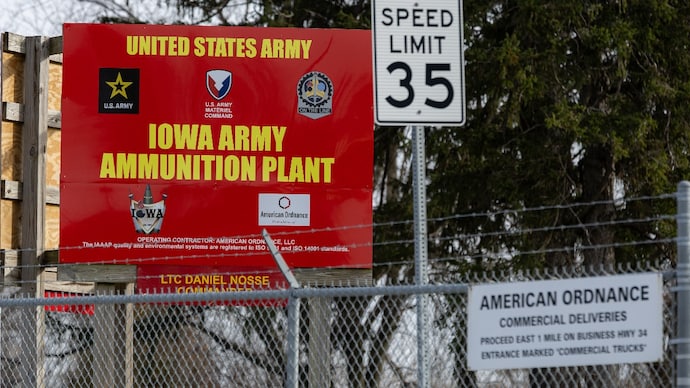
A major US government operation to destroy nearly 4.4 tonnes of unstable explosives is set to take place on Wednesday, November 25, at around 8:30 pm IST.
The operation at the Iowa Army Ammunition Plant in Middletown has triggered a coordinated federal response involving Nasa, the Federal Emergency Management Agency (FEMA), the Environmental Protection Agency (EPA) and other agencies.
In support of the operations, Nasa has deployed three research aircraft and activated satellite-based pollution monitoring at an ammunition plant in Iowa on Wednesday.
The concern surrounding the development is that the controlled explosion could release toxic lead particles into the air, potentially affecting nearby communities and the environment.
Nasa said it had deployed a P-3 Orion and a Gulfstream III from its Langley Research Center in Virginia, along with a contracted B200 aircraft from its Ames Research Center in California.
The space agency is also using observations from its TEMPO instrument in space, which monitors air pollution over North America.
Together, these capabilities will provide atmospheric and environmental information to support the federal response. TEMPO can track airborne pollutants and aerosols, although it is not designed to identify lead specifically.
WHY ARE THE EXPLOSIVES BEING BLOWN UP IN IOWA?
The material at the centre of the operation is lead azide, a highly sensitive explosive used to trigger larger explosions in ammunition.
Lead azide is a highly sensitive explosive compound used in detonators to trigger larger explosives. It can become dangerously unstable if it crystallises, making it vulnerable to friction, vibration, heat or shock.
During a routine safety inspection, the Army discovered that 68 drums containing more than 4,400 kg of the material had severely deteriorated.
To make matters worse, crystals had formed in the stored explosive, making it extremely sensitive to friction, vibration, heat and even minor shocks.
This means the drums cannot safely be moved, opened or treated with chemicals to neutralise their contents.
After examining several alternatives, the Army decided that destroying the material through a controlled explosion at the site was the only viable option.
WHY IS THERE A MASSIVE EMERGENCY RESPONSE?
The explosion itself is not the only concern.
Lead is toxic, and particles released during the blast could travel through the air before settling on homes, soil, farmland and other surfaces.
The Army has installed large sand barriers, water walls, gel blocks and foam systems to contain the blast and limit the spread of dust. Nasa's aircraft and satellite observations will supplement environmental monitoring being carried out by other agencies, including the EPA.
FEMA is supporting the recommended relocation of residents in a five-mile zone extending southwest of the plant.
As a precaution, people living within a wider 20-mile area have been advised to stay indoors with windows and doors closed.
CAN WINDS CARRY LEAD PARTICLES ACROSS THE REGION?
Weather conditions could also influence where airborne particles travel, making wind direction and atmospheric conditions particularly important.
A winter weather system is forecast to bring snow later Wednesday and into Thanksgiving Day.
The Army has said it will assess changing weather conditions before confirming the precise time of the explosion.
This is where Nasa weather monitoring infrastructure will play a crucial role to pink down to what to expect at the meteorological level.
With the operation hours away, officials have prepared extensive safeguards and monitoring arrangements to limit the environmental impact and respond if the explosion produces unexpected consequences.

