Born a century before India's independence: How 194-year-old tortoise is still alive
Jonathan, a 194-year-old Seychelles giant tortoise on Saint Helena, has been recognised as a Guinness World Records icon. Scientists say his exceptional lifespan could offer clues to extreme longevity and healthy ageing.
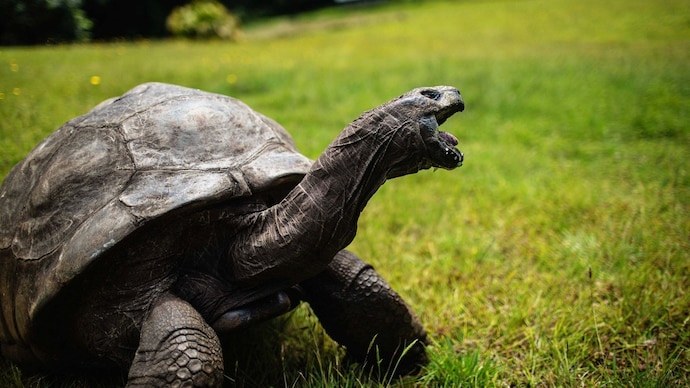
When Jonathan the tortoise was born around 1832, Queen Victoria had not yet ascended the British throne, Mahatma Gandhi had not been born, and India was firmly under British colonial rule.
Nearly two centuries later, Jonathan is still alive.
The Seychelles giant tortoise, believed to be 194 years old, has officially been recognised as a Guinness World Records ICON and remains the oldest known living land animal on Earth. His extraordinary age has fascinated scientists for years and offers a glimpse into one of nature's greatest mysteries: extreme longevity.
Jonathan lives on the South Atlantic island of Saint Helena, where he has become a global celebrity. While his exact birth date is unknown, historical records indicate he hatched around 1832 and arrived on the island in the 1880s as a fully grown adult.
THE GIANT OF THE SEYCHELLES
Jonathan belongs to the Seychelles giant tortoise species, a group of enormous herbivorous reptiles native to islands in the Indian Ocean. These tortoises can weigh more than 250 kilograms and grow over one metre in length.
The species evolved in isolated island environments with few natural predators, allowing them to develop slow lifestyles and remarkably long lifespans.
While many animals invest energy in rapid growth and reproduction, giant tortoises follow the opposite strategy: slow growth, delayed maturity and decades of reproduction.
The average lifespan of a Seychelles giant tortoise is estimated to be around 150 years, making them among the longest-lived vertebrates on the planet.
WHY DO THEY LIVE SO LONG?
Scientists believe several biological factors contribute to their longevity.
One key factor is their exceptionally slow metabolism. Giant tortoises burn energy at a much lower rate than mammals of similar size, reducing cellular damage over time.
A slower metabolism means fewer harmful byproducts are produced during normal bodily processes, potentially slowing ageing.
Research has also shown that giant tortoises possess genetic adaptations linked to DNA repair, immune function and cancer resistance. These mechanisms help cells remain healthy for longer periods and may protect the animals from age-related diseases.
Their large body size also plays a role. Larger animals generally face fewer predators and experience lower external mortality risks, allowing evolution to favour traits that support longer lifespans.
AGEING, BUT NOT AS WE KNOW IT
Remarkably, giant tortoises show little evidence of traditional ageing. Studies have found that many tortoise species experience what scientists call "negligible senescence," a condition where the rate of ageing is dramatically slower than in humans and most mammals.
Even at nearly 200 years old, Jonathan remains active. Although he has lost his sense of smell and is partially blind due to cataracts, caretakers report that he continues to enjoy eating, socialising and exploring his surroundings.
For scientists studying ageing, Jonathan is more than just a record-holder. He is a living laboratory, offering clues about how animals can remain healthy for decades beyond what seems biologically possible.
As researchers search for ways to extend healthy human lifespans, some of the answers may lie within the slow, steady life of a tortoise that has witnessed nearly two centuries of history unfold.
When Jonathan the tortoise was born around 1832, Queen Victoria had not yet ascended the British throne, Mahatma Gandhi had not been born, and India was firmly under British colonial rule.
Nearly two centuries later, Jonathan is still alive.
The Seychelles giant tortoise, believed to be 194 years old, has officially been recognised as a Guinness World Records ICON and remains the oldest known living land animal on Earth. His extraordinary age has fascinated scientists for years and offers a glimpse into one of nature's greatest mysteries: extreme longevity.
Jonathan lives on the South Atlantic island of Saint Helena, where he has become a global celebrity. While his exact birth date is unknown, historical records indicate he hatched around 1832 and arrived on the island in the 1880s as a fully grown adult.
THE GIANT OF THE SEYCHELLES
Jonathan belongs to the Seychelles giant tortoise species, a group of enormous herbivorous reptiles native to islands in the Indian Ocean. These tortoises can weigh more than 250 kilograms and grow over one metre in length.
The species evolved in isolated island environments with few natural predators, allowing them to develop slow lifestyles and remarkably long lifespans.
While many animals invest energy in rapid growth and reproduction, giant tortoises follow the opposite strategy: slow growth, delayed maturity and decades of reproduction.
The average lifespan of a Seychelles giant tortoise is estimated to be around 150 years, making them among the longest-lived vertebrates on the planet.
WHY DO THEY LIVE SO LONG?
Scientists believe several biological factors contribute to their longevity.
One key factor is their exceptionally slow metabolism. Giant tortoises burn energy at a much lower rate than mammals of similar size, reducing cellular damage over time.
A slower metabolism means fewer harmful byproducts are produced during normal bodily processes, potentially slowing ageing.
Research has also shown that giant tortoises possess genetic adaptations linked to DNA repair, immune function and cancer resistance. These mechanisms help cells remain healthy for longer periods and may protect the animals from age-related diseases.
Their large body size also plays a role. Larger animals generally face fewer predators and experience lower external mortality risks, allowing evolution to favour traits that support longer lifespans.
AGEING, BUT NOT AS WE KNOW IT
Remarkably, giant tortoises show little evidence of traditional ageing. Studies have found that many tortoise species experience what scientists call "negligible senescence," a condition where the rate of ageing is dramatically slower than in humans and most mammals.
Even at nearly 200 years old, Jonathan remains active. Although he has lost his sense of smell and is partially blind due to cataracts, caretakers report that he continues to enjoy eating, socialising and exploring his surroundings.
For scientists studying ageing, Jonathan is more than just a record-holder. He is a living laboratory, offering clues about how animals can remain healthy for decades beyond what seems biologically possible.
As researchers search for ways to extend healthy human lifespans, some of the answers may lie within the slow, steady life of a tortoise that has witnessed nearly two centuries of history unfold.

