Kashmir's Thajiwas glacier on cusp of vanishing, 95% ice lost since last Ice Age
A new study says Kashmir's Thajiwas Glacier has shrunk drastically since the last Ice Age. Scientists warn the retreat threatens water security, livelihoods and Sonamarg's fragile ecosystem.
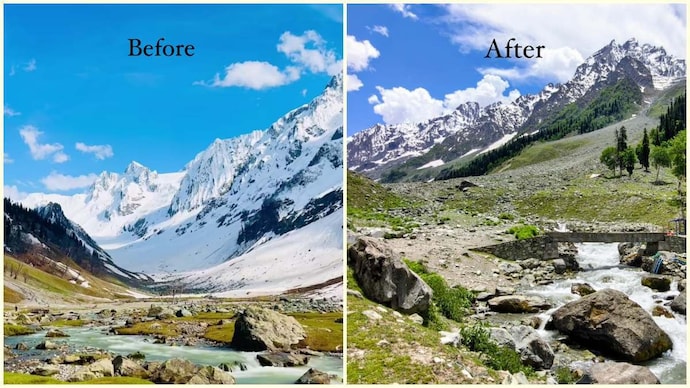


The famous Thajiwas Glacier, one of Kashmir’s most recognisable tourist attractions and a symbol of Sonamarg’s summer landscape, is rapidly disappearing, with a new scientific study revealing that nearly 95 per cent of its ice cover has been lost since the last Ice Age.
Researchers from the University of Kashmir (KU) and the Inter-University Accelerator Centre (IUAC), New Delhi, have found that the glacier, which once sprawled across nearly 54 square kilometres, has now shrunk to just 2.5 square kilometres.
The study, titled “Paleo-glacial Reconstruction of the Thajiwas Glacier in the Kashmir Himalaya,” describes the glacier as a “relic of a glacier,” a small remnant of what was once a massive ice body.
The findings paint a stark picture for Sonamarg, a popular hill destination in Jammu and Kashmir’s Ganderbal district. Visitors arriving this summer are greeted not by expansive snowfields but by dry meadows, patches of green grass and exposed brown earth. While distant Himalayan peaks still shimmer with snow, the iconic glacier that once defined the landscape has largely vanished.
Scientists attribute the dramatic retreat to a combination of factors, including rising temperatures across the Himalayas due to global warming, declining winter snowfall, black carbon pollution and increasing tourism pressure in an ecologically sensitive region.
Environmental geographer Dr Masoon A Beig warned that the loss represents an environmental crisis with far-reaching consequences.
“This means there is only about 5 to 7 per cent of the glacier cover left. It is nothing short of a disaster,” he said, adding that the retreat could affect agriculture, horticulture and hydropower generation in the region.
A WATER CRISIS IN THE MAKING
The Thajiwas Glacier is an important source of meltwater for the Sindh River, making its decline a concern not only for tourism but also for water security and local livelihoods.
Experts are now calling for urgent intervention, including Swiss-style glacier protection measures. Proposed steps include stricter controls on pollution and vehicle emissions, regulating tourist footfall, rerouting pony traffic, reducing black carbon deposits and enforcing zero-microplastic policies.
Scientists also stress the need for broader climate action aimed at reducing greenhouse gas emissions.
For many visitors, the glacier’s disappearance is deeply personal. Twenty-one-year-old Baidurjyo Kundu still remembers his first visit to Thajiwas in 2012 when, as a seven-year-old, he experienced snow for the first time.
“I always wanted to return with friends and make new memories there,” he said from his home in Delhi NCR. “The sad part is that I may never get to see the glacier the way it once was.”
As Thajiwas fades into history, its disappearance stands as a powerful image of the accelerating impact of climate change on the fragile Himalayan ecosystem.
The famous Thajiwas Glacier, one of Kashmir’s most recognisable tourist attractions and a symbol of Sonamarg’s summer landscape, is rapidly disappearing, with a new scientific study revealing that nearly 95 per cent of its ice cover has been lost since the last Ice Age.
Researchers from the University of Kashmir (KU) and the Inter-University Accelerator Centre (IUAC), New Delhi, have found that the glacier, which once sprawled across nearly 54 square kilometres, has now shrunk to just 2.5 square kilometres.
The study, titled “Paleo-glacial Reconstruction of the Thajiwas Glacier in the Kashmir Himalaya,” describes the glacier as a “relic of a glacier,” a small remnant of what was once a massive ice body.
The findings paint a stark picture for Sonamarg, a popular hill destination in Jammu and Kashmir’s Ganderbal district. Visitors arriving this summer are greeted not by expansive snowfields but by dry meadows, patches of green grass and exposed brown earth. While distant Himalayan peaks still shimmer with snow, the iconic glacier that once defined the landscape has largely vanished.
Scientists attribute the dramatic retreat to a combination of factors, including rising temperatures across the Himalayas due to global warming, declining winter snowfall, black carbon pollution and increasing tourism pressure in an ecologically sensitive region.
Environmental geographer Dr Masoon A Beig warned that the loss represents an environmental crisis with far-reaching consequences.
“This means there is only about 5 to 7 per cent of the glacier cover left. It is nothing short of a disaster,” he said, adding that the retreat could affect agriculture, horticulture and hydropower generation in the region.
A WATER CRISIS IN THE MAKING
The Thajiwas Glacier is an important source of meltwater for the Sindh River, making its decline a concern not only for tourism but also for water security and local livelihoods.
Experts are now calling for urgent intervention, including Swiss-style glacier protection measures. Proposed steps include stricter controls on pollution and vehicle emissions, regulating tourist footfall, rerouting pony traffic, reducing black carbon deposits and enforcing zero-microplastic policies.
Scientists also stress the need for broader climate action aimed at reducing greenhouse gas emissions.
For many visitors, the glacier’s disappearance is deeply personal. Twenty-one-year-old Baidurjyo Kundu still remembers his first visit to Thajiwas in 2012 when, as a seven-year-old, he experienced snow for the first time.
“I always wanted to return with friends and make new memories there,” he said from his home in Delhi NCR. “The sad part is that I may never get to see the glacier the way it once was.”
As Thajiwas fades into history, its disappearance stands as a powerful image of the accelerating impact of climate change on the fragile Himalayan ecosystem.

