Large Hadron Collider that discovered God Particle shut for four years: Here's why
Cern has switched off the Large Hadron Collider for a four-year shutdown and overhaul. The work will prepare the machine for its High-Luminosity phase and a major rise in data collection.
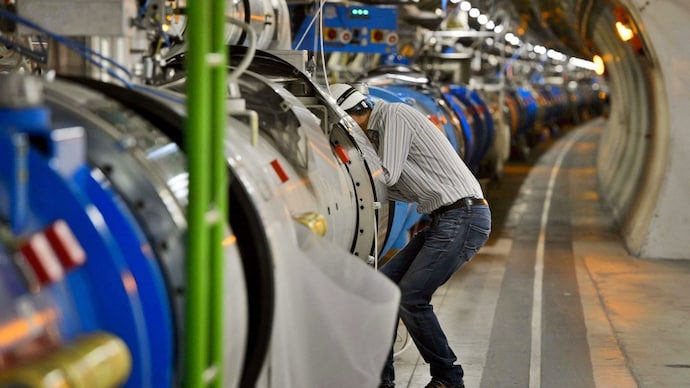
The Large Hadron Collider (LHC), the world's most powerful particle accelerator and the machine that famously discovered the Higgs boson, often called the God Particle, has been switched off after nearly two decades of groundbreaking science.
But the shutdown does not mark the end of the collider's journey.
Instead, it signals the beginning of one of the biggest engineering overhauls in Cern's history as scientists prepare the accelerator for its next incarnation, the High-Luminosity Large Hadron Collider (HiLumi LHC).
The four-year shutdown, known as Long Shutdown 3 (LS3), will run until 2030 and will involve extensive maintenance, upgrades and the installation of new technologies across Cern's accelerator complex.
Since circulating its first particle beams in September 2008, the 27-kilometre-long underground collider near Geneva has revolutionised particle physics. It delivered its first proton collisions in 2009 and, over three scientific runs, generated an unprecedented volume of data that transformed scientists' understanding of the Universe.
WHAT IS A GOD PARTICLE?
The collider's defining moment came on July 4, 2012, when the Atlas and CMS experiments announced the discovery of the Higgs boson, confirming a theory proposed nearly 50 years earlier that explains how fundamental particles acquire mass.
The Higgs boson, popularly known as the God Particle, is the particle that proves the existence of the Higgs field, an invisible field spread across the Universe.
This field gives fundamental particles their mass. Without it, atoms, stars, planets, and even humans wouldn't exist.
The LHC's achievements extended far beyond the Higgs boson. Scientists discovered more than 85 new hadrons, conducted precision studies of antimatter, explored particles that existed moments after the Big Bang, and placed increasingly stringent limits on the existence of particles beyond the Standard Model of physics.
"The LHC has exceeded every expectation," said Oliver Bruning, Cern's Director for Accelerators and Technology. "For nearly two decades, it has transformed our understanding of the Universe."
Now comes an even bigger challenge.
WHAT NEW UPGRADES WILL BE DONE TO THE LHC?
During LS3, engineers will remove and replace 1.2 kilometres of magnets and accelerator components, upgrade the Super Proton Synchrotron, modernise detector facilities and renovate critical infrastructure across Cern.
Thousands of engineers, physicists and technicians from around the world will participate in what Cern describes as its largest intervention since the collider was originally built.
The LHC's flagship detectors, Atlas and CMS, will also receive major upgrades. The new systems will be designed to cope with 140 to 200 proton-proton collisions every time particle bunches cross, compared with around 60 collisions during the collider's most recent run.
To handle this enormous increase in data, scientists are installing next-generation trigger systems, ultra-fast timing detectors capable of measuring events within trillionths of a second, and advanced all-silicon tracking systems containing billions of readout channels.
Although particle beams will remain switched off, Cern's research will not stop. Physicists will continue analysing the vast datasets collected over the past 17 years, searching for new insights into dark matter, antimatter and other unanswered mysteries of the cosmos.
When the upgraded High-Luminosity LHC begins operations in 2030, it is expected to increase the collider's data-collecting capability by up to ten times its original design.
The Large Hadron Collider (LHC), the world's most powerful particle accelerator and the machine that famously discovered the Higgs boson, often called the God Particle, has been switched off after nearly two decades of groundbreaking science.
But the shutdown does not mark the end of the collider's journey.
Instead, it signals the beginning of one of the biggest engineering overhauls in Cern's history as scientists prepare the accelerator for its next incarnation, the High-Luminosity Large Hadron Collider (HiLumi LHC).
The four-year shutdown, known as Long Shutdown 3 (LS3), will run until 2030 and will involve extensive maintenance, upgrades and the installation of new technologies across Cern's accelerator complex.
Since circulating its first particle beams in September 2008, the 27-kilometre-long underground collider near Geneva has revolutionised particle physics. It delivered its first proton collisions in 2009 and, over three scientific runs, generated an unprecedented volume of data that transformed scientists' understanding of the Universe.
WHAT IS A GOD PARTICLE?
The collider's defining moment came on July 4, 2012, when the Atlas and CMS experiments announced the discovery of the Higgs boson, confirming a theory proposed nearly 50 years earlier that explains how fundamental particles acquire mass.
The Higgs boson, popularly known as the God Particle, is the particle that proves the existence of the Higgs field, an invisible field spread across the Universe.
This field gives fundamental particles their mass. Without it, atoms, stars, planets, and even humans wouldn't exist.
The LHC's achievements extended far beyond the Higgs boson. Scientists discovered more than 85 new hadrons, conducted precision studies of antimatter, explored particles that existed moments after the Big Bang, and placed increasingly stringent limits on the existence of particles beyond the Standard Model of physics.
"The LHC has exceeded every expectation," said Oliver Bruning, Cern's Director for Accelerators and Technology. "For nearly two decades, it has transformed our understanding of the Universe."
Now comes an even bigger challenge.
WHAT NEW UPGRADES WILL BE DONE TO THE LHC?
During LS3, engineers will remove and replace 1.2 kilometres of magnets and accelerator components, upgrade the Super Proton Synchrotron, modernise detector facilities and renovate critical infrastructure across Cern.
Thousands of engineers, physicists and technicians from around the world will participate in what Cern describes as its largest intervention since the collider was originally built.
The LHC's flagship detectors, Atlas and CMS, will also receive major upgrades. The new systems will be designed to cope with 140 to 200 proton-proton collisions every time particle bunches cross, compared with around 60 collisions during the collider's most recent run.
To handle this enormous increase in data, scientists are installing next-generation trigger systems, ultra-fast timing detectors capable of measuring events within trillionths of a second, and advanced all-silicon tracking systems containing billions of readout channels.
Although particle beams will remain switched off, Cern's research will not stop. Physicists will continue analysing the vast datasets collected over the past 17 years, searching for new insights into dark matter, antimatter and other unanswered mysteries of the cosmos.
When the upgraded High-Luminosity LHC begins operations in 2030, it is expected to increase the collider's data-collecting capability by up to ten times its original design.

