Two Nasa astronauts to conduct seven-hour-long spacewalk to fix broken robotic arm
Two Nasa astronauts will step outside the International Space Station (ISS) on June 30 to replace a broken wrist joint on the 25-year-old Canadarm2 robotic arm. The repair spacewalk, expected to last nearly seven hours, is the 278th in the history of the space station.
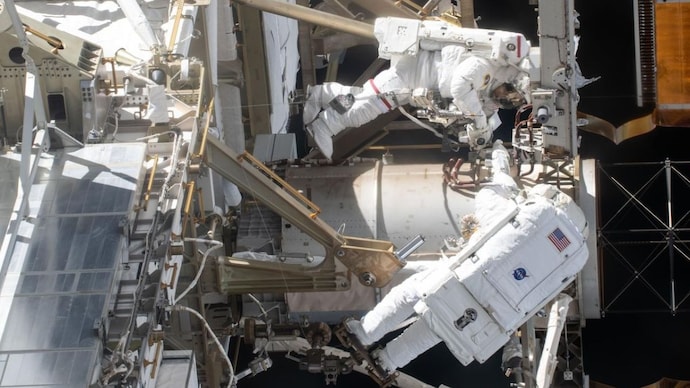
Two Nasa astronauts will step outside the International Space Station (ISS) on June 30 to repair a fault in the Canadarm2, the 17.6-metre robotic arm that has been reaching, grabbing, and shifting cargo in the silence of space for over 25 years.
The arm has helped build the Space Station piece by piece, shuffled astronauts during spacewalks, and berthed visiting spacecraft.
It has done all of this from roughly 400 kilometres above Earth, in a vacuum where temperatures swing between -157 and 121 degrees Celsius, without once stopping for a repair.
Until now. The Canadarm2, operated jointly by Nasa and the Canadian Space Agency (CSA), has developed a fault in one of its wrist joints. On June 30, the two astronauts will climb outside the orbital laboratory to fix it.
The spacewalk is expected to last nearly seven hours.
THE ARM THAT BUILT A SPACE STATION
The Canadarm2 is not a robotic arm in the way a factory robot is. It does not have a fixed base.
It can crawl along the exterior of the station, gripping a surface at one end, releasing, and gripping again with the other, the way an inchworm moves, transporting itself to wherever it is needed.
It has seven motorised joints, each capable of rotating through a range of motion, giving the arm a degree of flexibility that closely resembles a human limb.
Each of those joints is called a wrist, shoulder, or elbow, for precisely this reason.
One of those wrist joints has now malfunctioned. Nasa and the CSA analysed the problem and concluded that no software fix or workaround would resolve it.
The only solution is a physical replacement, conducted by human hands, in space.
THE SPACEWALKERS
Nasa flight engineers Jessica Meir and Chris Williams will begin the repair on June 30 at 7:35 am EDT (5:05 pm IST), stepping outside the station through the Quest airlock.
The joint spacewalk, which is expected to last approximately six hours and 40 minutes, will involve removing the faulty wrist joint and replacing it with a spare already stored aboard the station.
A spacewalk, also called an extravehicular activity or EVA, is any time an astronaut exits a spacecraft to work in open space.
It requires a pressurised suit that supplies oxygen, regulates body temperature, and protects against radiation and micrometeoroids, which are tiny, fast-moving particles of rock and dust drifting through space.
This will be the 278th spacewalk conducted in support of space station maintenance, upgrades, and assembly. It will be Williams's second spacewalk and Meir's fifth.
On Tuesday, the duo prepared inside the station. Williams tried on his spacesuit and tested it in its powered configuration with assistance from ESA flight engineer Sophie Adenot.
Together, they worked inside the Quest airlock to check the suit's pressure, comfort, mobility, and its communications and life support systems, while engineers on the ground monitored the readings.
Williams and Meir then reviewed a 3D interactive animation of the procedures on a computer, walking through every movement they would make outside the station before they make it in real time.
Afterward, they serviced emergency jetpacks that would be strapped to their suits on the day of the walk.
These are called SAFER units, short for Simplified Aid for EVA Rescue, worn as a backpack and used to propel an astronaut back to safety should they become untethered from the station.
Meir also installed batteries inside pistol grip tools, handheld power tools designed specifically for use in microgravity, which is the condition of near-weightlessness experienced in orbit, where objects float because both the station and everything inside it are in a continuous state of free-fall around Earth.
INSIDE THE STATION
While the two spacewalkers prepared, the rest of the Expedition 74 crew stayed busy.
Esa’s Sophie Adenot and Nasa flight engineer Jack Hathaway, who will serve as the inside crew monitoring the spacewalkers during the EVA, studied their support roles, including how to carefully position the Canadarm2 during the repair work.
Hathaway also handled a separate assignment involving CubeSats.
He removed a small satellite orbital deployer from the Kibo laboratory module's airlock and installed a fresh set of CubeSats inside a NanoRacks deployer, which will soon be placed outside Kibo’s airlock and released into Earth orbit.
CubeSats are miniature satellites, typically the size of a shoebox, designed to be cheap, light, and fast to build.
The batch being prepared was designed by university students for communications and technology experiments.
In the Russian segment, station commander Sergey Kud-Sverchkov and flight engineer Sergei Mikaev performed eye checks using standard medical imaging hardware, as part of ongoing research into how spaceflight affects the retina, lens, and cornea.
Roscosmos flight engineer Andrey Fedyaev continued testing artificial intelligence tools aimed at improving crew efficiency and communications in space.
A Nasa and CSA briefing previewing the spacewalk will be held on June 25 at 2 pm EDT (11:30 pm IST) on Nasa’s YouTube channel.
Two Nasa astronauts will step outside the International Space Station (ISS) on June 30 to repair a fault in the Canadarm2, the 17.6-metre robotic arm that has been reaching, grabbing, and shifting cargo in the silence of space for over 25 years.
The arm has helped build the Space Station piece by piece, shuffled astronauts during spacewalks, and berthed visiting spacecraft.
It has done all of this from roughly 400 kilometres above Earth, in a vacuum where temperatures swing between -157 and 121 degrees Celsius, without once stopping for a repair.
Until now. The Canadarm2, operated jointly by Nasa and the Canadian Space Agency (CSA), has developed a fault in one of its wrist joints. On June 30, the two astronauts will climb outside the orbital laboratory to fix it.
The spacewalk is expected to last nearly seven hours.
THE ARM THAT BUILT A SPACE STATION
The Canadarm2 is not a robotic arm in the way a factory robot is. It does not have a fixed base.
It can crawl along the exterior of the station, gripping a surface at one end, releasing, and gripping again with the other, the way an inchworm moves, transporting itself to wherever it is needed.
It has seven motorised joints, each capable of rotating through a range of motion, giving the arm a degree of flexibility that closely resembles a human limb.
Each of those joints is called a wrist, shoulder, or elbow, for precisely this reason.
One of those wrist joints has now malfunctioned. Nasa and the CSA analysed the problem and concluded that no software fix or workaround would resolve it.
The only solution is a physical replacement, conducted by human hands, in space.
THE SPACEWALKERS
Nasa flight engineers Jessica Meir and Chris Williams will begin the repair on June 30 at 7:35 am EDT (5:05 pm IST), stepping outside the station through the Quest airlock.
The joint spacewalk, which is expected to last approximately six hours and 40 minutes, will involve removing the faulty wrist joint and replacing it with a spare already stored aboard the station.
A spacewalk, also called an extravehicular activity or EVA, is any time an astronaut exits a spacecraft to work in open space.
It requires a pressurised suit that supplies oxygen, regulates body temperature, and protects against radiation and micrometeoroids, which are tiny, fast-moving particles of rock and dust drifting through space.
This will be the 278th spacewalk conducted in support of space station maintenance, upgrades, and assembly. It will be Williams's second spacewalk and Meir's fifth.
On Tuesday, the duo prepared inside the station. Williams tried on his spacesuit and tested it in its powered configuration with assistance from ESA flight engineer Sophie Adenot.
Together, they worked inside the Quest airlock to check the suit's pressure, comfort, mobility, and its communications and life support systems, while engineers on the ground monitored the readings.
Williams and Meir then reviewed a 3D interactive animation of the procedures on a computer, walking through every movement they would make outside the station before they make it in real time.
Afterward, they serviced emergency jetpacks that would be strapped to their suits on the day of the walk.
These are called SAFER units, short for Simplified Aid for EVA Rescue, worn as a backpack and used to propel an astronaut back to safety should they become untethered from the station.
Meir also installed batteries inside pistol grip tools, handheld power tools designed specifically for use in microgravity, which is the condition of near-weightlessness experienced in orbit, where objects float because both the station and everything inside it are in a continuous state of free-fall around Earth.
INSIDE THE STATION
While the two spacewalkers prepared, the rest of the Expedition 74 crew stayed busy.
Esa’s Sophie Adenot and Nasa flight engineer Jack Hathaway, who will serve as the inside crew monitoring the spacewalkers during the EVA, studied their support roles, including how to carefully position the Canadarm2 during the repair work.
Hathaway also handled a separate assignment involving CubeSats.
He removed a small satellite orbital deployer from the Kibo laboratory module's airlock and installed a fresh set of CubeSats inside a NanoRacks deployer, which will soon be placed outside Kibo’s airlock and released into Earth orbit.
CubeSats are miniature satellites, typically the size of a shoebox, designed to be cheap, light, and fast to build.
The batch being prepared was designed by university students for communications and technology experiments.
In the Russian segment, station commander Sergey Kud-Sverchkov and flight engineer Sergei Mikaev performed eye checks using standard medical imaging hardware, as part of ongoing research into how spaceflight affects the retina, lens, and cornea.
Roscosmos flight engineer Andrey Fedyaev continued testing artificial intelligence tools aimed at improving crew efficiency and communications in space.
A Nasa and CSA briefing previewing the spacewalk will be held on June 25 at 2 pm EDT (11:30 pm IST) on Nasa’s YouTube channel.

