Nasa's Swift telescope rescue mission launch scrubbed: When is the next attempt?
Nasa postponed the Swift Boost launch due to bad weather. The mission aims to robotically rescue the ageing Swift Observatory and extend its life in orbit.
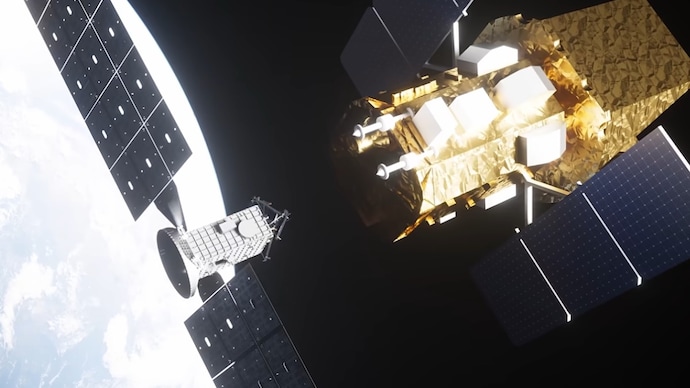
Nasa's ambitious Swift Boost mission has been called off after unfavourable weather forced officials to scrub Tuesday's planned launch.
The mission was scheduled to lift off at around 3:47 pm IST from Kwajalein Atoll in the Marshall Islands aboard Northrop Grumman's Pegasus XL rocket, carrying a robotic spacecraft designed to rescue one of Nasa's ageing space telescopes.
The space agency said the launch was cancelled because weather conditions were not suitable for a safe liftoff.
Nasa, however, said in a press release that another launch attempt would be made no earlier than Wednesday, July 1, at 3:13 pm IST.
WHY IS NASA RESCUING SWIFT?
Unlike most launches that send a brand-new satellite into orbit, Swift Boost aims to save one that has been operating in space for more than two decades.
Nasa's Neil Gehrels Swift Observatory, launched in 2004, was built to study gamma-ray bursts, which is the universe's most powerful explosions, as well as black holes, neutron stars and other high-energy cosmic events.
Although it was designed for a two-year mission, Swift remains one of Nasa's most productive space observatories.
The problem is that the telescope's orbit has been shrinking. Increased solar activity has heated and expanded Earth's upper atmosphere, creating extra atmospheric drag that is slowly pulling Swift closer to Earth.
Because the spacecraft was never equipped with engines, it cannot raise its own orbit and is projected to re-enter the atmosphere as early as this fall if nothing is done.
HOW WILL NASA SAVE SWIFT?
To extend Swift's life, Nasa awarded a contract in 2025 to Arizona-based Katalyst Space Technologies, which developed a robotic servicing spacecraft called LINK.
After launch, LINK will spend several weeks catching up with Swift before autonomously docking with it using three robotic arms.
Once attached, LINK will gradually fire its ion propulsion system over several months, pushing the telescope into a higher orbit about 600 kilometres above Earth, where it can continue carrying out scientific observations for years to come.
The mission is considered a major technology demonstration because no operational Nasa science observatory has ever been robotically "rescued" in this way.
If successful, Swift Boost could pave the way for future missions that repair, refuel or reposition ageing satellites instead of replacing them, potentially reducing costs, cutting space debris and making long-term space operations more sustainable.
Nasa's ambitious Swift Boost mission has been called off after unfavourable weather forced officials to scrub Tuesday's planned launch.
The mission was scheduled to lift off at around 3:47 pm IST from Kwajalein Atoll in the Marshall Islands aboard Northrop Grumman's Pegasus XL rocket, carrying a robotic spacecraft designed to rescue one of Nasa's ageing space telescopes.
The space agency said the launch was cancelled because weather conditions were not suitable for a safe liftoff.
Nasa, however, said in a press release that another launch attempt would be made no earlier than Wednesday, July 1, at 3:13 pm IST.
WHY IS NASA RESCUING SWIFT?
Unlike most launches that send a brand-new satellite into orbit, Swift Boost aims to save one that has been operating in space for more than two decades.
Nasa's Neil Gehrels Swift Observatory, launched in 2004, was built to study gamma-ray bursts, which is the universe's most powerful explosions, as well as black holes, neutron stars and other high-energy cosmic events.
Although it was designed for a two-year mission, Swift remains one of Nasa's most productive space observatories.
The problem is that the telescope's orbit has been shrinking. Increased solar activity has heated and expanded Earth's upper atmosphere, creating extra atmospheric drag that is slowly pulling Swift closer to Earth.
Because the spacecraft was never equipped with engines, it cannot raise its own orbit and is projected to re-enter the atmosphere as early as this fall if nothing is done.
HOW WILL NASA SAVE SWIFT?
To extend Swift's life, Nasa awarded a contract in 2025 to Arizona-based Katalyst Space Technologies, which developed a robotic servicing spacecraft called LINK.
After launch, LINK will spend several weeks catching up with Swift before autonomously docking with it using three robotic arms.
Once attached, LINK will gradually fire its ion propulsion system over several months, pushing the telescope into a higher orbit about 600 kilometres above Earth, where it can continue carrying out scientific observations for years to come.
The mission is considered a major technology demonstration because no operational Nasa science observatory has ever been robotically "rescued" in this way.
If successful, Swift Boost could pave the way for future missions that repair, refuel or reposition ageing satellites instead of replacing them, potentially reducing costs, cutting space debris and making long-term space operations more sustainable.

