Nasa to launch Swift telescope rescue mission on Tuesday: Here's what it will do
The mission will use a robotic spacecraft to rescue an ageing space observatory that is falling out of orbit, showcasing the future of satellite servicing in space. Here's what is planned.
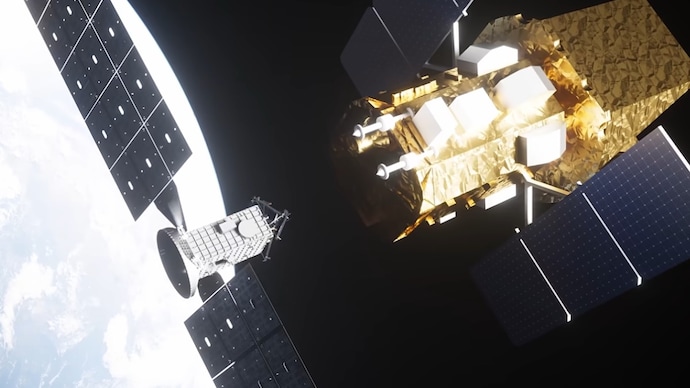
Nasa is preparing to launch the Swift Boost mission, one of its most ambitious orbital rescue missions yet, no earlier than June 30, at around 3:53 pm IST.
Instead of sending a new scientific spacecraft into orbit, the mission aims to save one that's already there, which could be a feat that could transform how satellites and space telescopes are maintained in the future.
The mission will see a robotic servicing spacecraft named LINK, built by Arizona-based Katalyst Space Technologies, launch aboard a Northrop Grumman Pegasus XL rocket.
Once in orbit, LINK will rendezvous with Nasa's 22-year-old Neil Gehrels Swift Observatory, capture it using robotic arms and raise it into a higher orbit, potentially extending its scientific life by several years.
If successful, it would mark one of the first US demonstrations of robotic satellite servicing in orbit, paving the way for repairing, refuelling and upgrading spacecraft instead of replacing them.
WHAT IS NASA SAVING AND WHY?
Launched in 2004, the Neil Gehrels Swift Observatory was originally designed to study gamma-ray bursts, which are the universe's most powerful explosions.
Over the years, however, it has evolved into one of Nasa's most versatile space observatories, detecting supernovae, black holes, neutron star mergers, comets and other short-lived cosmic events across gamma-ray, X-ray, ultraviolet and visible light.
Like all spacecraft in low-Earth orbit, Swift has gradually been losing altitude because of atmospheric drag.
Recent periods of heightened solar activity have heated and expanded Earth's upper atmosphere, increasing drag and causing the observatory's orbit to decay faster than expected.
Since Swift has no propulsion system of its own, Nasa faced the prospect of eventually losing a spacecraft that remains scientifically productive.
Rather than allowing the telescope to re-enter Earth's atmosphere, Nasa has opted for an innovative solution. It's going to rescue it.
A TEST FOR SPACE EXPLORATION
Nasa awarded Katalyst Space Technologies the contract in September 2025, giving the company less than a year to design, build and test the LINK spacecraft.
After launch, LINK will spend several weeks approaching Swift before carefully docking with the observatory and gradually lifting it into a safer orbit. Nasa has not yet shared an exact day-to-day timeline for the planned mission after launch.
Beyond extending Swift's lifespan, the mission is intended to demonstrate technologies that could become increasingly important as thousands of satellites populate Earth's orbit.
Instead of abandoning ageing spacecraft, future robotic servicing missions could repair, reposition or refuel them, reducing costs and helping tackle the growing challenge of orbital debris.
For Nasa, Swift Boost is therefore more than a rescue mission. It is a test of a new way of operating in space, one where valuable spacecraft can be maintained and upgraded rather than discarded, making future space exploration more sustainable and cost-effective.
Nasa is preparing to launch the Swift Boost mission, one of its most ambitious orbital rescue missions yet, no earlier than June 30, at around 3:53 pm IST.
Instead of sending a new scientific spacecraft into orbit, the mission aims to save one that's already there, which could be a feat that could transform how satellites and space telescopes are maintained in the future.
The mission will see a robotic servicing spacecraft named LINK, built by Arizona-based Katalyst Space Technologies, launch aboard a Northrop Grumman Pegasus XL rocket.
Once in orbit, LINK will rendezvous with Nasa's 22-year-old Neil Gehrels Swift Observatory, capture it using robotic arms and raise it into a higher orbit, potentially extending its scientific life by several years.
If successful, it would mark one of the first US demonstrations of robotic satellite servicing in orbit, paving the way for repairing, refuelling and upgrading spacecraft instead of replacing them.
WHAT IS NASA SAVING AND WHY?
Launched in 2004, the Neil Gehrels Swift Observatory was originally designed to study gamma-ray bursts, which are the universe's most powerful explosions.
Over the years, however, it has evolved into one of Nasa's most versatile space observatories, detecting supernovae, black holes, neutron star mergers, comets and other short-lived cosmic events across gamma-ray, X-ray, ultraviolet and visible light.
Like all spacecraft in low-Earth orbit, Swift has gradually been losing altitude because of atmospheric drag.
Recent periods of heightened solar activity have heated and expanded Earth's upper atmosphere, increasing drag and causing the observatory's orbit to decay faster than expected.
Since Swift has no propulsion system of its own, Nasa faced the prospect of eventually losing a spacecraft that remains scientifically productive.
Rather than allowing the telescope to re-enter Earth's atmosphere, Nasa has opted for an innovative solution. It's going to rescue it.
A TEST FOR SPACE EXPLORATION
Nasa awarded Katalyst Space Technologies the contract in September 2025, giving the company less than a year to design, build and test the LINK spacecraft.
After launch, LINK will spend several weeks approaching Swift before carefully docking with the observatory and gradually lifting it into a safer orbit. Nasa has not yet shared an exact day-to-day timeline for the planned mission after launch.
Beyond extending Swift's lifespan, the mission is intended to demonstrate technologies that could become increasingly important as thousands of satellites populate Earth's orbit.
Instead of abandoning ageing spacecraft, future robotic servicing missions could repair, reposition or refuel them, reducing costs and helping tackle the growing challenge of orbital debris.
For Nasa, Swift Boost is therefore more than a rescue mission. It is a test of a new way of operating in space, one where valuable spacecraft can be maintained and upgraded rather than discarded, making future space exploration more sustainable and cost-effective.

