Nasa to push a telescope falling to Earth away from it with another spacecraft
Nasa has tasked Katalyst Space's LINK spacecraft with raising the Neil Gehrels Swift Observatory into a higher orbit before it falls back towards Earth.
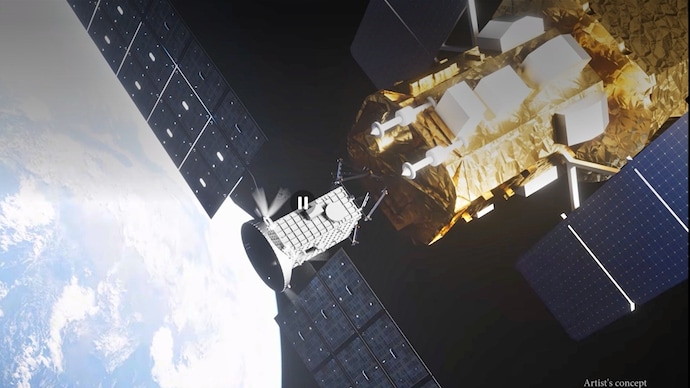
Nasa is preparing for a first-of-its-kind space rescue mission that could redefine how ageing satellites and observatories are maintained in orbit.
A privately built robotic spacecraft will attempt to rendezvous with the agency's Neil Gehrels Swift Observatory and push it into a higher orbit before it falls back toward Earth.
The ambitious mission aims to extend the life of Swift, one of Nasa's most versatile space telescopes, which has spent nearly two decades studying some of the universe's most energetic phenomena, including gamma-ray bursts, black holes, neutron stars, and supernova explosions.
Nasa has contracted Arizona-based Katalyst Space to carry out the mission using its robotic servicing spacecraft called LINK. The spacecraft is scheduled to launch aboard a Northrop Grumman Pegasus XL rocket from Kwajalein Atoll in the Marshall Islands.
Once in orbit, LINK will spend several months carefully approaching Swift before attempting one of the most challenging manoeuvres ever attempted in low-Earth orbit: capturing and boosting a spacecraft that was never designed to be serviced.
The challenge comes as Swift has been steadily losing altitude. Like all spacecraft in low-Earth orbit, the observatory experiences drag from Earth's upper atmosphere. Over time, this drag causes satellites to gradually descend unless they have propulsion systems to maintain their orbit.
Swift lacks such a propulsion system. The situation worsened after a series of intense solar storms heated and expanded Earth's atmosphere, increasing atmospheric drag and causing the observatory to sink faster than expected.
Rather than allowing Swift to re-enter Earth's atmosphere and burn up, Nasa saw an opportunity to demonstrate a technology that could be crucial to the future of space exploration.
The agency awarded Katalyst the contract in September 2025, giving the company less than a year to design, build, test, and launch the servicing spacecraft.
During that period, engineers at Nasa's Goddard Space Flight Center and Pennsylvania State University implemented operational changes to keep Swift above 300 kilometers in altitude, the minimum height considered optimal for the rescue mission.
If successful, the mission will mark a major milestone in on-orbit servicing, a field increasingly viewed as essential for sustainable space operations. Future robotic spacecraft could potentially refuel satellites, repair damaged systems, remove space debris, or extend the lives of expensive scientific observatories.
For Nasa, the mission offers a dual benefit. It preserves Swift's unique scientific capabilities while providing a real-world demonstration of technology that could save billions of dollars in future missions.
As LINK prepares for launch, space engineers around the world will be watching closely. If all goes according to plan, Nasa will prove that sometimes the best way to save a spacecraft is not to replace it—but to give it a helping push back toward the stars.

