Ghost sharks, death ball sponges: 1,100 new species discovered hiding in oceans
Scientists have discovered 1,121 new ocean species in a single year, including a ghost shark, a carnivorous death ball sponge, and a worm that lives inside a glass castle.
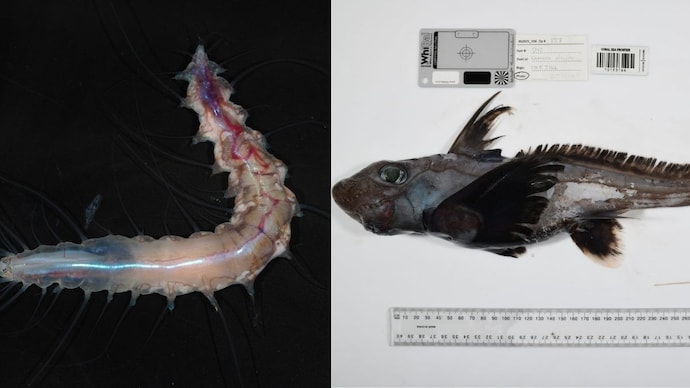
A bristle worm that lives inside a glass castle, a distant cousin of the shark that looks like a ghost, and a carnivorous sponge that wraps around its prey like a deadly ball. These are not creatures from science fiction but real, and they were found in our own oceans just last year.
Scientists have announced the discovery of 1,121 previously unknown marine species in a single year, in what is being described as a landmark moment for ocean science.
The findings were announced by the Ocean Census, a global initiative to catalogue ocean life involving more than 1,000 researchers across 85 countries.
The number represents a 54 per cent increase in annual species identifications compared to previous years, according to the organisation's Year 3 Impact Report.
Led by Japan's Nippon Foundation and Nekton, a British ocean exploration institute, the Ocean Census has been operating for three years. Its scientists conducted 13 expeditions to some of the least explored stretches of ocean on Earth to compile this list.
THE WORM IN THE GLASS CASTLE
Off the coast of Japan, at roughly 2,600 feet below the ocean's surface, researchers found a new species of bristle worm living inside a glass sponge.
Glass sponges are remarkable structures: their skeletons are made of silica, the same material as glass, giving them a translucent, mesh-like appearance. Scientists nicknamed it a glass castle, and it earned that name.
The worm's scientific name is Dalhousiella yabukii, named after the expedition's principal investigator, Dr Akinori Yabuki. It was discovered and described by Dr Naoto Jimi and colleagues, with the findings published in the Zoological Journal of the Linnean Society.
Interestingly, a second symbiotic worm species, Leocratides watanabeae, was found sharing the same glass sponge, and the study found their symbiotic lifestyles evolved independently of each other.
The worm and the sponge have what biologists call a symbiotic relationship, which means both creatures benefit from the arrangement. The worm gets a nutrient-rich, stable home inside the sponge.
In return, it cleans the sponge's surface of debris that could otherwise damage it. Two very different animals, helping each other survive in the dark.
THE GHOST SHARK
In the waters of Australia's Coral Sea Marine Park, at around 2,700 feet deep, scientists found a ghost shark, technically known as a chimaera.
These are not sharks in the conventional sense.
Ghost sharks are ancient relatives of sharks and rays, and their evolutionary paths diverged approximately 400 million years ago.
That is before the dinosaurs. Their pale, ghostly appearance and alien-like features have earned them their nickname.
THE DEATH BALL SPONGE
Perhaps the most dramatic find came from the North Trench of the South Sandwich Islands in the South Atlantic Ocean, at nearly 12,000 feet below the surface.
Scientists found a carnivorous sponge they have called the death ball sponge.
Most sponges feed by filtering tiny particles from water. This one does something far more sinister.
The death ball sponge is covered in microscopic hooks resembling velcro. When a small crustacean drifts past an ocean current, the hooks snag it. The sponge then envelops and digests its catch. It is, in essence, a living trap.
A RIBBON WORM WITH MEDICAL POTENTIAL
Off the coast of Timor-Leste, scientists discovered a brightly striped ribbon worm about an inch long. The orange stripes are a warning: this worm produces powerful toxins as a chemical defence.
Interestingly, similar toxins produced by ribbon worms are being studied by researchers as potential treatments for conditions including Alzheimer's disease and schizophrenia.
A RACE AGAINST TIME
Ocean Census is trying to speed up a process that has traditionally moved very slowly. On average, it takes 13.5 years between the discovery of a species and its formal scientific description in a peer-reviewed journal.
To shorten this gap, the organisation has launched Ocean Census NOVA, an open-access digital platform where experts can immediately log a newly validated discovery, making it visible to scientists and policymakers before the formal paperwork is complete.
The urgency is real. Ocean warming, chemical pollution, agricultural run-off, and the growing push to mine the seabed for minerals all threaten marine life, sometimes before scientists have even had a chance to document it.
The deep sea, once assumed to be nearly lifeless, has continued to surprise science. It now appears to be home to ecosystems brimming with creatures stranger, more resilient, and more ecologically significant than anyone once imagined.
A bristle worm that lives inside a glass castle, a distant cousin of the shark that looks like a ghost, and a carnivorous sponge that wraps around its prey like a deadly ball. These are not creatures from science fiction but real, and they were found in our own oceans just last year.
Scientists have announced the discovery of 1,121 previously unknown marine species in a single year, in what is being described as a landmark moment for ocean science.
The findings were announced by the Ocean Census, a global initiative to catalogue ocean life involving more than 1,000 researchers across 85 countries.
The number represents a 54 per cent increase in annual species identifications compared to previous years, according to the organisation's Year 3 Impact Report.
Led by Japan's Nippon Foundation and Nekton, a British ocean exploration institute, the Ocean Census has been operating for three years. Its scientists conducted 13 expeditions to some of the least explored stretches of ocean on Earth to compile this list.
THE WORM IN THE GLASS CASTLE
Off the coast of Japan, at roughly 2,600 feet below the ocean's surface, researchers found a new species of bristle worm living inside a glass sponge.
Glass sponges are remarkable structures: their skeletons are made of silica, the same material as glass, giving them a translucent, mesh-like appearance. Scientists nicknamed it a glass castle, and it earned that name.
The worm's scientific name is Dalhousiella yabukii, named after the expedition's principal investigator, Dr Akinori Yabuki. It was discovered and described by Dr Naoto Jimi and colleagues, with the findings published in the Zoological Journal of the Linnean Society.
Interestingly, a second symbiotic worm species, Leocratides watanabeae, was found sharing the same glass sponge, and the study found their symbiotic lifestyles evolved independently of each other.
The worm and the sponge have what biologists call a symbiotic relationship, which means both creatures benefit from the arrangement. The worm gets a nutrient-rich, stable home inside the sponge.
In return, it cleans the sponge's surface of debris that could otherwise damage it. Two very different animals, helping each other survive in the dark.
THE GHOST SHARK
In the waters of Australia's Coral Sea Marine Park, at around 2,700 feet deep, scientists found a ghost shark, technically known as a chimaera.
These are not sharks in the conventional sense.
Ghost sharks are ancient relatives of sharks and rays, and their evolutionary paths diverged approximately 400 million years ago.
That is before the dinosaurs. Their pale, ghostly appearance and alien-like features have earned them their nickname.
THE DEATH BALL SPONGE
Perhaps the most dramatic find came from the North Trench of the South Sandwich Islands in the South Atlantic Ocean, at nearly 12,000 feet below the surface.
Scientists found a carnivorous sponge they have called the death ball sponge.
Most sponges feed by filtering tiny particles from water. This one does something far more sinister.
The death ball sponge is covered in microscopic hooks resembling velcro. When a small crustacean drifts past an ocean current, the hooks snag it. The sponge then envelops and digests its catch. It is, in essence, a living trap.
A RIBBON WORM WITH MEDICAL POTENTIAL
Off the coast of Timor-Leste, scientists discovered a brightly striped ribbon worm about an inch long. The orange stripes are a warning: this worm produces powerful toxins as a chemical defence.
Interestingly, similar toxins produced by ribbon worms are being studied by researchers as potential treatments for conditions including Alzheimer's disease and schizophrenia.
A RACE AGAINST TIME
Ocean Census is trying to speed up a process that has traditionally moved very slowly. On average, it takes 13.5 years between the discovery of a species and its formal scientific description in a peer-reviewed journal.
To shorten this gap, the organisation has launched Ocean Census NOVA, an open-access digital platform where experts can immediately log a newly validated discovery, making it visible to scientists and policymakers before the formal paperwork is complete.
The urgency is real. Ocean warming, chemical pollution, agricultural run-off, and the growing push to mine the seabed for minerals all threaten marine life, sometimes before scientists have even had a chance to document it.
The deep sea, once assumed to be nearly lifeless, has continued to surprise science. It now appears to be home to ecosystems brimming with creatures stranger, more resilient, and more ecologically significant than anyone once imagined.

