Auroras in India's skies tonight. Who can watch this rare event?
The sky over India is about to do something extraordinary. A massive solar storm is hitting Earth tonight, and auroras, popularly known as northern lights, are closer to home than you ever imagined. Here is everything you need to know before midnight.
The Sun has been building to this for days.
The star erupted on June 6, 2026, exploding a billion-tonne cloud of magnetised plasma into space at 1,400 kilometres per second, the way the ocean throws a wave, with a force that has no interest in what stands in its way.
That cloud has been travelling for two days. It is here now, and is hitting Earth today.
The Space Weather Prediction Centre has issued a G3, or strong, geomagnetic storm watch, with brief G4, or severe, periods possible. The storm peaks between 11:30 PM IST tonight and 2:30 AM IST on Tuesday, June 9.
A geomagnetic storm is a temporary disturbance of Earth's magnetic field caused by a surge of solar energy hitting the magnetosphere.
Breathtaking auroras could be visible from India tonight. And somewhere above the cold, silent plains of Ladakh, the sky is deciding whether to do something it has only done once before.
HOW WILL AURORAS BE VISIBLE IN INDIA TONIGHT?
Auroras, popularly called the northern lights, are curtains of green, purple, and red light that ripple across the night sky when charged solar particles slam into gases in Earth's upper atmosphere. They are, in the most literal sense, the Sun's fury made beautiful.
They do not belong to India. This country sits too far from the poles, too deep in the latitudes where the northern lights do not ordinarily travel. The sky here is not supposed to do this.
But the sky does not always do what it is supposed to.
The severity of a geomagnetic storm is measured on a scale of G1 to G5, where G1 is minor, and G5 is the kind of catastrophic event that knocked out power grids and sent auroras blazing across India in May 2024, the storm that broke the internet and made an entire country look up at the sky in awe.
Tonight is forecast at G3, classified as strong, with brief G4 periods possible.
Not as strong as that in May 2024. But close enough to matter.
WHICH INDIAN CITIES COULD SEE AURORAS TONIGHT?
There is only one place in India where this story has happened before.
Hanle, Ladakh. The Indian Astronomical Observatory. Four thousand five hundred metres above sea level, sitting at the edge of the world where the air is so thin it makes your lungs remember themselves, where the darkness at night is not an absence but a presence, something you can feel pressing gently against your eyes. The kind of dark that cities have forgotten exists.
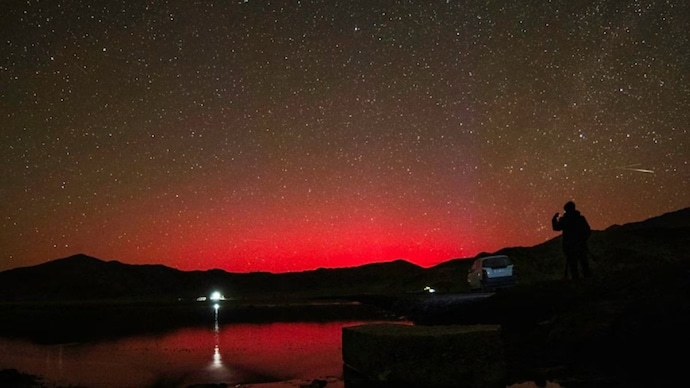
On the night of January 19, 2026, the all-sky cameras at Hanle watched the sky turn red. Scientists at the Indian Institute of Astrophysics confirmed what the cameras had seen.
It was real. An aurora, over India, burning silently above the Himalayan cold desert like something out of a painting that had not been painted yet.
Tonight, Hanle is waiting.
A G3 storm strong enough to push the auroral oval, which is the luminous ring of charged light encircling Earth's poles, this far south gives Hanle a genuine chance.
Other high-altitude locations carry slimmer but real possibilities: the Nubra Valley, Pangong Tso, parts of Kashmir, and the higher reaches of the Uttarakhand Himalayas.
At these elevations, on a night like this, a faint red or pink glow on the northern horizon is not impossible. It is rare and conditional, but not impossible.
Delhi sees nothing. Mumbai sees nothing. Bengaluru, Kolkata, Chennai, the great luminous cities of India, their own light has made them blind to this.
The aurora may exist somewhere above the glow. But no one standing on the ground in these cities will ever know.
If you are in Ladakh tonight, face north after midnight. Bring a long-exposure camera, because the camera sees this before the eye does. And bring patience, because patience is the only instrument that actually matters.
What you may see will not be Iceland. It will not be the photographs that make strangers gasp. It will be quieter than that, and rarer, and in its own way more extraordinary, because it will be happening in India, which was never supposed to be the kind of place where the sky does this at all.
WHICH CITIES IN THE WORLD COULD SEE THE NORTHERN LIGHTS?
The rest of the world has considerably better odds tonight, and some cities have extraordinary ones.
In North America, Minneapolis, Seattle, Bangor, and much of Canada, including Alberta, Saskatchewan, and Ontario, sit squarely within tonight's auroral zone.
In Europe, Scotland and Scandinavia are almost certain to see displays, the kind that fills the whole northern sky and needs no camera to find. Northern Germany and parts of Poland are well positioned. Iceland, which barely needs a solar storm as an excuse, is exceptional.
In the Southern Hemisphere, Tasmania in Australia, the South Island of New Zealand, and the southern tips of Argentina and Chile could witness the aurora australis, which is the southern counterpart of the northern lights, if storm intensity holds through their night hours.
The best window globally is between 10 PM and 2 AM local time, facing toward the nearest pole, under skies that are dark and clear and patient.
WHAT IS THE WEATHER FORECAST FOR INDIAN CITIES TONIGHT?
None of this matters without a clear sky. The sky is the only door through which any of the green or red glow arrives.
Ladakh has the best skies in India tonight. Cold after dark, falling to between 5 and 10 degrees Celsius, mostly clear, the northern horizon open and dark and genuinely available. This is the one location in India where tonight asks something of you, and offers something in return.
Srinagar and the higher parts of Himachal Pradesh should see mostly clear conditions, with thin high-altitude clouds possible in patches.
Delhi will be cloudless and hot, with daytime temperatures around 43 to 46 degrees Celsius. Clear skies, but the city's own light makes them useless for this purpose. The darkness that aurora-watching requires does not exist in Delhi, and has not for a long time.
Mumbai, Bengaluru, Kolkata, and Chennai are under the monsoon tonight. The clouds are real, the rain is steady, and the sky is simply not there. There is nothing to look for in these cities on a night like this. There has not been for years.
HOW TO WATCH, AND WHAT TO EXPECT
The single variable that determines whether any of this becomes visible is one that cannot be measured until the cloud is almost here.
Inside the arriving plasma is a magnetic field. If its southward-pointing component, known as Bz, is oriented southward on arrival, it connects with Earth's own field, the gate opens, and the aurora travels south.
If it shifts northward, the gate closes. The oval snaps back toward the poles. The sky forgets it was ever going to be remarkable.
This measurement only becomes available when the cloud crosses monitoring satellites roughly 1.5 million kilometres from Earth. Fifteen to sixty minutes of warning. That is all anyone gets.
Monitor live updates at swpc.noaa.gov through the night. The data updates by the minute. Face north. Find the darkest ground available.
Give your eyes twenty minutes to adjust fully to the dark. Use a long-exposure camera or your phone's night mode, because the camera will see what the eye cannot.
The Sun did its part two days ago. The cloud has been travelling ever since, crossing the silent distances of the inner solar system with the indifference of something that does not know it is being watched.
Tonight, above a cold dark plain in Ladakh, above the thin air and the silent instruments and the cameras that have already witnessed this once, the sky will either remember January or it will not.
It is worth staying awake to find out.
The Sun has been building to this for days.
The star erupted on June 6, 2026, exploding a billion-tonne cloud of magnetised plasma into space at 1,400 kilometres per second, the way the ocean throws a wave, with a force that has no interest in what stands in its way.
That cloud has been travelling for two days. It is here now, and is hitting Earth today.
The Space Weather Prediction Centre has issued a G3, or strong, geomagnetic storm watch, with brief G4, or severe, periods possible. The storm peaks between 11:30 PM IST tonight and 2:30 AM IST on Tuesday, June 9.
A geomagnetic storm is a temporary disturbance of Earth's magnetic field caused by a surge of solar energy hitting the magnetosphere.
Breathtaking auroras could be visible from India tonight. And somewhere above the cold, silent plains of Ladakh, the sky is deciding whether to do something it has only done once before.
HOW WILL AURORAS BE VISIBLE IN INDIA TONIGHT?
Auroras, popularly called the northern lights, are curtains of green, purple, and red light that ripple across the night sky when charged solar particles slam into gases in Earth's upper atmosphere. They are, in the most literal sense, the Sun's fury made beautiful.
They do not belong to India. This country sits too far from the poles, too deep in the latitudes where the northern lights do not ordinarily travel. The sky here is not supposed to do this.
But the sky does not always do what it is supposed to.
The severity of a geomagnetic storm is measured on a scale of G1 to G5, where G1 is minor, and G5 is the kind of catastrophic event that knocked out power grids and sent auroras blazing across India in May 2024, the storm that broke the internet and made an entire country look up at the sky in awe.
Tonight is forecast at G3, classified as strong, with brief G4 periods possible.
Not as strong as that in May 2024. But close enough to matter.
WHICH INDIAN CITIES COULD SEE AURORAS TONIGHT?
There is only one place in India where this story has happened before.
Hanle, Ladakh. The Indian Astronomical Observatory. Four thousand five hundred metres above sea level, sitting at the edge of the world where the air is so thin it makes your lungs remember themselves, where the darkness at night is not an absence but a presence, something you can feel pressing gently against your eyes. The kind of dark that cities have forgotten exists.
On the night of January 19, 2026, the all-sky cameras at Hanle watched the sky turn red. Scientists at the Indian Institute of Astrophysics confirmed what the cameras had seen.
It was real. An aurora, over India, burning silently above the Himalayan cold desert like something out of a painting that had not been painted yet.
Tonight, Hanle is waiting.
A G3 storm strong enough to push the auroral oval, which is the luminous ring of charged light encircling Earth's poles, this far south gives Hanle a genuine chance.
Other high-altitude locations carry slimmer but real possibilities: the Nubra Valley, Pangong Tso, parts of Kashmir, and the higher reaches of the Uttarakhand Himalayas.
At these elevations, on a night like this, a faint red or pink glow on the northern horizon is not impossible. It is rare and conditional, but not impossible.
Delhi sees nothing. Mumbai sees nothing. Bengaluru, Kolkata, Chennai, the great luminous cities of India, their own light has made them blind to this.
The aurora may exist somewhere above the glow. But no one standing on the ground in these cities will ever know.
If you are in Ladakh tonight, face north after midnight. Bring a long-exposure camera, because the camera sees this before the eye does. And bring patience, because patience is the only instrument that actually matters.
What you may see will not be Iceland. It will not be the photographs that make strangers gasp. It will be quieter than that, and rarer, and in its own way more extraordinary, because it will be happening in India, which was never supposed to be the kind of place where the sky does this at all.
WHICH CITIES IN THE WORLD COULD SEE THE NORTHERN LIGHTS?
The rest of the world has considerably better odds tonight, and some cities have extraordinary ones.
In North America, Minneapolis, Seattle, Bangor, and much of Canada, including Alberta, Saskatchewan, and Ontario, sit squarely within tonight's auroral zone.
In Europe, Scotland and Scandinavia are almost certain to see displays, the kind that fills the whole northern sky and needs no camera to find. Northern Germany and parts of Poland are well positioned. Iceland, which barely needs a solar storm as an excuse, is exceptional.
In the Southern Hemisphere, Tasmania in Australia, the South Island of New Zealand, and the southern tips of Argentina and Chile could witness the aurora australis, which is the southern counterpart of the northern lights, if storm intensity holds through their night hours.
The best window globally is between 10 PM and 2 AM local time, facing toward the nearest pole, under skies that are dark and clear and patient.
WHAT IS THE WEATHER FORECAST FOR INDIAN CITIES TONIGHT?
None of this matters without a clear sky. The sky is the only door through which any of the green or red glow arrives.
Ladakh has the best skies in India tonight. Cold after dark, falling to between 5 and 10 degrees Celsius, mostly clear, the northern horizon open and dark and genuinely available. This is the one location in India where tonight asks something of you, and offers something in return.
Srinagar and the higher parts of Himachal Pradesh should see mostly clear conditions, with thin high-altitude clouds possible in patches.
Delhi will be cloudless and hot, with daytime temperatures around 43 to 46 degrees Celsius. Clear skies, but the city's own light makes them useless for this purpose. The darkness that aurora-watching requires does not exist in Delhi, and has not for a long time.
Mumbai, Bengaluru, Kolkata, and Chennai are under the monsoon tonight. The clouds are real, the rain is steady, and the sky is simply not there. There is nothing to look for in these cities on a night like this. There has not been for years.
HOW TO WATCH, AND WHAT TO EXPECT
The single variable that determines whether any of this becomes visible is one that cannot be measured until the cloud is almost here.
Inside the arriving plasma is a magnetic field. If its southward-pointing component, known as Bz, is oriented southward on arrival, it connects with Earth's own field, the gate opens, and the aurora travels south.
If it shifts northward, the gate closes. The oval snaps back toward the poles. The sky forgets it was ever going to be remarkable.
This measurement only becomes available when the cloud crosses monitoring satellites roughly 1.5 million kilometres from Earth. Fifteen to sixty minutes of warning. That is all anyone gets.
Monitor live updates at swpc.noaa.gov through the night. The data updates by the minute. Face north. Find the darkest ground available.
Give your eyes twenty minutes to adjust fully to the dark. Use a long-exposure camera or your phone's night mode, because the camera will see what the eye cannot.
The Sun did its part two days ago. The cloud has been travelling ever since, crossing the silent distances of the inner solar system with the indifference of something that does not know it is being watched.
Tonight, above a cold dark plain in Ladakh, above the thin air and the silent instruments and the cameras that have already witnessed this once, the sky will either remember January or it will not.
It is worth staying awake to find out.

