Odisha was once underwater: Students discover 15-million-year-old shark teeth
A student field trip near Baripada led researchers to shark teeth and vertebrae fossils. The find suggests parts of present-day Odisha were once under an ancient sea.
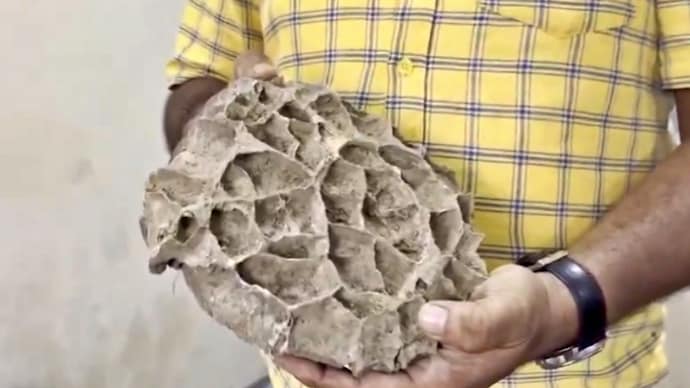
A routine student field trip in Odisha has led to the discovery of fossils dating back nearly 15 million years, including shark teeth and vertebrae, offering remarkable evidence that parts of the state were once submerged beneath an ancient sea.
The fossils were unearthed near Baripada in Odisha's Mayurbhanj district by a team led by Dr Debabrata Nandi, Assistant Professor at the PG Department of Remote Sensing and GIS, North Orissa University. The discovery was made while Dr Nandi was accompanying students on an educational tour.
"When I took our students on a tour, I noticed some fossil-like remnants there," Dr Nandi told ANI. Curious about the unusual objects, the team spoke to local residents, who referred to them as "Asura hadda" or "demon bones."
The finding prompted a detailed investigation. Researchers subsequently uncovered several fossils, including microscopic shark teeth, shark vertebrae and other fossilised remains that are yet to be identified.
The fossils are believed to date back to the Miocene Epoch, a geological period that lasted from about 23 million to 5.3 million years ago. Preliminary estimates suggest the remains are around 15 million years old.
The discovery is significant because it provides direct evidence that the region was once part of a marine environment.
"If it weren't a marine belt, we wouldn't have found shark teeth or fossils of other sea animals," Dr Nandi explained. "The presence of these fossils means there was a sea there."
Today, the Bay of Bengal coastline lies roughly 60 kilometres away from Baripada. The newly discovered fossils suggest that millions of years ago, seawater extended much farther inland than it does today.
Scientists believe the region may have undergone dramatic geological and environmental changes over millions of years, including shifts in sea level, sediment deposition and tectonic activity that gradually pushed the coastline eastward.
The team is now collaborating with palaeontologists from various research institutions to identify the remaining fossils and better understand the ancient ecosystem that once existed in the area.
Beyond its scientific value, researchers believe the site could become an important destination for geo-tourism and education.
Dr Nandi said the discovery highlights the need for further studies into how and why the sea retreated so far from the region. He also suggested that the fossil-rich area could be developed as a geo-heritage site, helping preserve Odisha's prehistoric past while creating opportunities for tourism and scientific outreach.
A routine student field trip in Odisha has led to the discovery of fossils dating back nearly 15 million years, including shark teeth and vertebrae, offering remarkable evidence that parts of the state were once submerged beneath an ancient sea.
The fossils were unearthed near Baripada in Odisha's Mayurbhanj district by a team led by Dr Debabrata Nandi, Assistant Professor at the PG Department of Remote Sensing and GIS, North Orissa University. The discovery was made while Dr Nandi was accompanying students on an educational tour.
"When I took our students on a tour, I noticed some fossil-like remnants there," Dr Nandi told ANI. Curious about the unusual objects, the team spoke to local residents, who referred to them as "Asura hadda" or "demon bones."
The finding prompted a detailed investigation. Researchers subsequently uncovered several fossils, including microscopic shark teeth, shark vertebrae and other fossilised remains that are yet to be identified.
The fossils are believed to date back to the Miocene Epoch, a geological period that lasted from about 23 million to 5.3 million years ago. Preliminary estimates suggest the remains are around 15 million years old.
The discovery is significant because it provides direct evidence that the region was once part of a marine environment.
"If it weren't a marine belt, we wouldn't have found shark teeth or fossils of other sea animals," Dr Nandi explained. "The presence of these fossils means there was a sea there."
Today, the Bay of Bengal coastline lies roughly 60 kilometres away from Baripada. The newly discovered fossils suggest that millions of years ago, seawater extended much farther inland than it does today.
Scientists believe the region may have undergone dramatic geological and environmental changes over millions of years, including shifts in sea level, sediment deposition and tectonic activity that gradually pushed the coastline eastward.
The team is now collaborating with palaeontologists from various research institutions to identify the remaining fossils and better understand the ancient ecosystem that once existed in the area.
Beyond its scientific value, researchers believe the site could become an important destination for geo-tourism and education.
Dr Nandi said the discovery highlights the need for further studies into how and why the sea retreated so far from the region. He also suggested that the fossil-rich area could be developed as a geo-heritage site, helping preserve Odisha's prehistoric past while creating opportunities for tourism and scientific outreach.

