Rome did not fall: DNA reveals how the ancient civilisation became modern
The story behind what happened to Roman civilisation was revealed by reading the DNA of the dead.
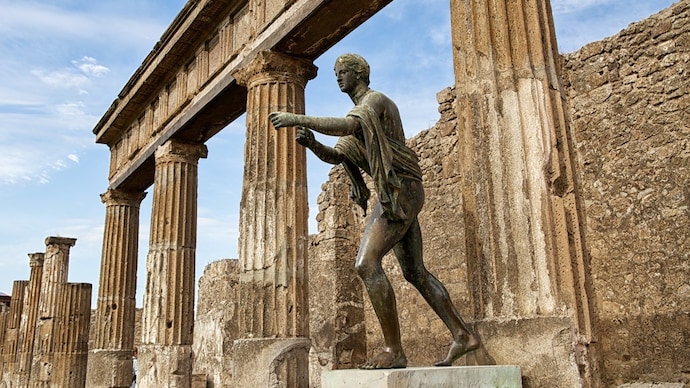
For centuries, the story of Rome's collapse has been told as one of violent conquest. It is of waves of barbarians crashing through the empire's borders and erasing an entire civilisation.
But what if that version of history was wrong?
New research published this week in the journal Nature tells a very different story, one of gradual migration, integration, and swift intermarriage. And it is written not in texts, but in the DNA of the dead.
READING THE BONES
Researchers analysed the genomes of 258 people buried in row-grave cemeteries in the modern-day German states of Bavaria and Hesse, with 112 interred at the Bavarian village of Altheim. Most dated to between 450 and 620 AD, the crucial decades straddling the Western Empire's collapse in 476 AD.
"Row grave cemeteries were a newly emerging early-medieval burial practice where individuals were buried in rows, often containing grave goods like clothing, jewellery, and weapons. These cemeteries stretched across the former Roman frontier from the Netherlands to Hungary," said Jens Blocher, a population geneticist at Johannes Gutenberg University Mainz and lead author of the study, told news agency Reuters.
What the genomes revealed was a major demographic shift coinciding almost exactly with the late-fifth-century collapse of Roman state structures.
People from Northern Europe, with ancestry traceable to places as distant as Britain, had been moving south into the region in small groups for generations, long before the empire fell, living separately from the Roman population, many likely as agricultural labourers.
HOW DID THE ROMAN EMPIRE COLLAPSE?
The most surprising finding was what the DNA did *not* show: any evidence of a mass invasion.
"Crucially, this influx was not driven by large, ethnically homogeneous tribal blocs or major clans, but rather by small kinship groups and even isolated individuals. This pattern directly contradicts the traditional narrative of a 'mass barbarian invasion' following Rome's collapse," said Joachim Burger, senior author of the study.
"They haven't arrived as mass invaders or hordes or big clans — these are individual families who are already four or five generations on Roman territory," Burger added. They probably saw themselves as Romans.
Before the empire's end, these northern settlers had been marrying almost exclusively within their own group. But once Roman authority collapsed and legal restrictions on intermarriage were lifted, the two populations blended rapidly.
"The temporal alignment between the fall of the Western Roman Empire in Italy and the genetic shift we detect in southern Germany is remarkably precise," Burger said.
A MODERN SOCIETY
The data also offered an intimate portrait of daily life.
Life expectancy stood at roughly 40 years for women and 43 for men, with infant mortality so poor that nearly a quarter of children had lost at least one parent by age 10.
Furthermore, families were strictly monogamous; widows did not remarry within their late husband's family, and close-kin marriages were strictly avoided.
"All these traits reflect Christian norms from Late Antiquity," Burger said.
By roughly the seventh century, a new genetic profile had emerged, and it was one that closely resembles the genetic profile we observe today in Central Europe.
Turns out, Rome did not simply vanish. It merged, one family at a time, into the world that came after it.
For centuries, the story of Rome's collapse has been told as one of violent conquest. It is of waves of barbarians crashing through the empire's borders and erasing an entire civilisation.
But what if that version of history was wrong?
New research published this week in the journal Nature tells a very different story, one of gradual migration, integration, and swift intermarriage. And it is written not in texts, but in the DNA of the dead.
READING THE BONES
Researchers analysed the genomes of 258 people buried in row-grave cemeteries in the modern-day German states of Bavaria and Hesse, with 112 interred at the Bavarian village of Altheim. Most dated to between 450 and 620 AD, the crucial decades straddling the Western Empire's collapse in 476 AD.
"Row grave cemeteries were a newly emerging early-medieval burial practice where individuals were buried in rows, often containing grave goods like clothing, jewellery, and weapons. These cemeteries stretched across the former Roman frontier from the Netherlands to Hungary," said Jens Blocher, a population geneticist at Johannes Gutenberg University Mainz and lead author of the study, told news agency Reuters.
What the genomes revealed was a major demographic shift coinciding almost exactly with the late-fifth-century collapse of Roman state structures.
People from Northern Europe, with ancestry traceable to places as distant as Britain, had been moving south into the region in small groups for generations, long before the empire fell, living separately from the Roman population, many likely as agricultural labourers.
HOW DID THE ROMAN EMPIRE COLLAPSE?
The most surprising finding was what the DNA did *not* show: any evidence of a mass invasion.
"Crucially, this influx was not driven by large, ethnically homogeneous tribal blocs or major clans, but rather by small kinship groups and even isolated individuals. This pattern directly contradicts the traditional narrative of a 'mass barbarian invasion' following Rome's collapse," said Joachim Burger, senior author of the study.
"They haven't arrived as mass invaders or hordes or big clans — these are individual families who are already four or five generations on Roman territory," Burger added. They probably saw themselves as Romans.
Before the empire's end, these northern settlers had been marrying almost exclusively within their own group. But once Roman authority collapsed and legal restrictions on intermarriage were lifted, the two populations blended rapidly.
"The temporal alignment between the fall of the Western Roman Empire in Italy and the genetic shift we detect in southern Germany is remarkably precise," Burger said.
A MODERN SOCIETY
The data also offered an intimate portrait of daily life.
Life expectancy stood at roughly 40 years for women and 43 for men, with infant mortality so poor that nearly a quarter of children had lost at least one parent by age 10.
Furthermore, families were strictly monogamous; widows did not remarry within their late husband's family, and close-kin marriages were strictly avoided.
"All these traits reflect Christian norms from Late Antiquity," Burger said.
By roughly the seventh century, a new genetic profile had emerged, and it was one that closely resembles the genetic profile we observe today in Central Europe.
Turns out, Rome did not simply vanish. It merged, one family at a time, into the world that came after it.

