Why Meghalaya got 526 mm of rain in a day and Seven Sisters Waterfall roared
A cyclonic circulation over Assam supercharged the southwest monsoon on June 21, 2026, delivering 526.4 mm of rain at Mawsynram and bringing the Seven Sisters Waterfall to full spate. Here is the science behind the season's first widespread extremely heavy rainfall in Meghalaya.
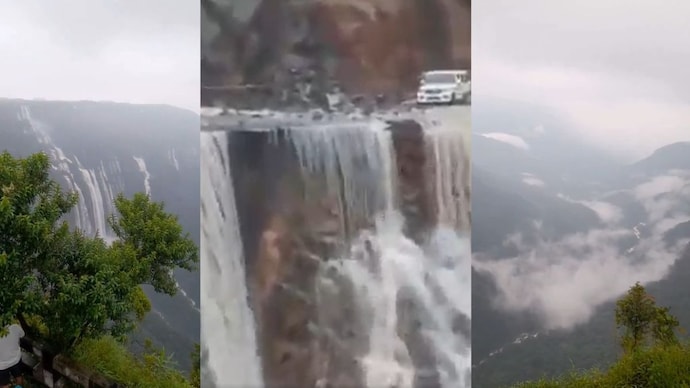
On the morning of June 21, 2026, a waterfall woke up. Not slowly, but all at once. Seven separate streams erupted over the limestone cliffs near Sohra in Meghalaya, swelling from trickles into a thundering white curtain within hours.
The Nohsngithiang Falls, better known as the Seven Sisters Waterfall, came alive for the first time this monsoon season.
What caused it?
The answer involves a rotating column of air over Assam, a moisture conveyor belt from the Bay of Bengal, and one of the most efficient rain-making systems on the planet.
WHAT TRIGGERED THE DELUGE
The season's first widespread extremely heavy rainfall spell over Meghalaya on June 21 was not simply the monsoon doing its usual thing. It was the monsoon being turbocharged.
An upper air cyclonic circulation over the central parts of Assam was the key atmospheric trigger. Think of it as a giant rotating column of air sitting just above the surface, spinning counterclockwise.
This system acted like a vacuum pump, pulling vast quantities of moisture from the warm Bay of Bengal and funnelling it straight toward the Khasi Hills at an accelerated rate.
That moisture then ran into a wall. The southern face of the Khasi Hills rises almost vertically from the flat plains of Bangladesh.
Warm, moisture-loaded air had nowhere to go but up. As air rises, it expands and cools.
Cooler air cannot hold as much water vapour as warm air. The excess falls as rain. This process, called orographic lift, is the reason this region receives more rainfall than almost anywhere else on Earth.
The combination of the cyclonic circulation delivering far more moisture than usual, plus the hills converting every gram of that moisture into rain, is what produced these numbers in just 24 hours.
Mawsynram recorded 526.4 mm, Sohra (Ram Krishna Mission) 470.4 mm, Mawkyrwat 385.0 mm, and Sohra 332.0 mm.
For context, London receives roughly 600 mm in an entire year. These places received nearly that in a single day.
The India Meteorological Department (IMD) issued a press release on June 21 forecasting very heavy to extremely heavy rainfall over northeast India till June 25.
WHY THE SEVEN SISTERS WATERFALL EXISTS AT ALL
The Nohsngithiang Falls do not flow year-round. They are a seasonal phenomenon, and understanding why they look the way they do requires a short trip into geology.
The Khasi Hills are made primarily of limestone, which is calcium carbonate. Limestone has a quality most rocks do not: it dissolves. Rainwater absorbs carbon dioxide from the air and becomes mildly acidic.
Over millions of years, this slightly acidic water has reacted with the rock, carved fractures into channels, and eroded seven separate pathways down the same 315-metre cliff face.
Each of the seven streams follows one of those ancient weakness lines in the rock. In the dry months between November and May, some streams reduce to a trickle or vanish entirely.
When the season's first major rainfall spell delivers 526 mm in 24 hours, all seven activate at once. That is exactly what happened today.
Mawsynram, which sits at an altitude of about 1,400 metres in the Khasi Hills, has an average annual rainfall of 11,872 mm, making it reportedly the wettest place on Earth.
The June 21 event was intense even by those standards, though Mawsynram's all-time single-day record remains the extraordinary 1,003.2 mm recorded on June 17, 2022.
WHY THIS REGION AND NOWHERE ELSE
The geography here is almost impossibly precise.
Mawsynram sits on the windward, or southern, face of the Khasi Hills, which is one of the first significant uplifts the monsoon flow encounters after crossing the plains.
When moist air is forced up the steep slopes, it cools and the water vapour condenses, producing heavy precipitation. Small increases in uplift produce large rainfall increases because of the high moisture content already present in the air.
The local valley geometry makes it worse, in the best possible way.
The valleys and gorges around Sohra and Mawsynram funnel and concentrate incoming monsoon winds into narrower and narrower channels, intensifying the upward push and maximising how much rain the clouds are forced to release.
When a cyclonic circulation over Assam adds its rotating moisture influx on top of all that, the result is what we witnessed today: the season's opening salvo, and the Seven Sisters Waterfall erupting into full, thundering life.
On the morning of June 21, 2026, a waterfall woke up. Not slowly, but all at once. Seven separate streams erupted over the limestone cliffs near Sohra in Meghalaya, swelling from trickles into a thundering white curtain within hours.
The Nohsngithiang Falls, better known as the Seven Sisters Waterfall, came alive for the first time this monsoon season.
What caused it?
The answer involves a rotating column of air over Assam, a moisture conveyor belt from the Bay of Bengal, and one of the most efficient rain-making systems on the planet.
WHAT TRIGGERED THE DELUGE
The season's first widespread extremely heavy rainfall spell over Meghalaya on June 21 was not simply the monsoon doing its usual thing. It was the monsoon being turbocharged.
An upper air cyclonic circulation over the central parts of Assam was the key atmospheric trigger. Think of it as a giant rotating column of air sitting just above the surface, spinning counterclockwise.
This system acted like a vacuum pump, pulling vast quantities of moisture from the warm Bay of Bengal and funnelling it straight toward the Khasi Hills at an accelerated rate.
That moisture then ran into a wall. The southern face of the Khasi Hills rises almost vertically from the flat plains of Bangladesh.
Warm, moisture-loaded air had nowhere to go but up. As air rises, it expands and cools.
Cooler air cannot hold as much water vapour as warm air. The excess falls as rain. This process, called orographic lift, is the reason this region receives more rainfall than almost anywhere else on Earth.
The combination of the cyclonic circulation delivering far more moisture than usual, plus the hills converting every gram of that moisture into rain, is what produced these numbers in just 24 hours.
Mawsynram recorded 526.4 mm, Sohra (Ram Krishna Mission) 470.4 mm, Mawkyrwat 385.0 mm, and Sohra 332.0 mm.
For context, London receives roughly 600 mm in an entire year. These places received nearly that in a single day.
The India Meteorological Department (IMD) issued a press release on June 21 forecasting very heavy to extremely heavy rainfall over northeast India till June 25.
WHY THE SEVEN SISTERS WATERFALL EXISTS AT ALL
The Nohsngithiang Falls do not flow year-round. They are a seasonal phenomenon, and understanding why they look the way they do requires a short trip into geology.
The Khasi Hills are made primarily of limestone, which is calcium carbonate. Limestone has a quality most rocks do not: it dissolves. Rainwater absorbs carbon dioxide from the air and becomes mildly acidic.
Over millions of years, this slightly acidic water has reacted with the rock, carved fractures into channels, and eroded seven separate pathways down the same 315-metre cliff face.
Each of the seven streams follows one of those ancient weakness lines in the rock. In the dry months between November and May, some streams reduce to a trickle or vanish entirely.
When the season's first major rainfall spell delivers 526 mm in 24 hours, all seven activate at once. That is exactly what happened today.
Mawsynram, which sits at an altitude of about 1,400 metres in the Khasi Hills, has an average annual rainfall of 11,872 mm, making it reportedly the wettest place on Earth.
The June 21 event was intense even by those standards, though Mawsynram's all-time single-day record remains the extraordinary 1,003.2 mm recorded on June 17, 2022.
WHY THIS REGION AND NOWHERE ELSE
The geography here is almost impossibly precise.
Mawsynram sits on the windward, or southern, face of the Khasi Hills, which is one of the first significant uplifts the monsoon flow encounters after crossing the plains.
When moist air is forced up the steep slopes, it cools and the water vapour condenses, producing heavy precipitation. Small increases in uplift produce large rainfall increases because of the high moisture content already present in the air.
The local valley geometry makes it worse, in the best possible way.
The valleys and gorges around Sohra and Mawsynram funnel and concentrate incoming monsoon winds into narrower and narrower channels, intensifying the upward push and maximising how much rain the clouds are forced to release.
When a cyclonic circulation over Assam adds its rotating moisture influx on top of all that, the result is what we witnessed today: the season's opening salvo, and the Seven Sisters Waterfall erupting into full, thundering life.

