Skyroot's Vikram-I getting ready for maiden launch at Sriharikota. See first pics
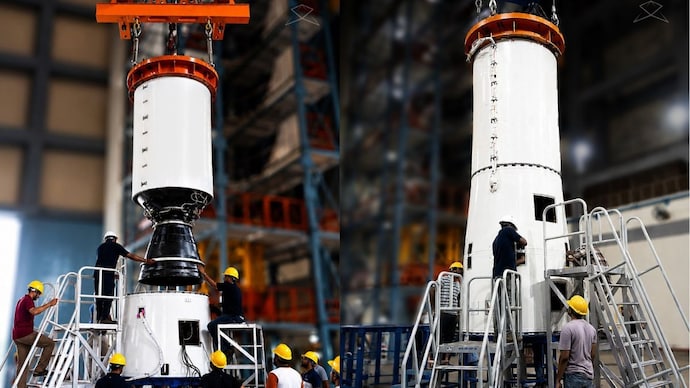
Skyroot Aerospace has completed Stage 2 integration of the Vikram-1 rocket at Sriharikota. India's first private orbital rocket is inching toward its maiden launch in 2026. Here is what the Kalam-250 motor actually does and why it matters.
The countdown to history has quietly begun inside India's busiest spaceport.
Skyroot Aerospace, the Hyderabad-based startup that wants to democratise access to space, has shared the first pictures of its flagship rocket, Vikram-1, taking shape at the Satish Dhawan Space Centre (SDSC-SHAR) in Sriharikota, Andhra Pradesh.
The milestone? Stage 2 of the four-stage rocket, known as Kalam-250, is now fully integrated.
Named after Dr A.P.J. Abdul Kalam, this solid-fuel motor is the rocket's critical middle act, the stage that carries the vehicle from the dense lower atmosphere straight into the edge of space.
WHAT MAKES KALAM-250 SPECIAL?
Think of a rocket stage as a relay runner. Kalam-250 takes the baton from Stage 1 (Kalam-1200, the heavyweight lifter), and sprints the rocket toward space.
During its 85-second burn, it produces up to 235 kilonewtons of thrust in vacuum conditions, roughly the force of 24 fully loaded lorries accelerating simultaneously.
But raw power is only half the story. Kalam-250 features a flex nozzle, a flexible exhaust pipe that can tilt by a few degrees to steer the rocket mid-flight, the way you would tilt the nozzle of a garden hose to redirect water.
Electro-mechanical actuators, precision robotic arms controlled by the onboard guidance computer, physically move this nozzle in real time to correct the rocket's path against wind and gravity.
The casing itself is built from carbon composite, a material stronger than steel but dramatically lighter, wound into shape by robotic arms. It is insulated against the ferocious heat of burning solid propellant by EPDM, a high-performance synthetic rubber used as an internal ablative shield.
Also mounted are Interstages, the structural collars connecting Stage 1 to Stage 2, which house the explosive separation systems that cleanly detach spent stages in milliseconds.
WHY DOES THIS MATTER FOR INDIA?
Vikram-1 stands 24 metres tall and can carry up to 350 kg of satellites to Low Earth Orbit. Its maiden flight would make India the first country to have a private orbital launch, placing it alongside the United States and New Zealand in a very exclusive club.
Final assembly of the remaining stages is now underway. The launch is targeted for 2026.
India's private space revolution is no longer a promise. It is sitting on a launchpad, bolt by bolt.
The countdown to history has quietly begun inside India's busiest spaceport.
Skyroot Aerospace, the Hyderabad-based startup that wants to democratise access to space, has shared the first pictures of its flagship rocket, Vikram-1, taking shape at the Satish Dhawan Space Centre (SDSC-SHAR) in Sriharikota, Andhra Pradesh.
The milestone? Stage 2 of the four-stage rocket, known as Kalam-250, is now fully integrated.
Named after Dr A.P.J. Abdul Kalam, this solid-fuel motor is the rocket's critical middle act, the stage that carries the vehicle from the dense lower atmosphere straight into the edge of space.
WHAT MAKES KALAM-250 SPECIAL?
Think of a rocket stage as a relay runner. Kalam-250 takes the baton from Stage 1 (Kalam-1200, the heavyweight lifter), and sprints the rocket toward space.
During its 85-second burn, it produces up to 235 kilonewtons of thrust in vacuum conditions, roughly the force of 24 fully loaded lorries accelerating simultaneously.
But raw power is only half the story. Kalam-250 features a flex nozzle, a flexible exhaust pipe that can tilt by a few degrees to steer the rocket mid-flight, the way you would tilt the nozzle of a garden hose to redirect water.
Electro-mechanical actuators, precision robotic arms controlled by the onboard guidance computer, physically move this nozzle in real time to correct the rocket's path against wind and gravity.
The casing itself is built from carbon composite, a material stronger than steel but dramatically lighter, wound into shape by robotic arms. It is insulated against the ferocious heat of burning solid propellant by EPDM, a high-performance synthetic rubber used as an internal ablative shield.
Also mounted are Interstages, the structural collars connecting Stage 1 to Stage 2, which house the explosive separation systems that cleanly detach spent stages in milliseconds.
WHY DOES THIS MATTER FOR INDIA?
Vikram-1 stands 24 metres tall and can carry up to 350 kg of satellites to Low Earth Orbit. Its maiden flight would make India the first country to have a private orbital launch, placing it alongside the United States and New Zealand in a very exclusive club.
Final assembly of the remaining stages is now underway. The launch is targeted for 2026.
India's private space revolution is no longer a promise. It is sitting on a launchpad, bolt by bolt.

