Skyroot's rocket has a stage that thinks. Here is how it aims for exact orbit
Skyroot Aerospace has revealed how the Orbit Adjustment Module, the liquid-powered top stage of its Vikram-1 rocket, can stop and restart in space to place satellites in exact orbits. Here is how the Raman-2 engine and its thrusters turn one launch into a precise space taxi.
A rocket leaving Earth is mostly violence. The first three stages of Skyroot Aerospace's Vikram-1 are built for one job: raw thrust, the brute force needed to tear free of gravity.
Then everything changes. At the very top sits a small, patient stage that does not push as much as it thinks.
Skyroot calls it the Orbit Adjustment Module, or OAM, and on Sunday, June 21, the Hyderabad company released a film explaining it.
Reaching space is the easy part. Arriving at exactly the right address is the hard one. A satellite released even a few metres per second too fast sails past its orbit. Released too slow, it falls back and dies. The OAM exists so that neither happens.
AN ENGINE THAT CAN STOP AND START AGAIN
The lower stages of Vikram-1 burn solid fuel, rather like a firework. Once lit, they cannot be paused or relit. The OAM does the opposite.
It is powered by a liquid engine called Raman-2, named after the Indian Nobel laureate CV Raman. A liquid engine can be throttled, its fuel flow turned up, turned down, or shut off entirely.
That single ability changes everything. In the vacuum of space, the Raman-2 engine can fire, fall silent, and fire again, as many times as a mission demands.
Each restart lets the stage shift the rocket into a fresh orbit, which is how one launch can drop several satellites at several addresses, a service the industry cheerfully calls a space taxi.
The engine is also 3D-printed and regeneratively cooled, a neat trick in which the cold fuel circulates around the engine walls before it burns, carrying away heat that would otherwise melt the metal.
The propellant doubles as its own coolant.
THE STEERING IS DONE BY WHISPERS
A main engine alone cannot aim with the delicacy orbit demands. So the OAM carries a small orchestra of helpers, four Raman Mini thrusters and eight cold gas thrusters.
Cold gas thrusters are the simplest rocket devices ever made, with no flame at all. They release a measured puff of pressurised gas, the same principle as releasing an inflated balloon, to turn the stage a fraction of a degree.
They are precious precisely because nothing burns, so almost nothing can fail.
Together these systems control pitch and yaw, the up-and-down and side-to-side tilt of the stage, nudging the path until the orbit is not roughly right but exactly right.
A QUIET MILESTONE BEFORE A LOUD ONE
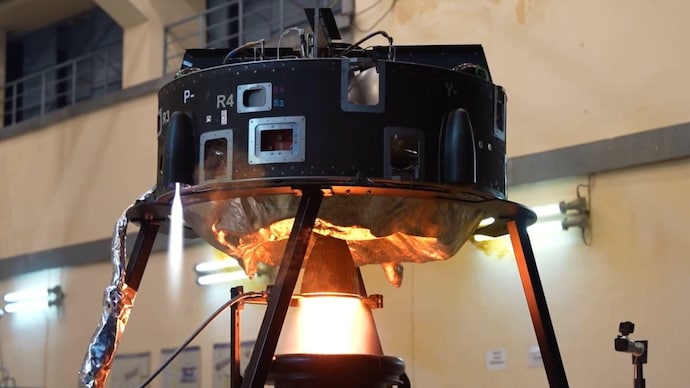
In October 2025, Skyroot fired the whole module on the ground through more than 1,000 thruster pulses, every engine and thruster firing under conditions built to mimic flight.
The timing matters. In May 2026, Skyroot became India's first space-tech unicorn, valued at $1.1 billion, and its Vikram-1 rocket is already waiting at the Satish Dhawan Space Centre in Sriharikota to become the first privately built Indian rocket to reach orbit.
When it flies, the fire will draw the eye.
But it is this quiet, thinking final stage that will decide whether the mission succeeds.
A rocket leaving Earth is mostly violence. The first three stages of Skyroot Aerospace's Vikram-1 are built for one job: raw thrust, the brute force needed to tear free of gravity.
Then everything changes. At the very top sits a small, patient stage that does not push as much as it thinks.
Skyroot calls it the Orbit Adjustment Module, or OAM, and on Sunday, June 21, the Hyderabad company released a film explaining it.
Reaching space is the easy part. Arriving at exactly the right address is the hard one. A satellite released even a few metres per second too fast sails past its orbit. Released too slow, it falls back and dies. The OAM exists so that neither happens.
AN ENGINE THAT CAN STOP AND START AGAIN
The lower stages of Vikram-1 burn solid fuel, rather like a firework. Once lit, they cannot be paused or relit. The OAM does the opposite.
It is powered by a liquid engine called Raman-2, named after the Indian Nobel laureate CV Raman. A liquid engine can be throttled, its fuel flow turned up, turned down, or shut off entirely.
That single ability changes everything. In the vacuum of space, the Raman-2 engine can fire, fall silent, and fire again, as many times as a mission demands.
Each restart lets the stage shift the rocket into a fresh orbit, which is how one launch can drop several satellites at several addresses, a service the industry cheerfully calls a space taxi.
The engine is also 3D-printed and regeneratively cooled, a neat trick in which the cold fuel circulates around the engine walls before it burns, carrying away heat that would otherwise melt the metal.
The propellant doubles as its own coolant.
THE STEERING IS DONE BY WHISPERS
A main engine alone cannot aim with the delicacy orbit demands. So the OAM carries a small orchestra of helpers, four Raman Mini thrusters and eight cold gas thrusters.
Cold gas thrusters are the simplest rocket devices ever made, with no flame at all. They release a measured puff of pressurised gas, the same principle as releasing an inflated balloon, to turn the stage a fraction of a degree.
They are precious precisely because nothing burns, so almost nothing can fail.
Together these systems control pitch and yaw, the up-and-down and side-to-side tilt of the stage, nudging the path until the orbit is not roughly right but exactly right.
A QUIET MILESTONE BEFORE A LOUD ONE
In October 2025, Skyroot fired the whole module on the ground through more than 1,000 thruster pulses, every engine and thruster firing under conditions built to mimic flight.
The timing matters. In May 2026, Skyroot became India's first space-tech unicorn, valued at $1.1 billion, and its Vikram-1 rocket is already waiting at the Satish Dhawan Space Centre in Sriharikota to become the first privately built Indian rocket to reach orbit.
When it flies, the fire will draw the eye.
But it is this quiet, thinking final stage that will decide whether the mission succeeds.

