Sun's vibration is changing due to massive sunspots not visible from Earth
Scientists have detected at least three massive sunspot regions hidden on the Sun's far side through helioseismic signals. The finding points to strong magnetic activity as the Sun approaches the peak of Solar Cycle 25.
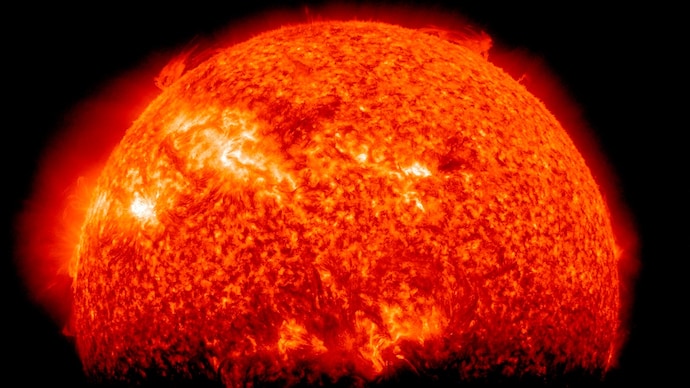
Massive sunspots hidden on the far side of the Sun are so enormous that scientists can already detect their impact, not through direct images, but by the way they disturb vibrations rippling across the solar surface.
According to helioseismic maps released by solar observers, at least three giant active regions are currently concealed behind the Sun’s eastern limb, out of direct view from Earth.
Despite remaining hidden, these sunspots are influencing the Sun’s internal acoustic waves, creating what scientists describe as “dark echoes” beneath the solar surface.
WHAT IS A SUNSPOT?
A sunspot is a dark, cooler region on the Sun’s surface caused by extremely strong magnetic fields.
These magnetic disturbances block some heat from rising, making the area appear darker than its surroundings.
Sunspots are often linked to solar flares and space weather events that can affect satellites, communications and Earth’s atmosphere.
SUN'S VIBRATION CHANGING
The nearest of these massive sunspot regions is expected to rotate into Earth’s view beginning May 22 as the Sun continues its roughly 27-day rotation cycle.
What makes the latest observation remarkable is that the active regions were detected before they became visible.
Scientists used a technique known as helioseismology, the study of vibrations and sound waves travelling through the Sun’s interior.
Similar to how earthquakes help researchers study Earth’s internal structure, solar vibrations allow astronomers to map activity occurring on the far side of the Sun.
When large sunspots form, their powerful magnetic fields alter the movement of these waves, producing detectable signatures in helioseismic maps. The newly observed “dark echoes” indicate particularly strong magnetic activity hidden beyond Earth’s line of sight.
Solar researchers are closely monitoring the regions because the Sun is currently approaching the peak of Solar Cycle 25, the phase of its approximately 11-year activity cycle marked by increased numbers of sunspots and solar storms.
Over the past year, the Sun has unleashed several powerful eruptions, including geomagnetic storms that produced vivid auroras across parts of Europe, North America and Asia. Scientists say the appearance of additional large sunspot regions could further intensify solar activity in the coming weeks.
If the active regions remain stable as they rotate into view, they may become targets for continuous monitoring by observatories and space agencies around the world.
For now, scientists are watching the Sun’s hidden hemisphere carefully, listening to its vibrations to predict what may soon emerge over the solar horizon.
Massive sunspots hidden on the far side of the Sun are so enormous that scientists can already detect their impact, not through direct images, but by the way they disturb vibrations rippling across the solar surface.
According to helioseismic maps released by solar observers, at least three giant active regions are currently concealed behind the Sun’s eastern limb, out of direct view from Earth.
Despite remaining hidden, these sunspots are influencing the Sun’s internal acoustic waves, creating what scientists describe as “dark echoes” beneath the solar surface.
WHAT IS A SUNSPOT?
A sunspot is a dark, cooler region on the Sun’s surface caused by extremely strong magnetic fields.
These magnetic disturbances block some heat from rising, making the area appear darker than its surroundings.
Sunspots are often linked to solar flares and space weather events that can affect satellites, communications and Earth’s atmosphere.
SUN'S VIBRATION CHANGING
The nearest of these massive sunspot regions is expected to rotate into Earth’s view beginning May 22 as the Sun continues its roughly 27-day rotation cycle.
What makes the latest observation remarkable is that the active regions were detected before they became visible.
Scientists used a technique known as helioseismology, the study of vibrations and sound waves travelling through the Sun’s interior.
Similar to how earthquakes help researchers study Earth’s internal structure, solar vibrations allow astronomers to map activity occurring on the far side of the Sun.
When large sunspots form, their powerful magnetic fields alter the movement of these waves, producing detectable signatures in helioseismic maps. The newly observed “dark echoes” indicate particularly strong magnetic activity hidden beyond Earth’s line of sight.
Solar researchers are closely monitoring the regions because the Sun is currently approaching the peak of Solar Cycle 25, the phase of its approximately 11-year activity cycle marked by increased numbers of sunspots and solar storms.
Over the past year, the Sun has unleashed several powerful eruptions, including geomagnetic storms that produced vivid auroras across parts of Europe, North America and Asia. Scientists say the appearance of additional large sunspot regions could further intensify solar activity in the coming weeks.
If the active regions remain stable as they rotate into view, they may become targets for continuous monitoring by observatories and space agencies around the world.
For now, scientists are watching the Sun’s hidden hemisphere carefully, listening to its vibrations to predict what may soon emerge over the solar horizon.

