Did Venezuela earthquakes release energy equal to 250 nuclear bombs?
Twin earthquakes struck northern Venezuela within 39 seconds, prompting claims about their explosive force. Scientists say the comparison is only a rough analogy as damage, aftershocks and response efforts continue.
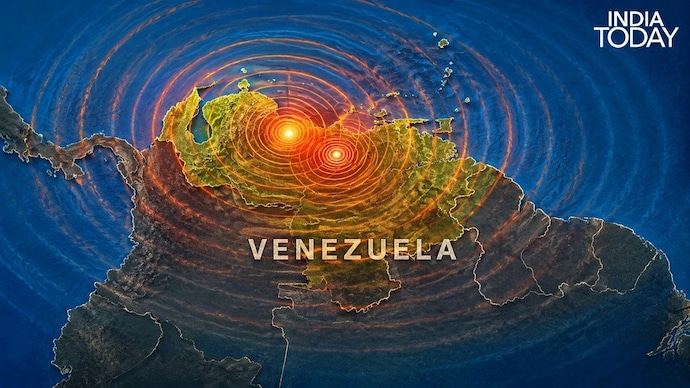
The two powerful earthquakes that struck northern Venezuela within seconds of each other have sparked widespread comparisons on social media, with some posts claiming the quakes released energy equivalent to about 250 nuclear bombs.
While such comparisons can help people grasp the immense power of earthquakes, scientists caution that they should be treated as rough analogies rather than precise measurements.
The earthquakes, measured at magnitude 7.2 and 7.5 by the US Geological Survey (USGS), occurred just 39 seconds apart, making them a rare seismic doublet. Both ruptured shallow faults along the boundary where the Caribbean and South American tectonic plates slide past each other, producing intense shaking across northern Venezuela and parts of the Caribbean.
So, where does the "250 nuclear bombs" figure come from?
Earthquakes release enormous amounts of energy that can be estimated using their magnitude. Scientists often compare this energy with that released by the Hiroshima atomic bomb because it provides an easily understood reference point.
However, there is no universally accepted "nuclear bomb equivalent" because the comparison depends on the bomb's yield, whether one refers to total energy or only seismic energy, and the assumptions used in the calculations.
Using standard earthquake-energy relationships, a magnitude 7.5 earthquake alone releases energy many orders of magnitude greater than conventional explosives. When the energy from both Venezuelan earthquakes is combined, estimates can range from hundreds to several thousand Hiroshima-sized bombs, depending on the methodology used.
That means a claim of "about 250 nuclear bombs" is plausible as a simplified estimate, but it is not a definitive scientific value.
Different scientific calculators and conversion methods produce different results.
More importantly, experts say such comparisons should not be interpreted literally. Unlike a nuclear explosion, which releases energy almost instantaneously from a single point, an earthquake releases accumulated tectonic stress along a fault that may extend for tens or even hundreds of kilometres.
Much of the energy goes into fracturing rocks, generating heat and moving Earth's crust, while only a portion is radiated as seismic waves that cause the shaking people feel.
For residents in Venezuela, the comparison matters far less than the consequences. The rare seismic doublet caused widespread damage, collapsed buildings and triggered a massive emergency response.
Scientists continue to monitor aftershocks, warning that significant tremors can continue for days or even weeks after such a major event.
The two powerful earthquakes that struck northern Venezuela within seconds of each other have sparked widespread comparisons on social media, with some posts claiming the quakes released energy equivalent to about 250 nuclear bombs.
While such comparisons can help people grasp the immense power of earthquakes, scientists caution that they should be treated as rough analogies rather than precise measurements.
The earthquakes, measured at magnitude 7.2 and 7.5 by the US Geological Survey (USGS), occurred just 39 seconds apart, making them a rare seismic doublet. Both ruptured shallow faults along the boundary where the Caribbean and South American tectonic plates slide past each other, producing intense shaking across northern Venezuela and parts of the Caribbean.
So, where does the "250 nuclear bombs" figure come from?
Earthquakes release enormous amounts of energy that can be estimated using their magnitude. Scientists often compare this energy with that released by the Hiroshima atomic bomb because it provides an easily understood reference point.
However, there is no universally accepted "nuclear bomb equivalent" because the comparison depends on the bomb's yield, whether one refers to total energy or only seismic energy, and the assumptions used in the calculations.
Using standard earthquake-energy relationships, a magnitude 7.5 earthquake alone releases energy many orders of magnitude greater than conventional explosives. When the energy from both Venezuelan earthquakes is combined, estimates can range from hundreds to several thousand Hiroshima-sized bombs, depending on the methodology used.
That means a claim of "about 250 nuclear bombs" is plausible as a simplified estimate, but it is not a definitive scientific value.
Different scientific calculators and conversion methods produce different results.
More importantly, experts say such comparisons should not be interpreted literally. Unlike a nuclear explosion, which releases energy almost instantaneously from a single point, an earthquake releases accumulated tectonic stress along a fault that may extend for tens or even hundreds of kilometres.
Much of the energy goes into fracturing rocks, generating heat and moving Earth's crust, while only a portion is radiated as seismic waves that cause the shaking people feel.
For residents in Venezuela, the comparison matters far less than the consequences. The rare seismic doublet caused widespread damage, collapsed buildings and triggered a massive emergency response.
Scientists continue to monitor aftershocks, warning that significant tremors can continue for days or even weeks after such a major event.

