Watch: Lightning bolt strikes Eiffel Tower. Here's how the landmark stays safe
A lightning bolt struck the Eiffel Tower during a thunderstorm over Paris, lighting up the skyline. The spectacle drew attention online, even as experts noted the landmark is designed to withstand such strikes.
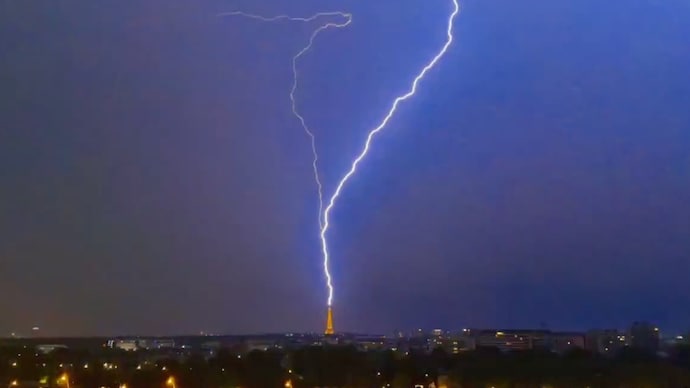
A dramatic bolt of lightning lit up the Paris skyline after striking the Eiffel Tower during a powerful thunderstorm that swept across the French capital, producing one of the most iconic weather spectacles in the world.
Videos shared across social media captured the dazzling flash hitting the 330-metre iron tower as dark storm clouds engulfed the city. While the sight appeared alarming, experts say such lightning strikes are expected and the monument is specifically engineered to withstand them.
The Eiffel Tower is struck by lightning several times every year, with estimates ranging from five to 10 direct hits annually depending on thunderstorm activity. Far from being a structural threat, these strikes are safely channelled into the ground through an elaborate lightning protection system.
WATCH LIGHTNING STRIKE THE EIFFEL TOWER
HOW DOES THE EIFFEL TOWER STAY SAFE DURING LIGHTNING?
The tower's height makes it a natural target during thunderstorms.
Lightning tends to strike the tallest conductive object in an area because it offers the shortest path between electrically charged storm clouds and the ground.
However, contrary to popular belief, the tower does not "attract" lightning. Instead, when a lightning discharge forms, the towering iron structure simply becomes the most efficient route for the immense electrical current.
The entire structure acts as a giant Faraday cage, a principle discovered by physicist Michael Faraday in the 19th century. When lightning hits the tower, the electrical current travels through the metal framework rather than passing through people inside or on observation decks.
Specially designed grounding systems at the base of the monument safely dissipate the current into the Earth within fractions of a second. Modern surge protection also shields the tower's elevators, lighting systems, communications equipment and electronic infrastructure from damage.
For visitor safety, authorities closely monitor weather conditions. During severe thunderstorms or strong winds, sections of the tower may be temporarily closed as a precaution, though lightning itself rarely causes any structural damage.
The latest strike comes as large parts of Western Europe endure an intense early summer heatwave followed by powerful thunderstorms triggered by unstable, moisture-laden air.
Such outbreaks have become increasingly common as hotter air holds more moisture, creating favourable conditions for explosive storm development.
For tourists and Parisians alike, the spectacular flashes may look terrifying, but the Eiffel Tower remains one of the safest places for lightning to strike, by design.
A dramatic bolt of lightning lit up the Paris skyline after striking the Eiffel Tower during a powerful thunderstorm that swept across the French capital, producing one of the most iconic weather spectacles in the world.
Videos shared across social media captured the dazzling flash hitting the 330-metre iron tower as dark storm clouds engulfed the city. While the sight appeared alarming, experts say such lightning strikes are expected and the monument is specifically engineered to withstand them.
The Eiffel Tower is struck by lightning several times every year, with estimates ranging from five to 10 direct hits annually depending on thunderstorm activity. Far from being a structural threat, these strikes are safely channelled into the ground through an elaborate lightning protection system.
WATCH LIGHTNING STRIKE THE EIFFEL TOWER
HOW DOES THE EIFFEL TOWER STAY SAFE DURING LIGHTNING?
The tower's height makes it a natural target during thunderstorms.
Lightning tends to strike the tallest conductive object in an area because it offers the shortest path between electrically charged storm clouds and the ground.
However, contrary to popular belief, the tower does not "attract" lightning. Instead, when a lightning discharge forms, the towering iron structure simply becomes the most efficient route for the immense electrical current.
The entire structure acts as a giant Faraday cage, a principle discovered by physicist Michael Faraday in the 19th century. When lightning hits the tower, the electrical current travels through the metal framework rather than passing through people inside or on observation decks.
Specially designed grounding systems at the base of the monument safely dissipate the current into the Earth within fractions of a second. Modern surge protection also shields the tower's elevators, lighting systems, communications equipment and electronic infrastructure from damage.
For visitor safety, authorities closely monitor weather conditions. During severe thunderstorms or strong winds, sections of the tower may be temporarily closed as a precaution, though lightning itself rarely causes any structural damage.
The latest strike comes as large parts of Western Europe endure an intense early summer heatwave followed by powerful thunderstorms triggered by unstable, moisture-laden air.
Such outbreaks have become increasingly common as hotter air holds more moisture, creating favourable conditions for explosive storm development.
For tourists and Parisians alike, the spectacular flashes may look terrifying, but the Eiffel Tower remains one of the safest places for lightning to strike, by design.

